Himachal to fill Jal Shakti posts and upgrade water systems
Source:tribuneindia ↗
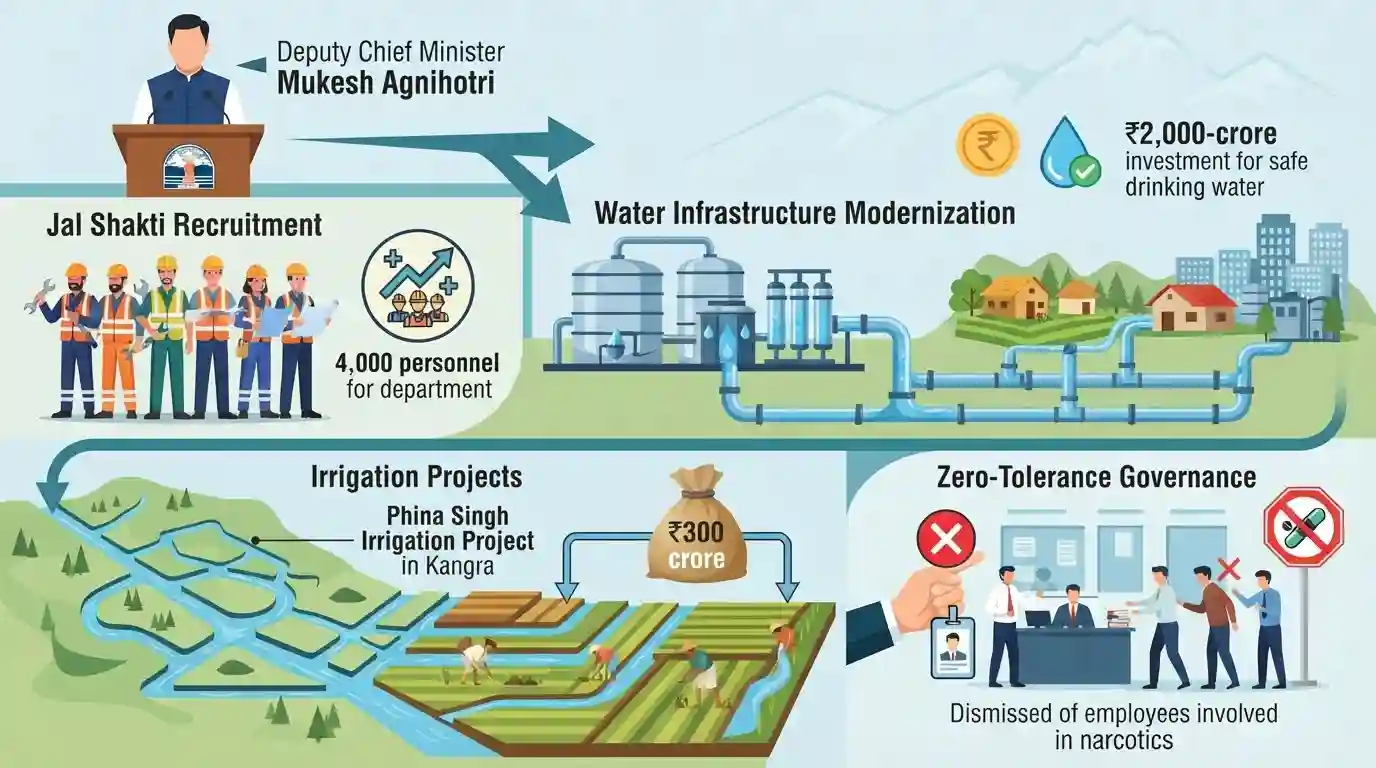
Why It Matters
Demonstrates a state government's approach to simultaneous infrastructure building (water sanitation and irrigation), public sector employment generation, and strict enforcement of administrative discipline regarding drug-related offenses. Useful for GS-2 (State policies/Governance) and GS-3 (Infrastructure/Agriculture) examples.
Summary
Himachal Pradesh Deputy Chief Minister Mukesh Agnihotri announced a comprehensive plan to strengthen the state's water infrastructure and employment. The state will recruit 4,000 personnel into the Jal Shakti Department and launch a ₹2,000-crore modernisation programme for drinking water purification to ensure treated, safe water for households. Crucial irrigation projects are being expedited, highlighted by a ₹300 crore central sanction for the Phina Singh Irrigation Project in Kangra. Agnihotri also underscored the administration's zero-tolerance stance on drug abuse, noting that 36 state government employees were recently dismissed for involvement in narcotics.
Key Points
- Himachal Pradesh will fill 4,000 vacant posts in the Jal Shakti Department to improve drinking water and irrigation services.
- A ₹2,000-crore programme will be implemented to modernise the state's drinking water purification systems.
- The Union Government has sanctioned ₹300 crore to complete the Phina Singh Irrigation Project in Kangra district.
- The state government strictly enforces a zero-tolerance policy against drug abuse, resulting in the recent dismissal of 36 employees involved in the drug trade.
Important Terms
Phina Singh Irrigation Project

An ongoing multipurpose irrigation project on the Chakki River (Beas tributary) in Kangra, Himachal Pradesh, designed to irrigate over 4,000 hectares of land across 60 villages.
UPSC context
GS Paper 3 (Agriculture & Irrigation); tests knowledge of regional water disputes, central funding schemes, and state-level infrastructure development.
Jal Shakti Department
A state-level administrative department (formerly Irrigation and Public Health Department) responsible for executing water supply, sanitation, sewerage, flood control, and irrigation schemes.
UPSC context
GS Paper 2 (Governance & Public Administration); tests understanding of decentralised water governance and public service delivery mechanisms.
Pradhan Mantri Krishi Sinchayee Yojana (PMKSY)
A centrally sponsored scheme launched in 2015 to expand cultivable area under assured irrigation, improve on-farm water-use efficiency ("More Crop Per Drop"), and promote sustainable conservation.
UPSC context
GS Paper 3 (Agriculture & Economy); evaluates knowledge of micro-irrigation, water security, and rural development policies.
Accelerated Irrigation Benefit Programme (AIBP)
A key component of PMKSY that provides central financial assistance to expedite the completion of ongoing major and medium irrigation projects.
UPSC context
GS Paper 3 (Infrastructure & Agriculture); tests financial relations in federal execution of mega-infrastructure projects.
Jal Jeevan Mission (JJM)
A flagship central initiative aiming to provide functional household tap connections (FHTCs) to all rural households, ensuring safe and adequate drinking water.
UPSC context
GS Paper 2 (Social Justice & Welfare); assesses strategies for rural health, gender equality, and sustainable resource management.
Prelims Trap
Under Article 311, a civil servant cannot be dismissed without a formal departmental inquiry under any circumstances.
Article 311(2) provides specific exceptions where an inquiry can be bypassed, such as when it is not reasonably practicable or for state security.
Static Concepts Connected
What are the exceptions to holding an inquiry before dismissing a civil servant?
- Criminal conviction: A civil servant can be dismissed without an inquiry based on conduct that has led to a criminal conviction.
- Impracticable inquiry: Dismissal is allowed if the competent authority records in writing that holding an inquiry is not reasonably practicable (Art 311(2)(b)).
- Security of State: An inquiry can be bypassed if the President/Governor is satisfied that it is against the interests of state security.
How does the Accelerated Irrigation Benefit Programme (AIBP) function?
- Core Objective: It provides Central financial assistance to states to expedite and complete stalled major and medium irrigation projects.
- PMKSY Integration: AIBP operates as a central component of the overarching Pradhan Mantri Krishi Sinchai Yojana (PMKSY) umbrella scheme.
- CWC Monitoring: The Central Water Commission acts as the apex technical body to appraise and monitor the physical and financial progress of AIBP projects.
Cross-Topic Patterns
Water Security & State Capacity
State-led recruitments and upgrades are crucial to sustain the Operations & Maintenance (O&M) of assets created by central funds like the Jal Jeevan Mission.
Narcotics nexus & Internal Security
The dismissal of government employees highlights the growing nexus between drug syndicates and lower bureaucracy, a key theme in GS-3 organized crime.

Expect a prelims statement on the constitutional exceptions under Art 311(2) allowing summary dismissal of civil servants without inquiry.
Linked PYQs · 2
Linked PYQs · 2
- 2020HPAS_PRELIMSGS1
Consider the given four statements and choose the correct answer from the given options. Which of the following statement(s) is / are not correct about the Social Welfare programs of Government of Himachal Pradesh? 1. e-Udyan portal: Where farmers can avail Horticulture farming service benefits while sitting in their home. 2. Vishesh Mahila Uthan Yojna: Scheme formulated for rehabilitation of physically and sexually abused women through technical and vocational training. 3. Medha Protsahan Yojna: Rupees one lakh is provided to the meritorious students to provide guidance at coaching centers. 4. Mukhya Mantri Ek Bigha Scheme: State Government will empower rural women by helping them become self-sufficient and get employment under MGNREGS.
- 2024HPAS_PRELIMSGS1
Consider the following statements : (1) Himachal Pradesh Government approved an outlay of 1200 crore rupees for economic services during 2022-23. (2) Himachal Pradesh Government approved an outlay of 267 crore rupees for rural development during 2022-23. (3) Himachal Pradesh Government approved an outlay of 140 crore rupees for Mahatma Gandhi National Employment Guarantee Scheme during 2022-23. (4) Himachal Pradesh Government approved an outlay of 22 crore rupees for Forestry and Wildlife during 2022-23. Choose the correct answer from the options given below :
