Students fall ill due to suspected water contamination in Kullu school
Source:the-print ↗
Why It Matters
Incidents of mass illness in government schools underscore critical gaps in basic infrastructure, particularly the provision of safe drinking water and food safety protocols under schemes like the Mid-Day Meal. It highlights the need for stringent inter-departmental coordination (health, education, and water/sanitation) to ensure child safety.
Summary
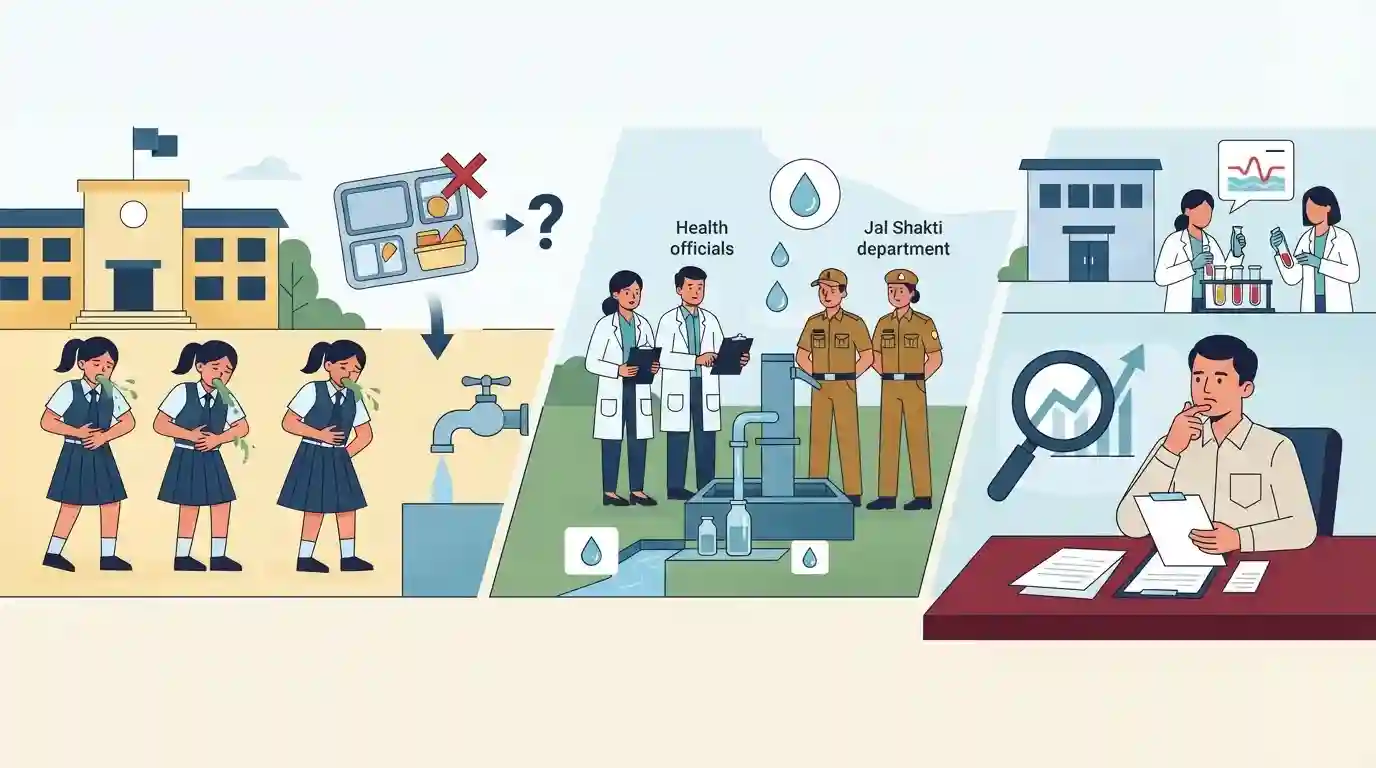
Following lunch at a government primary school in Bari village of Kullu district, 40 students fell ill, displaying symptoms of stomach ache and vomiting. While the food was initially suspected, local authorities, including SDM Anurag Chander, indicated that contaminated water was the likely cause. The Health and Jal Shakti departments have subsequently drawn water samples from the local source for laboratory testing, and an official inquiry has been initiated.
Key Points
- 40 students at a government primary school in Bari, Kullu, fell ill with symptoms like vomiting and stomach ache after eating lunch.
- Authorities suspect the cause to be contaminated water used in food preparation or consumed afterwards, rather than the food itself.
- Both the Health Department and the Jal Shakti Department have collected water samples from the source for testing.
- The Sub-Divisional Magistrate (SDM) of Kullu has ordered an official inquiry into the incident to ascertain the exact cause and fix accountability.
Important Terms
Mid-Day Meal Scheme (PM POSHAN)

A Centrally Sponsored Scheme providing hot, cooked meals to children in government and aided schools (pre-primary to Class VIII) to improve nutritional outcomes, school attendance, and learning levels.
UPSC context
HPAS General Studies Paper II (Social Justice); tests government welfare schemes addressing child malnutrition and education.
Jal Shakti Department
The state department managing water supply, irrigation, and sanitation. It ensures safe drinking water access through schemes like the Jal Jeevan Mission and conducts vital water quality testing.
UPSC context
HPAS GS Paper II (Governance) and III (Infrastructure); tests mechanisms ensuring public water safety and sanitation.
Health Department
The government body responsible for public health services, medical care, and emergency response. In health crises like suspected contamination, it oversees patient treatment and epidemiological investigations.
UPSC context
HPAS GS Paper II (Health); examines state capacity for healthcare delivery, disease control, and emergency medical response.
Prelims Trap
"The funding pattern for PM POSHAN in Himachal Pradesh is 60:40 between the Centre and the State."
Funding for PM POSHAN is shared in a 90:10 ratio between the Centre and Himalayan states like Himachal Pradesh, not 60:40.
Static Concepts Connected
What are the key compliance and funding mandates under the PM POSHAN scheme?
- Funding Pattern: As a Centrally Sponsored Scheme, funding is shared in a 90:10 ratio between the Centre and Himalayan states (like HP) and North-Eastern states.
- FSSAI Mandate: Schools and food business operators handling mid-day meals must obtain mandatory FSSAI registration or licenses to ensure hygiene.
- Quality Control: Guidelines mandate compulsory daily tasting of meals by a teacher or a School Management Committee (SMC) member before serving students.
How is rural drinking water quality monitored by the Jal Shakti department?
- Testing Infrastructure: Water is tested at state, district, and sub-division laboratories to detect chemical contaminants and bacterial pathogens (like coliforms).
- Community Surveillance: Trained local women and village committees use Field Test Kits (FTKs) at the Panchayat level for regular basic surveillance of water sources.
Cross-Topic Patterns
PM POSHAN & Food Safety Standards
Incidents of school food poisoning often trigger exam questions combining the PM POSHAN scheme's structural guidelines with the statutory backing of the Food Safety and Standards Act (FSSA), 2006.
Water Sanitation & Rural Governance
Suspected water contamination highlights the syllabus overlap between public health and rural governance, particularly the role of Village Water and Sanitation Committees (VWSCs) in utilizing Field Test Kits (FTKs).

Expect a multi-statement question combining PM POSHAN funding (90:10 for HP), compulsory FSSAI norms, and daily meal tasting guidelines.
Linked PYQs · 2
Linked PYQs · 2
- 2020HPAS_PRELIMSGS1
The sustainable Development Goal "Good Health and Well being" has shown improvement in India due to:
- 2023HPAS_PRELIMSGS1
Consider the following statements : (1) Protozoans cause serious diseases like dysentery. (2) All microorganisms grow on our food and cause food poisoning. (3) Microorganisms can live in desert environment. (4) All microorganisms are useful for commercial production of medicines and alcohol. Choose the correct answer from the options given below :
