Yamuna Pollution Mitigation Infrastructure Projects in Delhi
Source:Indian Express ↗
Why It Matters
Urban river pollution is a critical environmental challenge in India. This article offers a concrete case study on urban wastewater management and the scale of infrastructure investment required to mitigate river pollution, highly relevant for GS3 Environment and GS1 Urbanization questions.
Summary
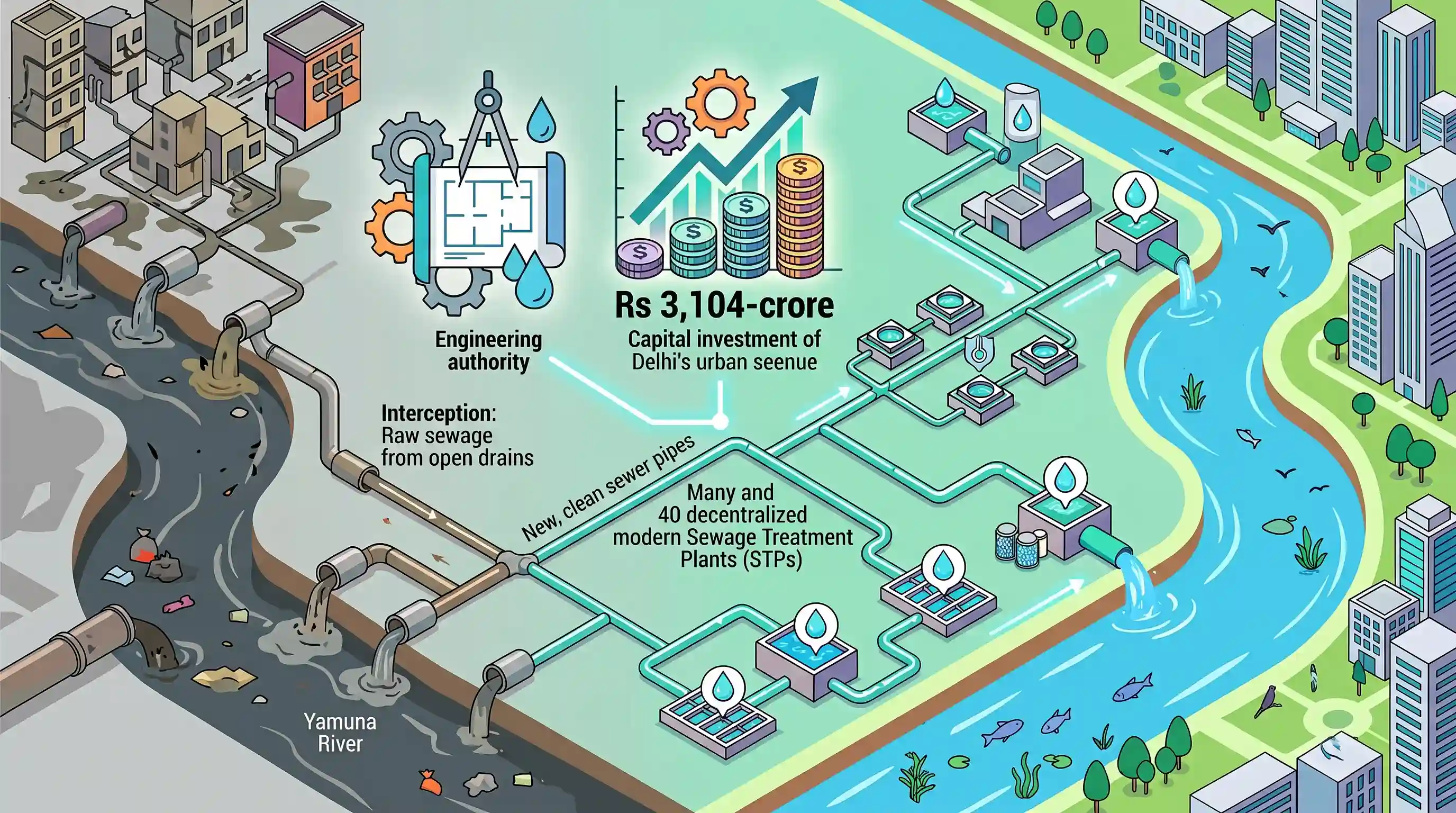
The Delhi Jal Board (DJB) has formulated a major Rs 3,104-crore infrastructure proposal to combat pollution in the Yamuna River. The strategy centers on expanding the city's sewage management capabilities by constructing 40 decentralized Sewage Treatment Plants (STPs) and laying down an extensive network of new sewer lines. By intercepting raw sewage before it reaches the river via open drains, the project aims to significantly curb domestic and municipal wastewater discharge, which is the primary source of the river's severe degradation.
Key Points
- The Delhi Jal Board (DJB) has proposed a comprehensive Rs 3,104-crore project aimed at cleaning the heavily polluted Yamuna River.
- The initiative plans for the construction of 40 new decentralized Sewage Treatment Plants (STPs) to treat wastewater at the source.
- A major component of the proposal is the extensive expansion of sewer lines to intercept raw, untreated sewage that currently flows directly into storm-water drains and the river.
- This infrastructure upgrade targets a substantial reduction in pollution metrics like Biological Oxygen Demand (BOD) and coliform bacteria, primarily caused by municipal and domestic waste.
Important Terms
Yamuna Action Plan (YAP)

A bilateral project between India and Japan launched in 1993 to clean the Yamuna. It focuses on creating sewage treatment infrastructure and community toilets across multiple states.
UPSC context
Relevant for GS Paper 3 (Environment/Pollution) and Paper 2 (Government Schemes). Tests understanding of trans-boundary river conservation and international cooperation.
Delhi Jal Board (DJB)
The statutory body responsible for the supply of potable water and the treatment/disposal of sewage in the National Capital Territory (NCT) of Delhi.
UPSC context
Relevant for GS Paper 2 (Governance) and Paper 3 (Urban Infrastructure). Tests knowledge of local bodies and their administrative role in environmental management.
Decentralized Sewage Treatment Plants (DSTPs)
Small-scale, modular facilities that treat wastewater near its source (e.g., colonies, villages) instead of pumping it long distances to massive, centralized treatment hubs.
UPSC context
Relevant for GS Paper 3 (Science & Tech/Environment). Tests knowledge of sustainable urban planning and "in-situ" waste management technologies.
Interceptor Sewage Project (ISP)
A major DJB infrastructure project aimed at trapping raw sewage from minor drains and diverting it to treatment plants to prevent river pollution.
UPSC context
Relevant for GS Paper 3 (Pollution/Infrastructure). Highlights the technical challenges and administrative failures in large-scale environmental engineering projects.
AMRUT 2.0
A national mission to make Indian cities "water secure" by providing functional water taps and 100% sewage management in 500 cities.
UPSC context
Relevant for GS Paper 2 (Welfare Schemes). Essential for understanding central-state funding mechanisms and sustainable urban rejuvenation targets.
Wazirabad to Okhla Stretch
The critical 22-kilometer segment of the Yamuna in Delhi that accounts for over 70% of the river's total pollution load.
UPSC context
Relevant for GS Paper 1 (Geography) and GS Paper 3 (Pollution). Tests knowledge of specific geographic hotspots for environmental degradation.
Biological Oxygen Demand (BOD)
A measure of the organic pollution in water; it represents the amount of dissolved oxygen needed by organisms to break down organic material.
UPSC context
Relevant for GS Paper 3 (Environment/Science). A fundamental concept for assessing water quality and the effectiveness of STPs.
Prelims Trap
"High Biological Oxygen Demand (BOD) implies high dissolved oxygen levels, indicating a healthy river ecosystem."
High BOD signifies severe organic pollution. It means aerobic bacteria are actively consuming the available dissolved oxygen to decompose waste, which actually starves and suffocates aquatic life.
Static Concepts Connected
What are the core metrics used to measure water pollution?
- BOD: Measures the oxygen consumed by bacteria to decompose organic waste. A higher BOD value indicates higher organic pollution and poorer water quality.
- COD: Measures the total oxygen required to chemically oxidize both organic and inorganic substances in a water sample. It is always higher than BOD.
- Dissolved Oxygen (DO): The actual amount of oxygen available in the water for aquatic life. It is inversely proportional to both BOD and COD levels.
Why are Decentralized Sewage Treatment Plants (STPs) increasingly preferred in urban planning?
- Cost & Infrastructure: Treats wastewater near the generation point, eliminating the capital-intensive need for massive, deep trunk sewer networks across the city.
- Local Reuse: Treated wastewater can be immediately repurposed for local horticulture, groundwater recharge, or non-potable domestic uses, aiding a circular water economy.
- Scalability: Smaller land footprints and modular designs make them easier to deploy in congested, unplanned urban centers where large land acquisition is impossible.
Cross-Topic Patterns
Urban Flooding & Drainage Integration
Lack of segregated storm-water and sewage drains exacerbates urban flooding, as heavy monsoon rains overwhelm combined networks and push raw sewage directly into streets and rivers.
Inter-state River Governance & E-Flows
Cleaning the Yamuna relies on ecological flow maintenance from upstream states (like Haryana) to dilute localized urban pollution, linking urban sanitation to inter-state water sharing.

Expect a 2026 prelims question pairing BOD/COD water metrics with decentralized urban wastewater infrastructure as a multi-statement item.
Linked PYQs · 3
Linked PYQs · 3
- 2024MainsGS3
Industrial pollution of river water is a significant environmental issue in India. Discuss the various mitigation measures to deal with this problem and also the government's initiatives in this regard.
- 2021MainsGS1
What are the environmental implications of the reclamation of water bodies into urban land use ? Explain with examples.
- 2016PrelimsGS1
'Gadgil Committee Report' and 'Kasturirangan Committee Report', sometimes seen in the news, are related to
