Nursing Recruitment Protests and Policy Disputes in Uttarakhand
Source:medicaldialogues ↗
Why It Matters
Highlights the social impact and administrative friction caused by shifts in public sector recruitment policies, specifically the transition from seniority-based hiring to competitive examinations in state health departments.
Summary
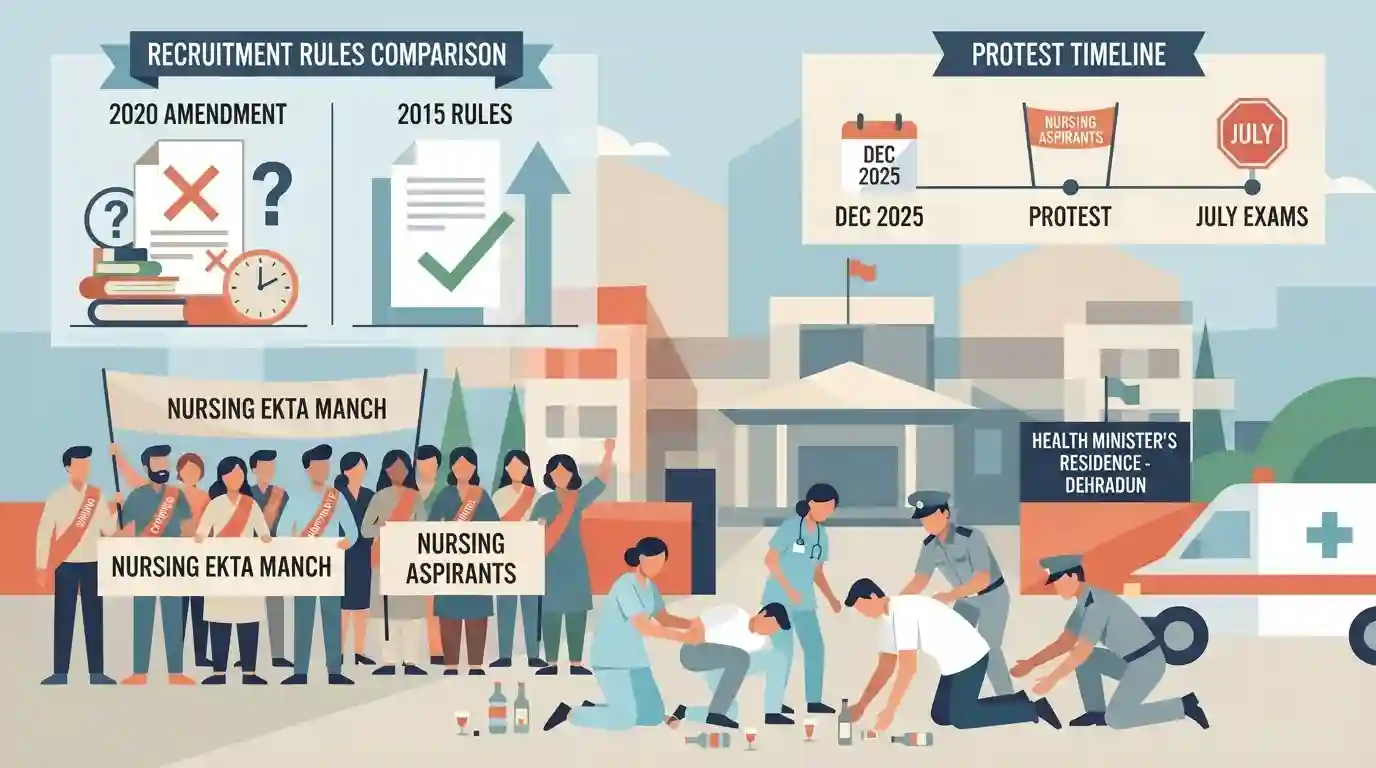
Four nursing job aspirants in Uttarakhand allegedly attempted suicide by consuming phenyl during a protest outside Health Minister Subodh Uniyal's residence in Dehradun. The incident occurred after talks regarding recruitment policies failed. The Nursing Ekta Manch (NEM) has been protesting since December 2025 against the 2020 amendment to the state's nursing service rules, which introduced a written examination for recruitment. Aspirants are demanding a return to the 2015 rules, which granted government jobs based on year-wise merit and seniority, and the cancellation of the upcoming July recruitment exams.
Key Points
- Four nursing job aspirants consumed phenyl outside Uttarakhand Health Minister Subodh Uniyal's residence in Dehradun after failed negotiations.
- The protesters, organized under the Nursing Ekta Manch (NEM), have been agitating since December 2025 outside the Directorate of Medical Health & Family Welfare.
- The core demand is the cancellation of the nursing recruitment exams scheduled for July 25 and 26, advocating instead for recruitment based on year-wise merit and seniority.
- The dispute stems from a 2020 amendment to the nursing service rules which mandated a written exam, replacing the 2015 rules that based selection on academic marks and experience.
- Uttarakhand currently has nearly 35,000 unemployed nursing diploma and degree holders affected by these recruitment policies.
Important Terms
2015 nursing service rules

A former Uttarakhand government policy where state nursing appointments were made based on diploma/degree marks, professional work experience, and year-wise seniority rather than through competitive written examinations.
UPSC context
GS-2 (Governance). Tests understanding of traditional state-level public employment policies and seniority-based recruitment methods versus exam-based systems.
2020 amendment to state's nursing service rules
A policy reform in Uttarakhand that replaced the seniority-based recruitment of nurses with mandatory competitive written examinations to ensure objective and uniform selection.
UPSC context
GS-2 (Governance). Highlights reforms in public sector recruitment, focusing on meritocracy, transparency, and modern competitive selection processes.
Nursing Ekta Manch (NEM)
An association of nursing job aspirants in Uttarakhand leading protests against examination-based recruitment, demanding a return to year-wise seniority hiring and mandatory clinical experience.
UPSC context
GS-2 (Polity). Serves as a useful case study for pressure groups and civil society organizations influencing state employment policies.
Uttarakhand Medical Service Selection Board
The state statutory body responsible for conducting competitive recruitment examinations and selecting qualified candidates for various medical, health, and family welfare department posts in Uttarakhand.
UPSC context
GS-2 (Statutory Bodies). Relevant for understanding the institutional framework managing specialized public service recruitment at the state level.
Directorate of Medical Health & Family Welfare
The administrative state health department responsible for overseeing public healthcare services, executing health policies, and managing personnel, including the recruitment guidelines for nurses.
UPSC context
GS-2 (Health/Governance). Illustrates the role of administrative departments in managing state healthcare infrastructure and human resources policies.
Prelims Trap
"The Mental Healthcare Act, 2017 repealed Section 309 of the IPC, completely decriminalizing attempted suicide."
The Act did not repeal Section 309 of the IPC. It merely established a presumption of 'severe stress,' which restricts prosecution but leaves the penal provision intact.
Static Concepts Connected
How does the Indian Constitution regulate the recruitment of state public servants?
- Article 309: Empowers Parliament and State Legislatures to regulate the recruitment and service conditions of persons appointed to public services and posts.
- Executive Rule-making: Under the proviso to Article 309, the President or Governors can frame temporary, statutory rules until the respective legislature formally enacts a law.
- Article 16 Alignment: Shifting from legacy seniority-based hiring to competitive written exams ensures compliance with Article 16's mandate for equality of opportunity in public employment.
How does the Mental Healthcare Act, 2017 address attempted suicide?
- Presumption of stress: Section 115(1) legally presumes the individual was under 'severe stress,' effectively shielding them from trial and punishment under IPC Section 309.
- Duty of Care: The Act mandates the government to provide care, treatment, and rehabilitation to the person to prevent any recurrence, shifting the approach from punitive to therapeutic.
Cross-Topic Patterns
Healthcare workforce shortages vs. Unemployment
Protests by unemployed nurses paradoxically coexist with India's overall nurse-to-population ratio (2.6/1,000) remaining below the WHO benchmark of 3/1,000, highlighting severe human resource maldistribution.
Article 16 and Service Rule Amendments
Modifying statutory recruitment rules under Article 309 to introduce competitive exams frequently triggers protests, but courts generally uphold them to satisfy Article 16 equality mandates.

The paradox of unemployed healthcare workers amidst structural shortages (WHO's 44.5/10k threshold) makes a strong GS2 Mains topic.
Linked PYQs · 1
Linked PYQs · 1
- 2025UKPSC_PRELIMSGS1
Which of the following records is not maintained by the Panchayats in Uttarakhand?
