Project Cheetah Relocation Challenges and Sympatric Predator Dynamics
Source:Indian Express ↗
Why It Matters
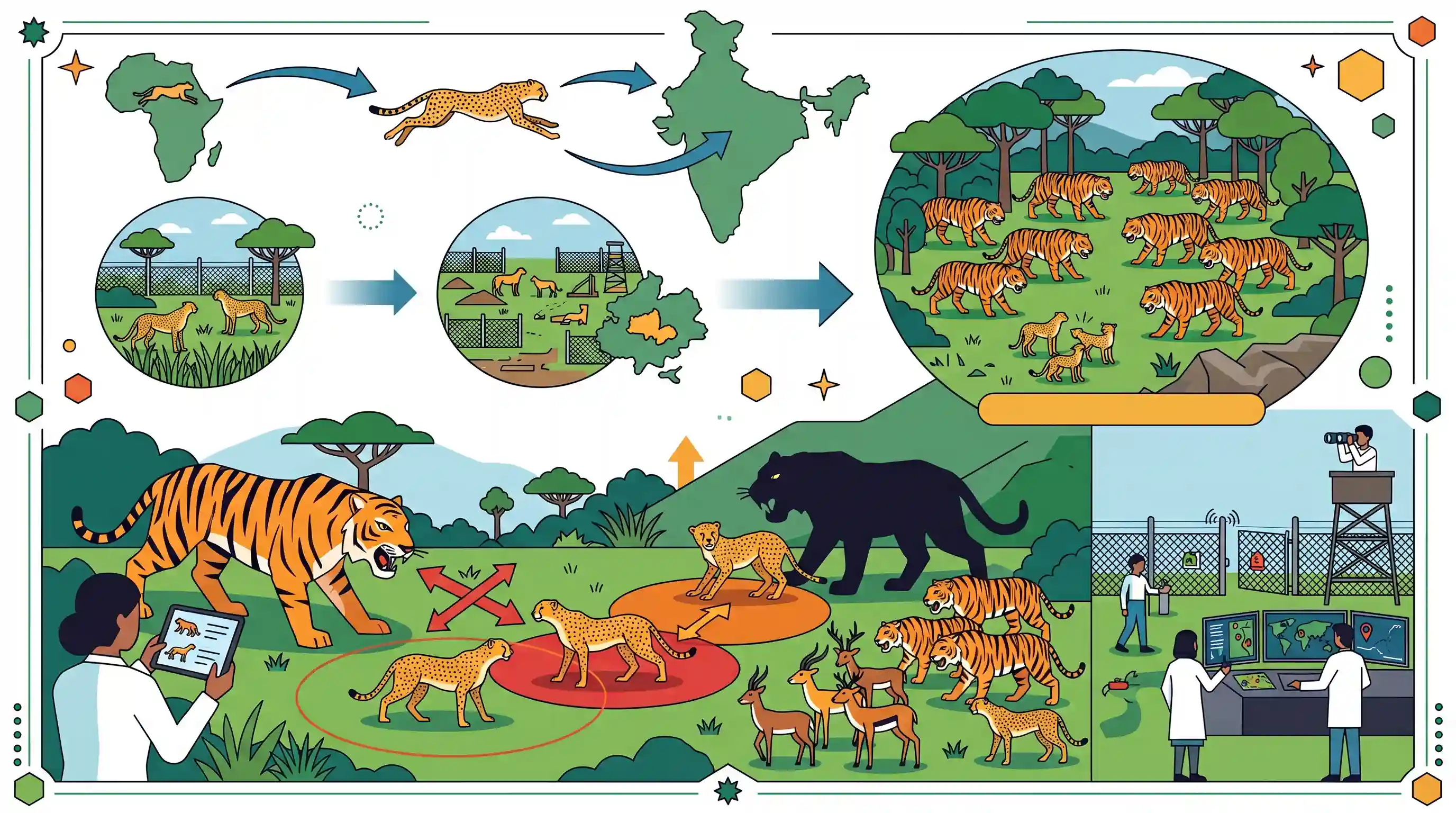
The article illustrates the practical and ecological difficulties of executing ambitious species reintroduction programs like Project Cheetah. For UPSC aspirants, it is essential for understanding the concepts of carrying capacity, sympatric predators, and the complexities of managing overlapping habitats for apex carnivores under GS Paper 3 (Environment & Ecology).
Summary
The ongoing implementation of 'Project Cheetah' in India faces a new ecological hurdle as authorities prepare a third home for the relocated African felines. Following their introduction to Kuno National Park and the upcoming second site at Gandhi Sagar Sanctuary, the third designated habitat—likely Nauradehi Sanctuary within the Veerangana Durgavati Tiger Reserve in Madhya Pradesh—presents a major challenge: it is already home to around 25 tigers. This high density of tigers raises critical concerns regarding inter-species competition, spatial overlap, and the direct threat of predation on the more vulnerable cheetahs. The scenario highlights the intricate challenges of reintroducing apex predators into ecosystems where other dominant carnivores are thriving, necessitating robust habitat management and careful ecological monitoring.
Key Points
- India is preparing a third habitat for the African cheetahs relocated under Project Cheetah, following Kuno National Park and Gandhi Sagar Sanctuary.
- The proposed site, likely the Nauradehi Sanctuary (now part of the Veerangana Durgavati Tiger Reserve in Madhya Pradesh), presents a significant ecological challenge.
- The presence of approximately 25 tigers in the reserve poses a high risk of inter-species competition and potential predation on the cheetahs by the dominant tigers.
- The situation underscores the complexities of wildlife relocation, emphasizing the need to assess habitat carrying capacity, prey base availability, and the dynamics between sympatric apex predators.
Important Terms
Project Cheetah

The world's first intercontinental large wild carnivore translocation project, aiming to reintroduce African cheetahs into India to restore grassland ecosystems and conserve the species after its 1952 local extinction.
UPSC context
GS Paper III: Environment and Biodiversity. Tests knowledge of conservation efforts, flagship species, and challenges of transcontinental wildlife management.
National Tiger Conservation Authority (NTCA)
A statutory body under the Ministry of Environment, Forest and Climate Change, established in 2006 to oversee Project Tiger and now implementing Project Cheetah via standardized habitat management.
UPSC context
GS Paper II: Governance/Statutory Bodies. Tests understanding of legal frameworks for wildlife protection and center-state conservation dynamics.
Wildlife (Protection) Act, 1972
India's foundational wildlife law providing a legal framework for protecting species through Schedules (I-IV) and establishing protected areas like National Parks and Sanctuaries for ecological security.
UPSC context
GS Paper III: Environment/Legislation. Core topic for Prelims and Mains regarding environmental governance and species protection levels.
Wildlife Institute of India (WII)
An autonomous research institution under the Ministry of Environment, Forest and Climate Change that provides scientific expertise, habitat assessments, and technical support for wildlife conservation and reintroduction programs.
UPSC context
GS Paper III: Science & Tech/Environment. Relevant for the role of scientific institutions in evidence-based conservation and wildlife policy.
Veerangana Durgavati Tiger Reserve
A newly notified tiger reserve in Madhya Pradesh (combining Nauradehi and Durgavati sanctuaries) designated as the third home for cheetahs, highlighting the challenge of tiger-cheetah coexistence.
UPSC context
GS Paper III: Biodiversity/Mapping. Tests geographical knowledge of new protected areas and ecological challenges like inter-species competition.
Species Reintroduction
The deliberate release of a species into the wild, from captivity or other areas, to establish a self-sustaining population in its former range where it has become extinct.
UPSC context
GS Paper III: Environment. Tests ecological concepts related to niche restoration, ecosystem balance, and anthropogenic impacts on biodiversity.
Prelims Trap
"Veerangana Durgavati Tiger Reserve was newly established exclusively to serve as a designated habitat for translocated cheetahs."
It was actually established to compensate for the significant core habitat loss in Panna Tiger Reserve caused by the Ken-Betwa river interlinking project.
Static Concepts Connected
What are sympatric species and intraguild predation?
- Sympatric species: Related species that exist in the exact same geographic area and frequently encounter one another, such as tigers and leopards.
- Intraguild predation: A dynamic where apex predators (like tigers and cheetahs) kill or actively compete with each other for shared prey resources within the same ecosystem.
- Niche partitioning: To survive together, competing predators must evolve different hunting schedules or utilize distinct micro-habitats to avoid direct fatal encounters.
How does the Ken-Betwa link impact the Panna Tiger Reserve?
- Submergence risk: The construction of the Daudhan Dam will submerge a significant portion of the core critical tiger habitat inside the Panna Tiger Reserve.
- Compensatory reserve: Veerangana Durgavati Tiger Reserve was specifically notified as a compensatory measure to offset this massive ecological loss for central Indian tigers.
- Regional geography: Both the Ken and Betwa are tributaries of the Yamuna originating in Madhya Pradesh, intended to transfer water to the parched Bundelkhand region.
Cross-Topic Patterns
River Linking vs Tiger Habitats
The creation of Veerangana Durgavati TR was driven by the Ken-Betwa interlinking project. UPSC heavily tests the ecological costs of major hydro-projects and compensatory afforestation mechanisms.
Rivers Mapping Protected Areas
Kuno sits on the Kuno river, Gandhi Sagar is bisected by the Chambal, and Panna is on the Ken. Mapping protected areas to their defining river systems is a staple Prelims format.

Expect a 2026 Prelims question mapping the three Cheetah habitats (Kuno, Gandhi Sagar, Nauradehi) against their rivers and forest types.
Linked PYQs · 3
Linked PYQs · 3
- 2017PrelimsGS1
The term 'M-STRIPES' is sometimes seen in the news in the context of
- 2020PrelimsGS1
Among the following Tiger Reserves, which one has the largest area under "Critical Tiger Habitat"?
- 2012PrelimsGS1
Which one of the following groups of animals belongs to the category of endangered species?
