Uttarakhand Global Employment Scheme Promotes International Careers
Source:devdiscourse ↗
Why It Matters
State-specific welfare schemes, skill upgradation programs, and digital administrative portals (like Apuni Sarkar) are high-yield areas for the UKPSC PCS Prelims exam. Understanding how Uttarakhand connects its demographic dividend to global markets is crucial for regional economic and governance topics.
Summary
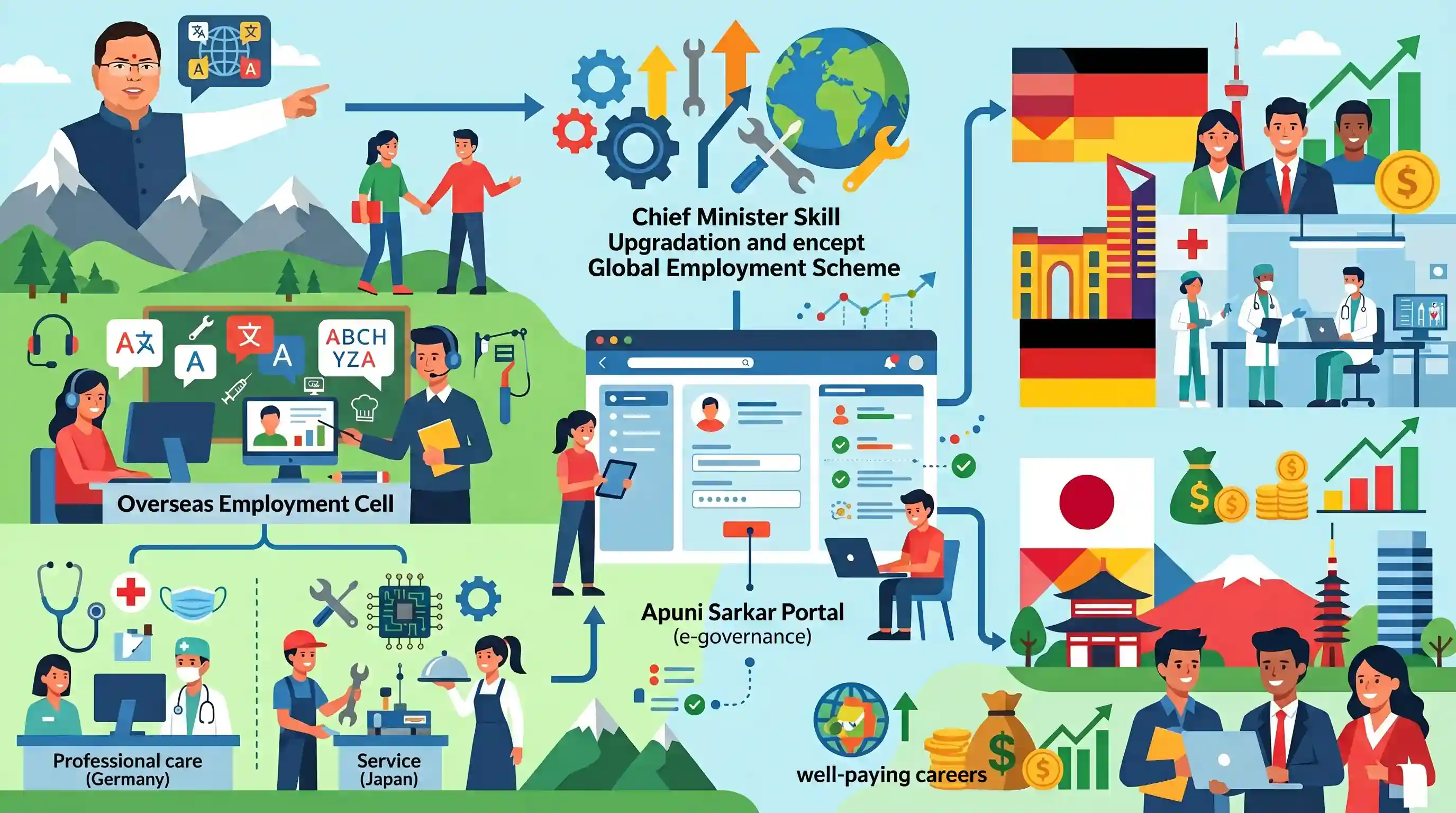
Uttarakhand Chief Minister Pushkar Singh Dhami highlighted the progress of the state's 'Chief Minister Skill Upgradation and Global Employment Scheme,' aimed at preparing and placing local youth in international jobs. Through language and professional training provided by the state's Overseas Employment Cell, youth are securing well-paying careers abroad, notably in Germany's healthcare sector and in Japan. To support this, the government has integrated registration facilities on the 'Apuni Sarkar Portal' to track and assist global job aspirants.
Key Points
- The Uttarakhand Cabinet formally approved the 'Chief Minister Skill Upgradation and Global Employment Scheme' to enhance the international employability of the state's youth.
- The scheme is implemented by the Overseas Employment Cell of Uttarakhand, which offers tailored language and skill training programs to prepare candidates for overseas opportunities.
- Under this initiative, youth from Uttarakhand are being placed in jobs abroad, particularly in Japan (where 65 youth are already employed) and Germany (specifically targeting the high-demand nursing sector).
- A prime success story highlighted is Sapna Rana, who secured a nursing role at the Schon Klinik Hospital in Hamburg, Germany, earning approximately ₹3.30 lakh per month after completing German language training.
- To streamline registration, the government has launched a dedicated online application on the state's e-governance 'Apuni Sarkar Portal' to maintain a detailed database of job-seekers aspiring to work abroad.
Important Terms
Chief Minister Skill Upgradation and Global Employment Scheme

An Uttarakhand government initiative designed to train local youth in foreign languages and domain skills to facilitate placement in international job markets, notably Germany and Japan.
UPSC context
GS Paper II & III (Govt Schemes/Skill Development); tests state-level initiatives enhancing global employability.
Apuni Sarkar Portal
A unified e-governance platform launched by the Uttarakhand government to digitize citizen-centric services, improve transparency, and track applications for schemes like the global employment initiative.
UPSC context
GS Paper II (E-governance); tests understanding of ICT tools in digital service delivery and public administration.
Overseas Employment Cell of Uttarakhand
A specialized institutional wing under Uttarakhand's Skill Development and Employment Department that provides foreign language, cultural, and domain training to prepare youth for international placements.
UPSC context
GS Paper III (Employment); tests understanding of state mechanisms for facilitating managed international labor migration and human capital.
Prelims Trap
Schemes facilitating institutional overseas placement and foreign language training subsidies are exclusively designed and funded by the Union Ministry of External Affairs.
Under India's federal structure, individual state governments run independent, subsidized overseas placement and language training programs (like Kerala's NORKA or Uttarakhand's scheme) alongside central initiatives.
Static Concepts Connected
What are State Institutions for Transformation (SITs) under NITI Aayog's State Support Mission?
- Definition: Policy think tanks set up by states (e.g., SETU in Uttarakhand, MITRA in Maharashtra) to replace traditional State Planning Commissions.
- NITI Support: NITI Aayog provides financial support (up to ₹2 crore annually) and technical expertise under the State Support Mission.
- Objective: To foster cooperative federalism by helping states design strategic, evidence-based development policies aligned with national goals.
How does India regulate international labor migration and mobility?
- MMPAs: Bilateral pacts (e.g., with Germany, Japan) signed to facilitate organized, legal labor mobility and skill recognition.
- Nodal Authority: The MEA regulates emigration under the Emigration Act, 1983, utilizing the eMigrate portal to protect overseas workers.
- State Role: State-level overseas employment cells act as registered, ethical recruiting agents under federal guidelines to prevent worker exploitation.
Cross-Topic Patterns
Demographic dividend + Federal skill migration
India's aging bilateral partners (Germany, Japan) shift state-level skill mandates from domestic employment to active international labor-market integration.
E-Governance + Citizen Service Delivery
Integrating emigration databases with state portals under Right to Service Acts shows local e-governance evolving into global citizen-service delivery systems.

State-led migration frameworks and NITI's State Support Mission (SITs) will likely be tested under federalism and global labor mobility.
Linked PYQs · 3
Linked PYQs · 3
- 2025UKPSC_PRELIMSGS1
Arrange the following social welfare schemes in chronological order: i. Integrated Rural Development Programme (IRDP) ii. Rural Employment Generation Programme (REGP) iii. Prime Minister Rojgar Yojana (PMRY) iv. Rural Landless Employment Guarantee Programme (RLEGP)
- 2024UKPSC_PRELIMSGS1
Who among the following was the Human Resource Development/Education Minister from Uttarakhand in Central Government in the year 2019 ?
- 2024UKPSC_PRELIMSGS1
UTDB is established in Uttarakhand to promote:
