Electoral rolls special revision in Andhra Pradesh
Source:devdiscourse ↗
Why It Matters
The maintenance of accurate electoral rolls is the bedrock of democratic elections in India. Understanding the procedures of the Election Commission, the role of Booth Level Officers, and the significance of qualifying dates is crucial for civil service aspirants studying statutory frameworks like the Representation of the People Act, 1950.
Summary
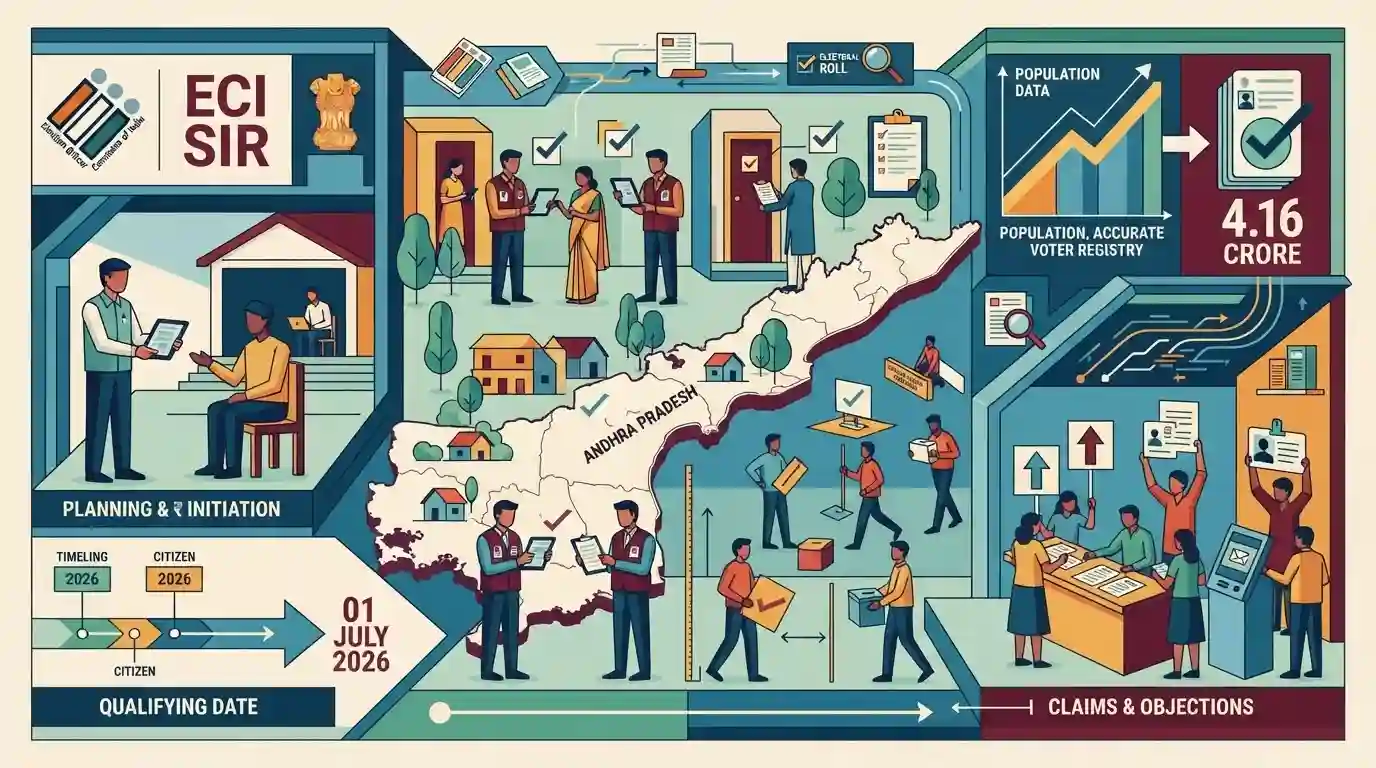
The Election Commission of India (ECI) has initiated a Special Intensive Revision (SIR) of the electoral rolls in Andhra Pradesh, setting July 1, 2026, as the qualifying date. Chief Electoral Officer Vivek Yadav outlined the participatory process, which involves house-to-house verifications by Booth Level Officers (BLOs), rationalisation of polling stations, and an official period for handling claims and objections. This intensive process aims to update and accurately maintain the electoral registry for the state's 4.16 crore eligible voters.
Key Points
- The Election Commission of India is conducting a Special Intensive Revision (SIR) of electoral rolls in Andhra Pradesh.
- July 1, 2026, has been designated as the qualifying date for this revision process.
- Booth Level Officers (BLOs) will conduct house-to-house visits to verify and update voter information.
- The exercise aims to rationalise polling stations and ensure accurate inclusion of the state's 4.16 crore electors.
Important Terms
Election Commission of India (ECI)

An autonomous constitutional authority established under Article 324 of the Indian Constitution, responsible for administering and supervising Union and State legislative election processes to ensure free and fair democratic voting.
UPSC context
GS Paper II (Constitutional Bodies/Elections) – Tests knowledge of ECI's powers, structure, and constitutional mandates under Article 324.
Special Intensive Revision (SIR)
A large-scale, door-to-door voter enumeration and verification exercise conducted by the ECI under Section 21 of the Representation of the People Act, 1950, to clean and update electoral rolls.
UPSC context
GS Paper II (Electoral Reforms) – Tests understanding of measures taken by the ECI to ensure electoral accuracy and clean databases.
Qualifying Date
A specific reference date (Jan 1, Apr 1, Jul 1, Oct 1) by which a citizen must have attained 18 years to qualify for registration as an elector.
UPSC context
GS Paper II (Elections) – Relates to voter eligibility rules, the Representation of the People Act, and recent legislative amendments.
Booth Level Officer (BLO)
A local government or semi-government employee appointed under Section 13B of the RPA, 1950, to serve as the ECI's grass-root representative and custodian of electoral rolls.
UPSC context
GS Paper II (Electoral Machinery) – Analyzes grass-roots implementation of election administration, physical verification of voters, and field coordination.
Chief Electoral Officer (CEO)
An IAS-level statutory authority appointed under Section 13A of the Representation of the People Act, 1950, who supervises the preparation of electoral rolls and conduct of elections in a State/UT.
UPSC context
GS Paper II (Electoral Machinery) – Important for understanding state-level election administration and the execution of ECI guidelines during elections.
Prelims Trap
"January 1 is the sole qualifying date for voter registration in India, and rolls are revised only once annually."
The 2021 Amendment Act introduced four quarterly qualifying dates (Jan 1, Apr 1, Jul 1, Oct 1). The ECI can also order a Special Intensive Revision anytime.
Static Concepts Connected
What are the key matters covered exclusively under the RPA, 1950?
- Electoral Rolls: Deals with the preparation, revision, and correction of electoral rolls for Parliamentary and Assembly constituencies.
- Seat Allocation: Governs the allocation of seats and delimitation of constituencies for the Lok Sabha and State Legislative Assemblies.
- Election Machinery: Provides statutory backing for election officials like Chief Electoral Officers (CEOs), District Election Officers (DEOs), and Booth Level Officers (BLOs).
What is the scope of ECI's power under Article 324 regarding electoral rolls?
- Superintendence and Control: Grants the ECI absolute power of superintendence, direction, and control over the preparation of electoral rolls.
- Plenary Powers: Acts as a reservoir of power; the ECI can order Special Intensive Revisions (SIR) to ensure roll fidelity even outside routine summaries.
Cross-Topic Patterns
Electoral Reforms + Aadhaar linking
The Election Laws (Amendment) Act, 2021 added four qualifying dates but also introduced the voluntary linking of Aadhaar with electoral rolls to curb duplication, intersecting with right-to-privacy debates.
Judicial review of Article 324 powers
The SC's recent ruling upholding SIR under Article 324 mirrors landmark judgments like Mohinder Singh Gill, reinforcing ECI's plenary power over election mechanics where parliamentary statutes are silent or insufficient.

RPA 1950 vs 1951 distinctions + the 4 new quarterly qualifying dates (2021 amendment) are highly probable for a 2026 Prelims question.
Linked PYQs · 2
Linked PYQs · 2
- 2024APPSC_PRELIMSGS1
Consider the following statements with reference to the Election Commission of India : I. The Constitution of India has debarred the retiring Election Commissioners from any further appointment by the government. II. In 'Anoop Baranwal Case' (2023), the Supreme Court has directed the Government to treat the Regional Commissioners on par with the Election Commissioners (other than the Chief Election Commissioner), as far as removal from office is concerned. III. Since its inception, the Election Commission had functioned as a multi-member body. IV. The power of superintendence, direction and control of elections to the office of Vice-President of India is vested in the Election Commission. Which of the above statement/statements is/are valid ?
- 2023APPSC_PRELIMSGS1
The powers of the Election Commission include which of the following? I. The Election Commission takes decisions on every aspect of conduct and control of elections from the announcement of elections to the declaration of results. II. During the election period, the Election Commission can order the Government to dismiss some government officials. III. When on election duty, Government officers work under the control of the Election Commission. Choose the correct answer using the codes given below:
