Childhood Leprosy Cases and Elimination Targets
Source:The Hindu ↗
हे का महत्त्वाचे आहे
The detection of leprosy cases among children highlights persistent grassroots transmission, testing the efficacy of India's healthcare system and its goal to eliminate transmission by 2027.
सारांश
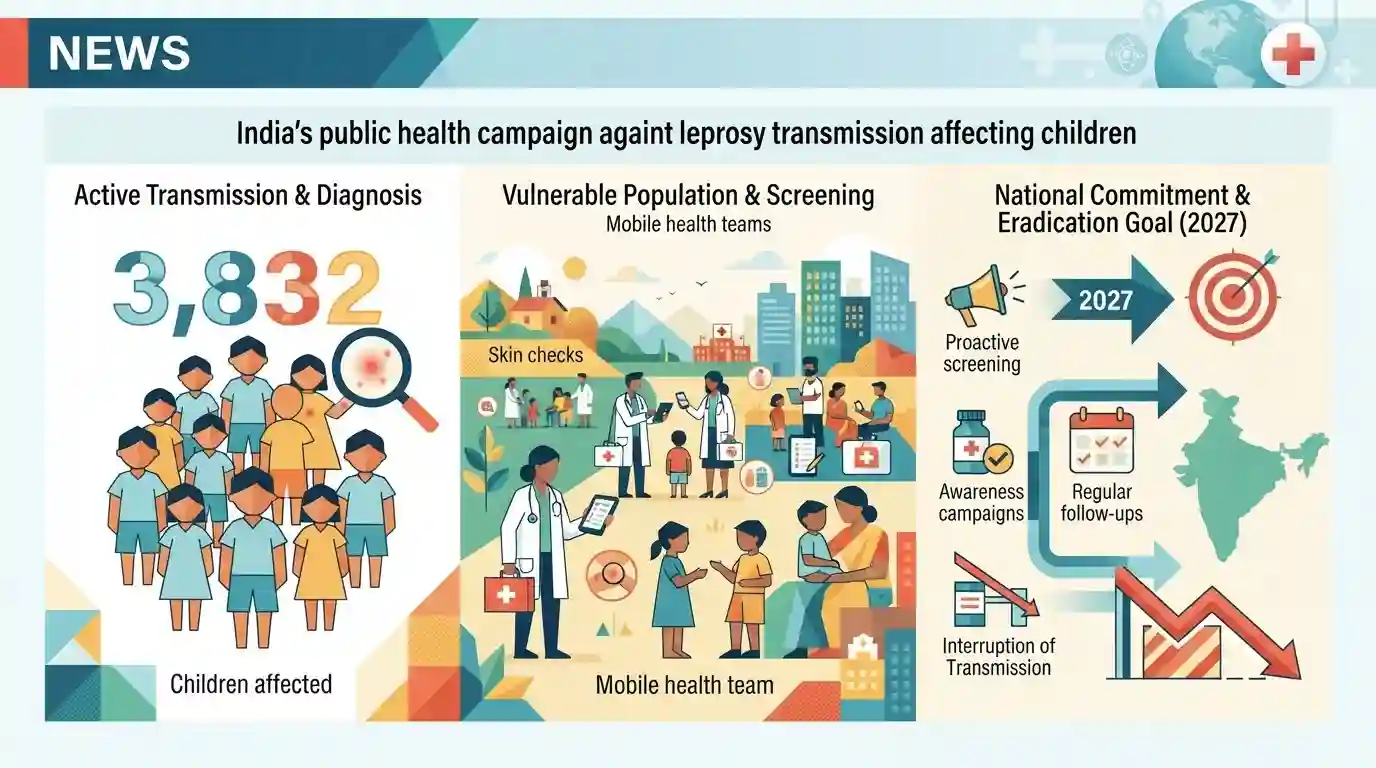
A recent update on India's public health campaign reveals that 3,832 children have been diagnosed with leprosy, underscoring active transmission. India has committed to interrupting leprosy transmission nationwide by 2027 through proactive screening, early detection, and intensified management under the National Leprosy Eradication Programme.
मुख्य मुद्दे
- 3,832 children were diagnosed with leprosy in India, reflecting ongoing local transmission among pediatric populations.
- India has set a target to interrupt the transmission of leprosy by 2027, ahead of the global Sustainable Development Goals timeline.
- Early case detection, active surveillance, and post-exposure prophylaxis are critical pillars in combating childhood leprosy and reducing social stigma.
महत्त्वाच्या संज्ञा
National Leprosy Eradication Programme

A centrally sponsored public health scheme under the National Health Mission aimed at achieving the complete eradication and interruption of leprosy transmission across India through early detection, free treatment, and proactive screening campaigns.
UPSC context
UPSC GS Paper II (Health Policies & Vulnerable Sections): Crucial for evaluating government disease eradication targets, public health initiatives, and welfare schemes.
Ministry of Health and Family Welfare
The central government department in India responsible for formulating national health policies, overseeing major disease control and eradication programmes, and managing public healthcare delivery systems.
UPSC context
UPSC GS Paper II (Governance): Tests knowledge of institutional frameworks, central ministries, and policy execution in the public health sector.
World Health Organization
A specialized agency of the United Nations responsible for international public health, setting global health standards, and monitoring disease elimination targets such as leprosy thresholds worldwide.
UPSC context
UPSC GS Paper II (International Organizations): Important for understanding global governance bodies, health metrics, and international health cooperation frameworks.
पूर्वपरीक्षा सापळा
India's achievement of leprosy elimination in 2005 means that community transmission of the disease has completely ceased nationwide.
Achieving elimination as a public health problem (<1 case per 10,000 population in 2005) does not mean zero transmission or eradication. Active cases in children prove local transmission persists.
संबंधित स्थिर संकल्पना
What is the difference between disease elimination and eradication in public health epidemiology?
- Elimination Definition: Reduction to zero incidence in a defined geographical area as a result of deliberate efforts, with continued intervention required (e.g., neonatal tetanus).
- Eradication Definition: Permanent reduction to zero worldwide incidence; no further intervention is required once achieved (e.g., smallpox).
- Leprosy Context: India achieved leprosy 'elimination' nationally in 2005 (prevalence <1 per 10,000), but transmission has not yet been fully interrupted.
आंतर-विषय नमुने
Leprosy Eradication & SDG 3 Targets
The 2027 NLEP transmission interruption goal and vulnerable pediatric tracking intersect with SDG 3 (Good Health and Well-being) targets and domestic decentralised primary healthcare governance via ASHAs.

Expect a statement-based prelims question distinguishing between leprosy 'elimination' (prevalence <1/10k) and 'interruption of transmission'.
संबंधित PYQ · 5
संबंधित PYQ · 5
- 2020PrelimsGS1
In the context of recent advances in human reproductive technology, "Pronuclear Transfer" is used for
- 2021PrelimsGS1
In the context of hereditary diseases, consider the following statements : 1. Passing on mitochondrial diseases from parent to child can be prevented by mitochondrial replacement therapy either before or after in vitro fertilization of egg. 2. A child inherits mitochondrial diseases entirely from mother and not from father. Which of the statements given above is/are correct?
- 2019PrelimsGS1
Which one of the following statements is not correct?
- 2024MainsGS2
In a crucial domain like the public healthcare system the Indian State should play a vital role to contain the adverse impact of marketisation of the system. Suggest some measures through which the State can enhance the reach of public healthcare at the grassroots level.
- 2020MainsGS2
In order to enhance the prospects of social development, sound and adequate health care policies are needed particularly in the fields of geriatric and maternal health care. Discuss.
