CAG highlights unspent Rajasthan Road Safety Fund despite accidents
Source:the-times-of-india ↗
Why It Matters
The article underscores the practical importance of the CAG's audit functions in highlighting systemic inefficiencies and financial underutilization in state governance, directly impacting citizen safety and public policy outcomes.
Summary
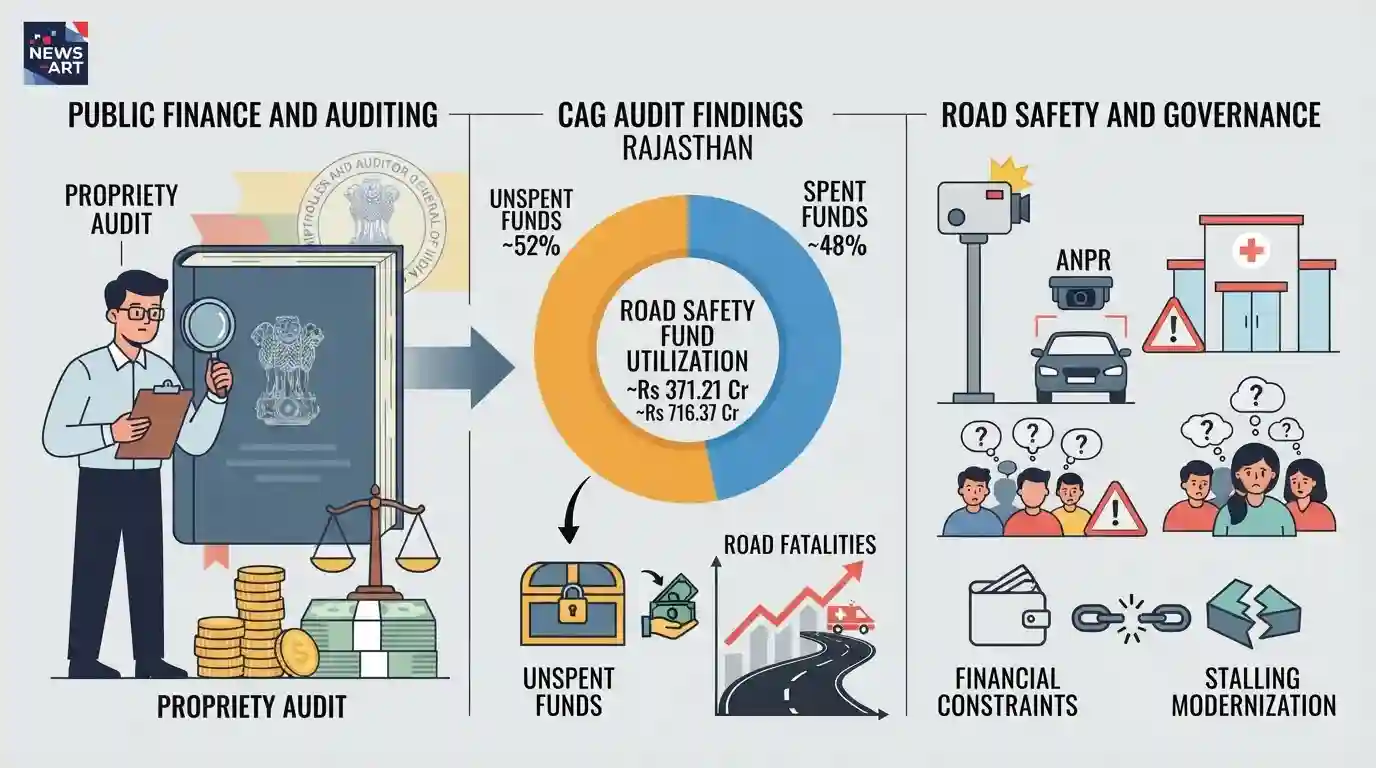
A CAG audit report has revealed that Rajasthan left over half of its Road Safety Fund unspent (Rs 373.01 crore out of Rs 716.37 crore available up to 2024-25) despite rising road fatalities. The funds, meant for safety technology like speed cameras, ANPR systems, and trauma center upgrades, remained unused, contradicting state departments' claims of financial constraints stalling modernization.
Key Points
- The CAG audit revealed that more than half of Rajasthan's Road Safety Fund (Rs 373.01 crore out of Rs 716.37 crore available up to fiscal 2024-25) remained unspent and unutilized.
- This underutilization occurred despite a high and rising road accident toll in the state, showcasing a gap between policy intent and ground execution.
- The unspent funds were intended for critical road safety upgrades, including automated driving tracks, traffic parks, speed-detection cameras, ANPR systems, and equipment for trauma centers.
- The findings directly contradict past assertions by police and local administrative bodies that road safety modernization efforts were stalled due to a lack of funds.
- This case illustrates the role of CAG in conducting 'propriety audits' to examine the efficiency, economy, and effectiveness of public expenditure beyond mere compliance.
Prelims Trap
The Rajasthan Road Safety Fund is a lapsable fund financed by 100% of the traffic compounding fees collected annually.
The fund is strictly non-lapsable and is financed by only 25% (not 100%) of the traffic compounding fees collected by the state.
Static Concepts Connected
What is a 'Propriety Audit' conducted by the CAG, and how does it operate?
- Core Objective: Evaluates the wisdom, faithfulness, and economy of public spending, going beyond mere regulatory and legal compliance.
- Discretionary Aspect: Unlike regulatory audits, propriety auditing relies heavily on the auditor's professional judgment of "public interest".
- Key Standards: Checks if the expenditure is wasteful, excessive, or violates basic rules of commercial financial prudence.
What is the institutional and financial framework governing road safety in Rajasthan?
- Funding Mechanism: Established in April 2017 as a non-lapsable fund, drawing 25% of annual traffic compounding fees.
- Institutional Change: Renamed as the 'Department of Transport and Road Safety' in October 2021 to sharpen policy focus on safety.
- Policy Goal: Collaborating with the World Bank for a 10-year action plan targeting a 50% reduction in road deaths by 2030.
Cross-Topic Patterns
CAG oversight and state financial accountability
Shows how legislative control over state finances depends on CAG's post-facto audits to expose executive inefficiency in utilizing non-lapsable developmental funds.
Multilateral funding + State-level reforms
Rajasthan’s World Bank-backed road safety plan highlights how global finance directly targets sub-national infrastructure governance and policy frameworks.

Statement-based questions on Rajasthan's Road Safety Fund features (25% funding share, non-lapsable nature) are highly likely in RAS.
Linked PYQs · 2
Linked PYQs · 2
- 2021RPSC_PRELIMSGS1
Statement (A): The duty of the Comptroller and Auditor General is not only to ensure the validity but also the propriety of expenditure. Reason (R): He is to maintain the Constitution and laws of Parliament in the field of financial administration.
- 2018RPSC_PRELIMSGS1
The process of removing the Comptroller and Auditor General of India from his office is similar to that of which one of the following?
