Thirty Seven West Bengal Residents Missing After Nepal Floods
Source:the-statesman ↗
Why It Matters
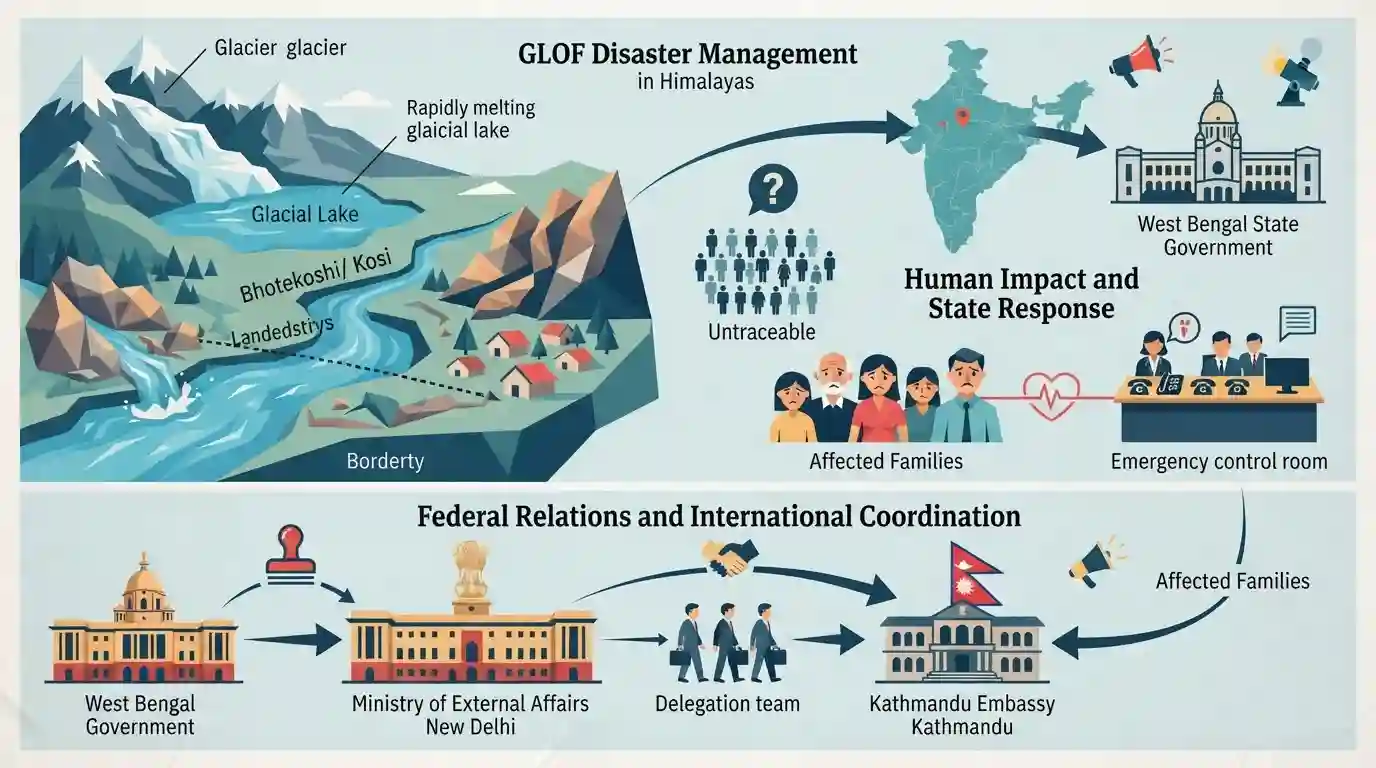
The incident highlights the growing threat of transboundary disasters (like GLOFs and landslide-induced floods) in the vulnerable Himalayan ecosystem and their direct impact on neighboring Indian states. From a governance perspective, it demonstrates the constitutional interplay between State governments and the Union Ministry of External Affairs under the Seventh Schedule (Union List) when dealing with cross-border disaster relief operations.
Summary
West Bengal Chief Minister Suvendu Adhikari announced that 37 people from the state remain untraceable in Nepal following major floods and landslides in the Bhotekoshi river basin. To aid in rescue and rehabilitation, the state government is seeking clearance from the Ministry of External Affairs (MEA) to dispatch a special delegation to Kathmandu, while establishing emergency control rooms and coordinating with central and international embassies to assist affected families.
Key Points
- 37 residents of West Bengal remain untraceable following severe landslides and floods in Nepal, particularly triggered by the Bhotekoshi river deluge.
- The West Bengal government is preparing to send a high-level rescue and relief delegation to Kathmandu consisting of a state minister, an IG-rank police officer, and a senior IAS officer.
- Because external/foreign affairs falls strictly under the Union List, the state government is actively coordinating with the Union Ministry of External Affairs (MEA) to secure the necessary travel and operational clearances.
- A dedicated control room supervised by a senior IPS officer has been established, and the Resident Commissioner in Delhi is assisting families with visas/permits to travel to Nepal, China, or Tibet.
Important Terms
Ministry of External Affairs (MEA)

The Indian government ministry responsible for conducting foreign relations, managing diplomatic missions, administering passports/visas, and coordinating cross-border rescue and relief operations for Indian citizens abroad.
UPSC context
WBCS Mains Paper V (Polity). Tests federal division of power (Union List) and center-state diplomatic coordination.
West Bengal State Government
The state-level governing authority of West Bengal, comprising an elected legislative assembly and a state executive headed by the Chief Minister and Governor.
UPSC context
WBCS Mains Paper V (Polity) and Paper III (Geography). Tests state executive powers and regional disaster response coordination.
Government of India
The central governing authority of the Republic of India, established by the Constitution, exercising supreme power over defense, external affairs, and national policy.
UPSC context
WBCS Mains Paper V (Polity). Tests federalism, center-state relations, and Seventh Schedule legislative distribution.
Chinese Embassy
The diplomatic mission representing the People's Republic of China in India, which oversees bilateral affairs, consular services, and visa clearance for travel to Tibet.
UPSC context
WBCS Mains Paper IV (Current Affairs) and Paper V. Tests international relations, neighboring diplomacy, and border region transit.
Prelims Trap
Disaster Management is explicitly listed as a subject under the Concurrent List of the Seventh Schedule.
Disaster Management is not explicitly mentioned in any of the three lists of the Seventh Schedule. The DM Act, 2005 was enacted under Entry 23 (Social Security) of the Concurrent List.
Static Concepts Connected
What is the structure and geo-instability of the Saptakoshi (Kosi) River system?
- Seven Tributaries: Formed in Nepal by seven Himalayan tributaries: Sun Kosi, Arun, Tamur, Indravati, Tamba Kosi, Likhu Kosi, and Dudh Kosi.
- Trans-boundary Origin: Tributaries like the Bhote Koshi (Poiqu) originate in the high-altitude glaciers of Tibet before cutting through the Himalayas.
- Channel Instability: Its heavy silt load leads to frequent course-shifting (historically over 120 km westward), earning it the moniker 'Sorrow of Bihar'.
What are the constitutional provisions governing External Affairs and Disaster Management?
- Foreign Affairs Jurisdiction: Placed under Entry 10 of the Union List (List I), giving the Central Government exclusive jurisdiction over relations with foreign countries.
- Clearance for States: State governments cannot independently dispatch official delegations to foreign nations without political clearance from the Ministry of External Affairs.
- Disaster Management Legislative Source: Not explicitly mentioned in the Seventh Schedule; legislated under Concurrent List Entry 23 ('Social security and social insurance').
Cross-Topic Patterns
Paradiplomacy vs Union Supremacy
State-level disaster relief initiatives crossing international borders test the constitutional limits of paradiplomacy, requiring strict MEA clearance under Entry 10 of the Union List.
Kosi Hydrology & Bengal Delta Evolution
Kosi's high sediment-load and westward migration historically influenced the Bengal delta's hydrology by pushing the Ganga's main flow eastward into the Padma river system.

Constitutional basis of the DM Act 2005 and trans-boundary tributaries of Kosi are highly probable for upcoming WBCS Mains GS papers.
Linked PYQs · 2
Linked PYQs · 2
- 2018WBCS_PRELIMSGS1
Geomorphologists opine that change of the course of the Kosi river resulted in
- 2015WBCS_PRELIMSGS1
The North flowing rivers of West Bengal are
