Kanniyakumari Plastic Pellet Spill and Disaster Response
Source:The Hindu ↗
Why It Matters
Demonstrates the vulnerability of India's coastal ecosystems to international shipping hazards and highlights practical, inter-state disaster management mechanisms and SOPs for handling toxic/plastic maritime spills.
Summary
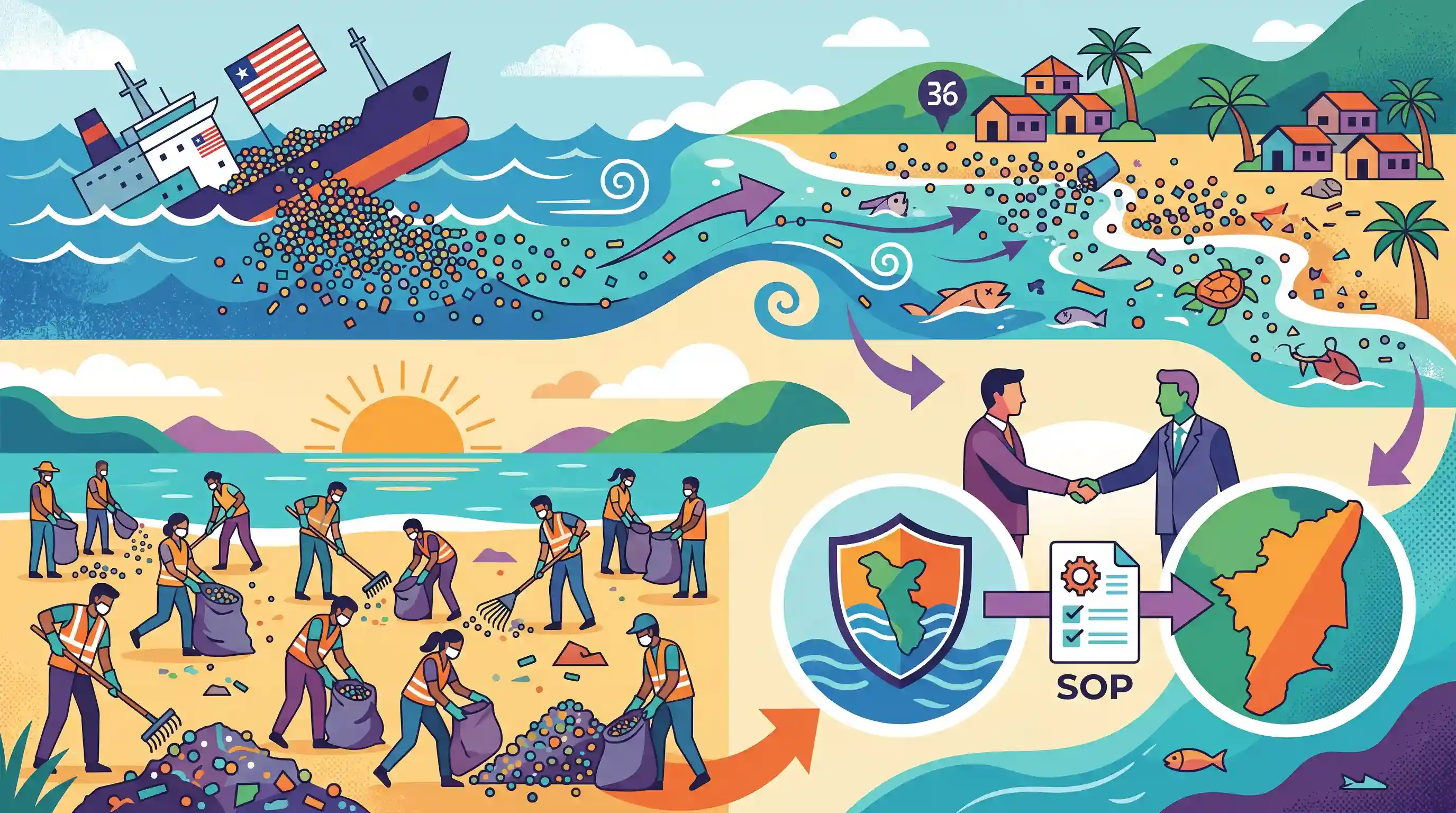
Plastic pellets (nurdles) and debris from a sunken Liberian vessel off the Kochi coast have washed ashore in 36 coastal villages of Kanniyakumari district, Tamil Nadu. The district administration has initiated a massive clean-up drive, guided by a Standard Operating Procedure (SOP) from the Kerala State Disaster Management Authority, highlighting inter-state coordination to manage the coastal marine pollution hazard and protect local ecosystems.
Key Points
- 36 out of 42 coastal villages in Kanniyakumari district (Neerodi to Keezha Manakudi) have been affected by plastic pellets (nurdles) washing ashore.
- The plastic pellets and debris originated from a Liberian vessel that sank off the Kochi coast on May 24.
- A major clean-up drive is underway, guided by a Standard Operating Procedure (SOP) formulated by the Kerala State Disaster Management Authority.
- Collected nurdles are being stored safely and will be transported to harbours like Thengapattinam, Colachel, and Chinna Muttam before handover to the Customs Department.
- The effort reflects multi-departmental coordination involving revenue, fisheries, pollution control, and disaster management authorities across states.
Important Terms
Plastic Pellets (Nurdles)

Small (1-5mm) pre-production plastic granules used as raw material for manufacturing. They are primary microplastics that pose severe threats to marine ecosystems via ingestion and toxin bioaccumulation.
UPSC context
GS Paper III: Environment and Pollution. Tests understanding of microplastics, marine biodiversity threats, and the 'hidden' sources of plastic pollution.
MARPOL Convention
The main international treaty (1973/78) aimed at preventing marine environment pollution by ships from operational or accidental causes. India is a signatory, aligning its domestic Merchant Shipping laws with it.
UPSC context
GS Paper III: Environment/International Conventions. Relevant for ship-based pollution governance and India's international environmental obligations.
Kerala State Disaster Management Authority (KSDMA)
A statutory body under the Disaster Management Act, 2005, chaired by the Chief Minister of Kerala. It formulates state disaster plans and coordinates responses to natural and man-made hazards.
UPSC context
GS Paper III: Disaster Management. Tests knowledge of the institutional framework for disaster response and the role of State-level authorities.
Marine Pollution
The contamination of oceans and seas by substances like plastics, oil, chemicals, and sewage. It is primarily addressed by the Water Act, 1974 and the Environment (Protection) Act, 1986 in India.
UPSC context
GS Paper III: Environment. Relates to Sustainable Development Goal 14 (Life Below Water) and the impact of industrial/shipping activities on coastal livelihoods.
Disaster Management Act, 2005
The primary legal framework in India for managing disasters. It established the NDMA, SDMAs, and DDMAs, shifting India's approach from relief-centric to proactive prevention, mitigation, and response.
UPSC context
GS Paper III: Disaster Management. The fundamental law for all emergency protocols (SOPs) and institutional coordination in India.
Coastal Regulation Zone (CRZ)
Coastal areas notified under the Environment (Protection) Act, 1986, to regulate developmental activities. It aims to protect coastal ecosystems and ensure the safety of coastal communities from hazards.
UPSC context
GS Paper III: Environment/Governance. Tests knowledge of regulatory zones and the protection of fragile coastal biomes from pollution and encroachment.
Prelims Trap
"Nurdles are secondary microplastics formed exclusively by the fragmentation of larger plastic waste in the ocean."
Nurdles are intentionally manufactured 'primary' microplastics used as raw materials for making larger plastic products, unlike secondary microplastics which result from environmental breakdown.
Static Concepts Connected
How are microplastics classified and why do they biomagnify toxins?
- Primary Microplastics: Intentionally manufactured at small sizes (1-5mm), such as 'nurdles' (industrial raw materials) or 'microbeads' (used in cosmetics).
- Secondary Microplastics: Created by the degradation of larger plastic items (e.g., bottles, ghost nets) due to UV radiation, weathering, and wave action in the ocean.
- Biomagnification mechanism: Plastics act as sponges for Persistent Organic Pollutants (POPs). When mistaken for fish eggs and ingested, toxins bioaccumulate and biomagnify up the food chain.
What is the MARPOL convention and how does it address marine plastic spills?
- Core mandate: The International Convention for the Prevention of Pollution from Ships (MARPOL) prevents both accidental and operational marine pollution from vessels.
- Annex V regulations: Annex V of MARPOL specifically bans the disposal of all forms of plastics into the sea, driving recent IMO pushes to regulate nurdle transport.
Cross-Topic Patterns
Ocean currents & transboundary pollution
Debris drifting from Kochi to Kanniyakumari highlights ocean currents as pollution vectors, linking physical geography directly to transboundary environmental disaster management.
Wreckage and Customs jurisdiction
Recovered cargo from foreign vessels is surrendered to Customs. Under the Customs Act, flotsam and jetsam brought ashore are legally treated as imported goods liable for duty.

The distinction between primary (nurdles) and secondary microplastics is highly probable as a Prelims 2026 environment question.
Linked PYQs · 3
Linked PYQs · 3
- 2023MainsGS3
What is oil pollution? What are its impacts on the marine ecosystem? In what way is oil pollution particularly harmful for a country like India?
- 2019MainsGS1
How do ocean currents and water masses differ in their impacts on marine life and coastal environment? Give suitable examples.
- 2022MainsGS3
Explain the causes and effects of coastal erosion in India. What are the available coastal management techniques for combating the hazard?
