Gujarat Initiates Damage Surveys As Floodwaters Recede
Source:The Hindu ↗
Why It Matters
This event serves as a practical example of state-level disaster response, the functioning of meteorological early warning systems (IMD alerts), and post-disaster rehabilitation frameworks (SDRF norms). These are key components of the Disaster Management and Geography syllabi for civil services examinations.
Summary
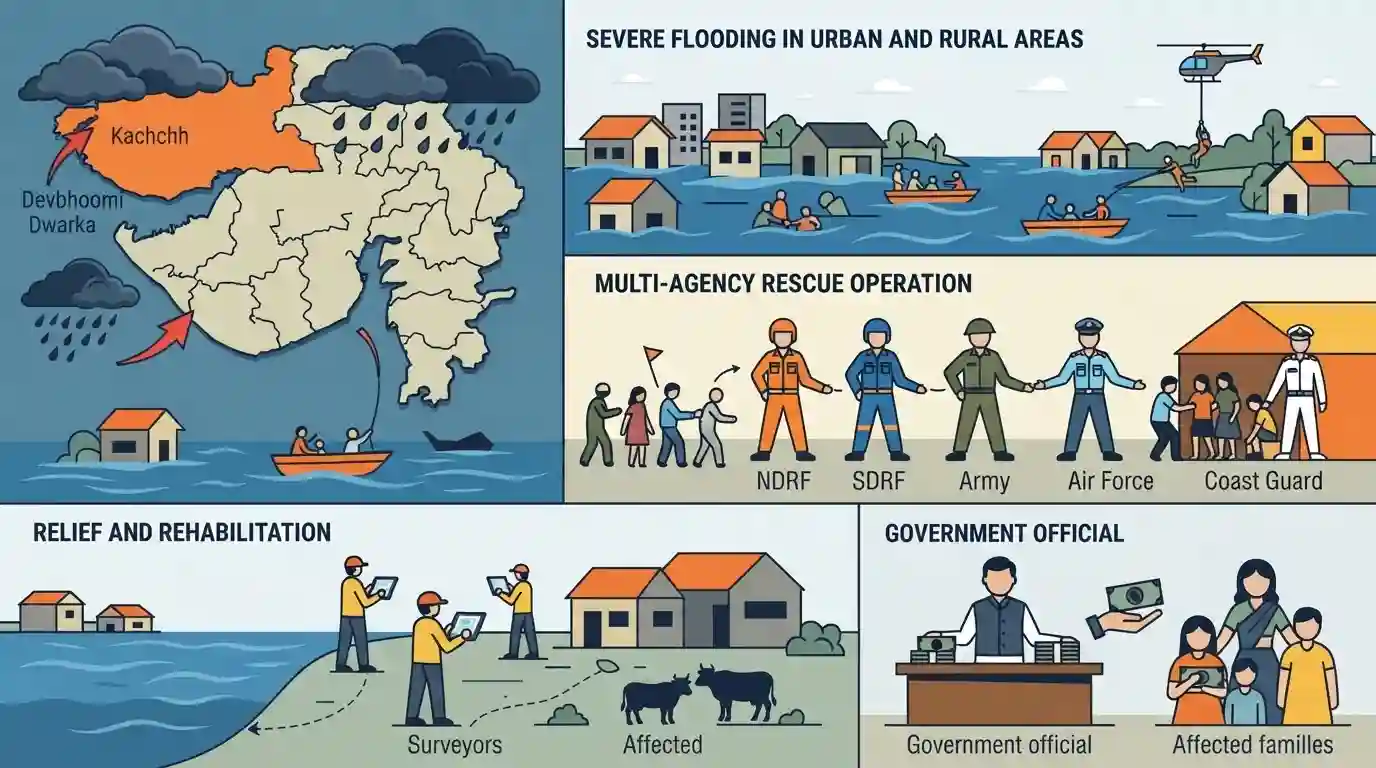
Severe rainfall and consequent flooding in Gujarat have claimed 35 lives, prompting extensive rescue and relief operations across multiple districts. The India Meteorological Department (IMD) issued critical red alerts for the worst-hit areas like Devbhoomi Dwarka and Kachchh. Coordinated efforts by the NDRF, SDRF, the Indian Army, Air Force, and Coast Guard successfully relocated over 32,000 affected people. With floodwaters now receding, the state government under Chief Minister Bhupendra Patel has initiated immediate damage assessment surveys. The government plans to disburse compensation for human casualties, livestock losses, and property damage in adherence to State Disaster Response Fund (SDRF) guidelines, highlighting the importance of robust disaster management and rapid rehabilitation mechanisms.
Key Points
- Heavy rains and widespread flooding in Gujarat resulted in 35 rain-related fatalities over a four-day period.
- The India Meteorological Department (IMD) issued red alerts for districts such as Kachchh, Jamnagar, Porbandar, and Devbhoomi Dwarka, which recorded nearly 299 mm of rainfall in a short span.
- A massive rescue and evacuation effort relocated over 32,000 individuals to safety and rescued nearly 1,200 others, executed by the NDRF, SDRF, Armed Forces, and the Coast Guard.
- As floodwaters begin to recede, Chief Minister Bhupendra Patel has instructed local administrations to commence comprehensive damage surveys.
- Financial assistance and cash doles will be distributed according to SDRF norms to compensate for loss of life, livestock, household goods, and agricultural damage.
Important Terms
State Disaster Response Fund (SDRF) norms

The primary fund available to state governments for immediate response to notified disasters under the Disaster Management Act, 2005. The Centre typically contributes 75% (90% for special states), governed by expenditure norms set by the Home Ministry.
UPSC context
Important for GS-3 Disaster Management and GS-2 Centre-State financial relations, specifically testing knowledge of disaster risk financing and cooperative federalism.
India Meteorological Department (IMD)
India's principal agency under the Ministry of Earth Sciences responsible for meteorological observations, weather forecasting, and issuing early warnings for natural hazards like cyclones, heatwaves, and heavy rainfall.
UPSC context
Highly relevant for GS-1 Geography and GS-3 Disaster Management, testing early warning systems, monsoon tracking, and climate change impacts.
National Disaster Response Force (NDRF)
A specialized force established under the Disaster Management Act, 2005, for swift response to natural and man-made disasters. Operating under the Ministry of Home Affairs, its battalions are drawn from Central Armed Police Forces.
UPSC context
Essential for GS-3 Disaster Management, focusing on India's institutional framework, emergency response capabilities, and coordination during severe calamities.
Indian Coast Guard (ICG)
An armed force under the Ministry of Defence responsible for maritime law enforcement, securing maritime zones, protecting the marine environment, and executing coastal search, rescue, and disaster relief operations.
UPSC context
Relevant to GS-3 Security and Disaster Management, testing the roles of security forces in border management and humanitarian assistance.
Prelims Trap
States cannot utilize SDRF funds for any disaster that is not explicitly notified on the Central Government’s official list.
Under SDRF norms, states have the autonomy to use up to 10% of their allocation for immediate relief against state-specific "local disasters" not included in the central list.
Static Concepts Connected
What is the SDRF and how is it funded?
- Statutory Basis: Constituted under Section 48(1)(a) of the Disaster Management Act, 2005, serving as the primary financial reserve for state-level immediate disaster response.
- Funding Ratio: Financed by the Centre and States in a 75:25 ratio for general category states, and 90:10 for special category states.
- Local Autonomy: Allows states to use up to 10% of their funds for state-specific local disasters not listed on the central registry.
What do the IMD's color-coded weather warnings signify?
- Green and Yellow: Green indicates no adverse weather and no action. Yellow signals watch and update as local weather situations deteriorate.
- Orange and Red: Orange warns to prepare for severe disruptions. Red mandates immediate protective action as extremely bad weather is imminent.
Cross-Topic Patterns
Semi-arid desertification vs. extreme wet anomalies
Regimes like Kachchh, traditionally dry, are seeing frequent flash floods. This shifts the focus of dryland geography studies from drought mitigation to climate-resilient drainage systems.
Finance Commission mandates on disaster funding
The division of SDRF and NDRF funding is closely tied to Finance Commission recommendations, linking Article 280 fiscal devolution directly with localized climate adaptation.

Climate shift anomalies in arid zones combined with statutory SDRF financing rules (75:25 vs 90:10 ratios) likely to feature in 2026.
Linked PYQs · 3
Linked PYQs · 3
- 2026GPSC_PRELIMSGS1
Consider the following statements regarding climate change: 1. Floods and droughts are increasing in India. 2. There has been a sharp increase in the number of tropical cyclones in India. 3. Humidity levels are gradually increasing in the regions of central India. Which of the above statement/s is/are correct?
- 2021GPSC_PRELIMSGS1
The 15ᵗʰ Finance Commission recommended Grants-in-Aid falls into five broad categories. Which of the following is NOT in the said categories?
- 2021GPSC_PRELIMSGS1
Match the column: | Waterfall | District | |---|---| | 1. Zanzhari Waterfall | a. Narmada | | 2. Zharwani Waterfall | b. Aravalli | | 3. Girmall Waterfall | c. Tapi | | 4. Chimer Waterfall | d. Dangs | Code:
