CEEW study highlights extreme heat risk across Indian districts
Source:The Hindu ↗
Why It Matters
Provides critical empirical data on climate change vulnerability in India, addressing both geography (urban heat islands, changing Himalayan microclimates) and environment/economy (impact on GDP, outdoor workers). The focus on warm nights and rising humidity offers specific points for analytical answers on climate adaptation and disaster management.
Summary
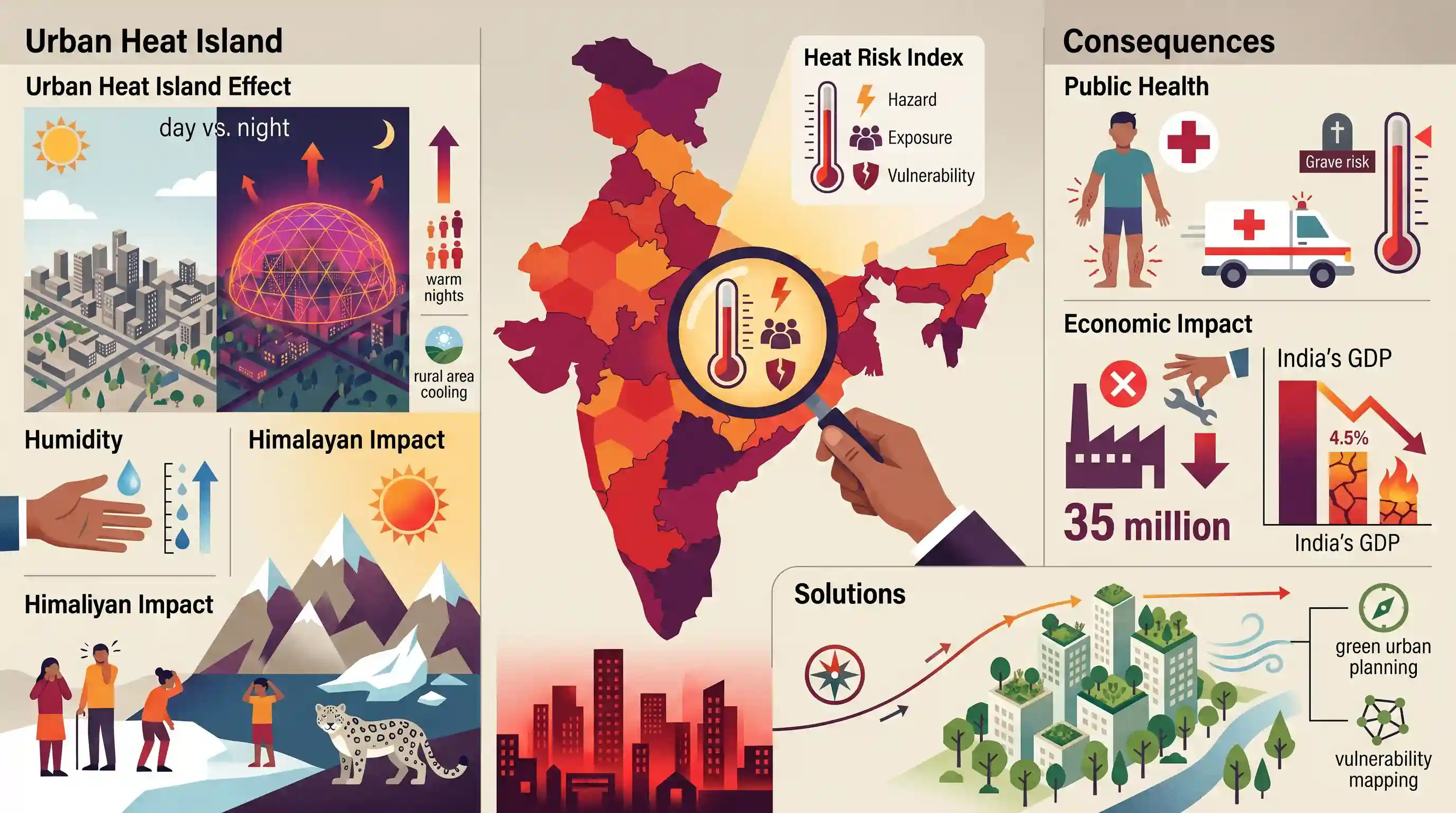
A recent study by the Council on Energy Environment and Water (CEEW) reveals that three-quarters of India's population faces 'high' to 'very high' heat risk. Using a newly developed Heat Risk Index, the report highlights the alarming rise in very warm nights, driven significantly by the urban heat island effect as built-up areas expand. Compounded by rising humidity and affecting even traditionally cooler Himalayan regions, the extreme heat poses grave public health risks and severe economic consequences, threatening 35 million jobs and a 4.5% hit to India's GDP by 2030. The findings underscore the critical need for vulnerability mapping and green urban planning to build resilience.
Key Points
- 76% of India's population across 57% of districts is at 'high' to 'very high' heat risk according to a new CEEW study.
- A significant climatic shift shows that very warm nights are increasing at a faster rate than very hot days, inhibiting the human body's ability to cool down and exacerbating heatstroke risks.
- Major tier-I, tier-II, and tier-III cities are severely impacted by the 'urban heat island' effect due to rapid, unregulated built-up area expansion between 2005 and 2023.
- Traditionally cooler Himalayan regions, including Jammu & Kashmir and Ladakh, are surprisingly vulnerable, recording an increase of over 15 very hot days and warm nights per summer.
- Rising summer humidity in the Indo-Gangetic plain (climbing from 30-40% to 40-50%) severely compounds heat stress, especially for outdoor workers and vulnerable demographics.
- Extreme heat threatens to wipe out 35 million full-time jobs and cause a 4.5% reduction in India's GDP by 2030, though areas with better green cover and water bodies show higher resilience.
Important Terms
Council on Energy, Environment and Water (CEEW)

A prominent New Delhi-based non-profit think tank that provides data-driven research on energy, climate, and sustainability to inform public policy in India and the Global South.
UPSC context
GS Paper II/III; crucial for understanding domestic climate governance, policy research, and India's progress toward international sustainability commitments.
Heat Risk Index (HRI)
A composite metric developed by CEEW that measures heat risk by integrating climatological hazard intensity (including humidity), population exposure, and socio-economic vulnerability (e.g., healthcare access).
UPSC context
GS Paper III (Disaster Management); tests the ability to analyze climate hazards as multi-dimensional risks beyond simple temperature readings.
Urban Heat Island (UHI) Effect
A localized phenomenon where urban areas experience significantly higher temperatures than surrounding rural areas due to heat-retaining materials (concrete/asphalt), dense buildings, and waste heat from human activities.
UPSC context
GS Paper I (Geography) and GS Paper III (Urbanization/Environment); explores how urban design exacerbates heat stress and affects public health.
Very Warm Nights
Nights when the minimum temperature remains above the 95th percentile of historical norms, preventing the human body from recovering from daytime heat and increasing mortality and morbidity risks.
UPSC context
GS Paper I (Climatology); highlights changing weather patterns and their physiological impacts on vulnerable populations and energy demand.
Heat Action Plan (HAP)
A comprehensive policy framework for managing heatwaves, encompassing early warning systems, public awareness, inter-departmental coordination, and structural interventions like cool roofs and green urban planning.
UPSC context
GS Paper III (Disaster Management); essential for discussing administrative preparedness and localized mitigation strategies for climate-induced disasters.
Vulnerability Mapping
A spatial assessment process used to identify populations and regions most susceptible to hazards based on their exposure, sensitivity, and lack of adaptive capacity (e.g., poverty, age).
UPSC context
GS Paper III (Environment); key tool for targeted resource allocation and building equitable climate resilience at the district level.
Prelims Trap
Very hot days are increasing at a faster rate than very warm nights across India due to climate change.
The study explicitly highlights that very warm NIGHTS are increasing faster than hot days, which is deadlier as it prevents overnight bodily cooling.
Static Concepts Connected
What is Wet-Bulb Temperature and why is it critical for human health?
- Definition: A measure of heat and humidity combined, representing the lowest temperature to which air can be cooled by the evaporation of water.
- Human Limit: A wet-bulb temperature of 35°C is considered the theoretical human survivability limit, as perspiration can no longer cool the body down.
- Regional Vulnerability: Regions like the Indo-Gangetic plain are highly vulnerable due to the dangerous combination of rising temperatures and high moisture content from agriculture and monsoon winds.
What are the primary drivers of the Urban Heat Island (UHI) effect?
- Surface Modification: Replacement of natural vegetation with concrete and asphalt, which heavily absorb and retain daytime shortwave radiation.
- Anthropogenic Heat: Heat generated by human activities like industrial processes, vehicular emissions, and extensive air conditioning use.
- Urban Geometry: Tall buildings create a 'canyon effect' that traps heat, blocks terrestrial radiation from escaping, and reduces wind speeds.
Cross-Topic Patterns
Climate stress meets labor economics
Rising heat/humidity directly bridges environment and economy. The predicted 4.5% GDP loss by 2030 highlights how climate change disproportionately impacts informal, outdoor sectors like agriculture and construction.
Himalayan warming & GLOF risks
The surprising heat vulnerability in J&K and Ladakh accelerates glacier melt, linking directly to GS3 disaster management topics like Glacial Lake Outburst Floods (GLOFs) and shifting regional hydrology.

Expect a 2026 multi-statement question linking 'wet-bulb temperature' in the Indo-Gangetic plain to 'Urban Heat Islands'.
Linked PYQs · 4
Linked PYQs · 4
- 2013MainsGS1
Bring out the causes for the formation of heat islands in the urban habitat of the world.
- 2017MainsGS3
'Climate change' is a global problem. How India will be affected by climate change? How Himalayan and coastal states of India will be affected by climate change?
- 2013MainsGS3
How important are vulnerability and risk assessment for pre-disaster management ? As an administrator, what are key areas that you would focus on in a Disaster Management System.
- 2019MainsGS3
Vulnerability is an essential element for defining disaster impacts and its threat to people. How and in what ways can vulnerability to disasters be characterized? Discuss different types of vulnerability with reference to disasters.
