Tamil Nadu secures major foreign investments during European tour
Source:The Hindu ↗
Why It Matters
The article serves as an excellent case study for GS3 questions concerning the realization of Foreign Direct Investment (FDI) and the gap between signed MoUs and actual ground investments. It also provides contemporary examples of para-diplomacy—where states bypass the Centre to forge direct global economic ties (GS2 Federalism)—and connects to historical topics through the commemoration of Periyar's Self-Respect Movement (GS1).
Summary
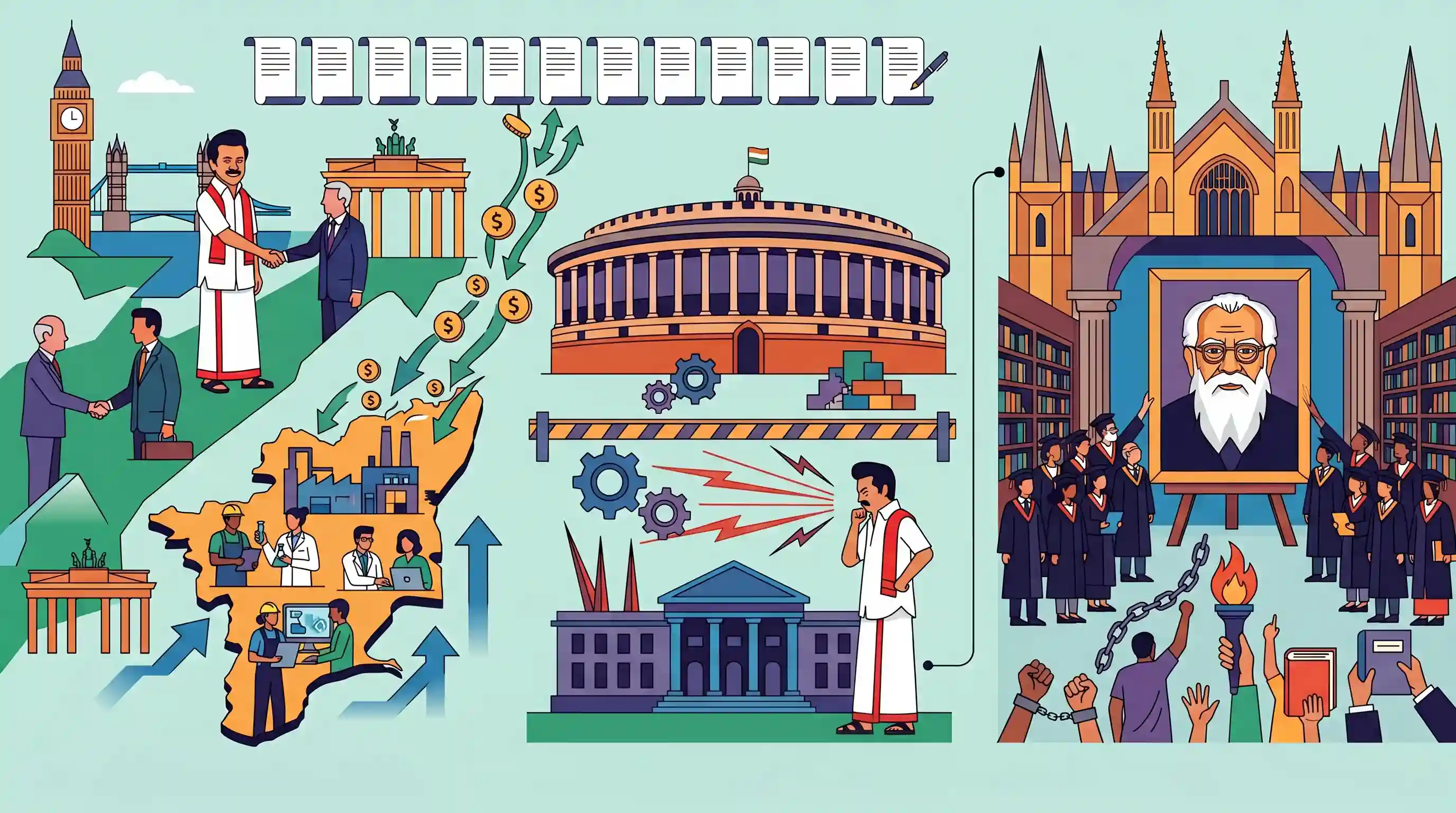
Tamil Nadu Chief Minister M.K. Stalin successfully concluded a visit to Germany and the U.K., securing 33 Memoranda of Understanding (MoUs) projected to bring ₹15,516 crore in Foreign Direct Investment (FDI) and create over 17,600 jobs. The investments highlight the growing trend of 'para-diplomacy', where state governments directly engage in foreign economic relations to attract investments and boost regional growth. Additionally, Stalin criticized the Union Government for neglecting the state's development needs, reflecting ongoing federal tensions. The trip also had a socio-cultural dimension, with the unveiling of a portrait of social reformer Periyar E.V. Ramasamy at Oxford to commemorate the Self-Respect Movement.
Key Points
- Tamil Nadu Chief Minister M.K. Stalin signed 33 MoUs worth ₹15,516 crore during his visit to Germany and the U.K., expected to generate employment for 17,613 people.
- The investments highlight the growing trend of state-led economic diplomacy (para-diplomacy), as state governments actively court global businesses to drive regional industrial growth and FDI.
- Stalin criticized the Union Government for allegedly ignoring Tamil Nadu's financial and developmental needs, pointing to ongoing federal friction over resource distribution.
- The Chief Minister also unveiled a portrait of social reformer Periyar E.V. Ramasamy at an Oxford campus and participated in the 'Self-Respect Movement and its Legacies Conference'.
Important Terms
Para-diplomacy

The conduct of international relations by subnational entities like state governments (e.g., Tamil Nadu's investment summits) to pursue regional economic and cultural interests.
UPSC context
Relevant for GS Paper 2 (International Relations and Federalism); tests understanding of decentralized foreign policy and state-led economic diplomacy.
Self-Respect Movement
A 1925 social reform movement founded by E.V. Ramasamy (Periyar) in Tamil Nadu to secure social equality, dignity, and rationalism for non-Brahmin and oppressed castes.
UPSC context
Key for GS Paper 1 (Social Reform Movements) and GS Paper 2 (Social Justice); essential for studying Dravidian politics and modern Indian history.
Dravidian model
A governance paradigm in Tamil Nadu emphasizing social justice, rationalism, and inclusive growth through welfare schemes, education, and healthcare while maintaining high industrial productivity.
UPSC context
Relevant for GS Paper 2 (Governance and Welfare) and GS Paper 3 (Economy); serves as a case study for competitive and inclusive federalism.
Foreign Direct Investment (FDI)
Investment made by a foreign entity into a country to gain a lasting interest and significant control (typically 10%+ equity) in a domestic enterprise.
UPSC context
Core topic for GS Paper 3 (Indian Economy); tests knowledge of capital inflows, industrial growth, and ease of doing business.
Federalism
The constitutional distribution of powers between the Central (Union) government and State governments, balancing national unity with regional autonomy.
UPSC context
Fundamental to GS Paper 2 (Indian Constitution and Polity); focuses on Centre-State tensions, cooperative federalism, and the Seventh Schedule.
Union Government of India
The central authority of the Republic of India, established by the Constitution, comprising the Executive (President/PM), Legislature (Parliament), and the Judiciary.
UPSC context
Basic requirement for GS Paper 2 (Polity); encompasses the functioning of the executive and legislative branches at the national level.
Prelims Trap
"State governments possess constitutional authority to independently negotiate and sign binding international trade treaties."
Foreign affairs and treaties fall exclusively under the Union List (Entries 10 & 14). States engage in 'para-diplomacy' via non-binding MoUs, not sovereign treaties.
Static Concepts Connected
What is 'Para-diplomacy' in the context of Indian federalism?
- Definition: The direct engagement of sub-national entities (like states or cities) in international relations, primarily to attract foreign investment, technology, and trade.
- Constitutional boundaries: While foreign affairs is exclusively a Union subject (Article 246), states act as economic facilitators by signing non-binding MoUs and hosting global investor summits.
- Competitive federalism: It marks a paradigm shift in competitive federalism, where states compete globally for capital instead of relying solely on the Centre for financial allocation.
What were the core features of the Self-Respect Movement?
- Origin & Aim: Launched by E.V. Ramasamy (Periyar) in 1925 in Tamil Nadu to eradicate untouchability, promote rationalism, and dismantle Brahminical hegemony.
- Self-Respect Marriages: Advocated for marriages conducted without Brahmin priests or orthodox religious rituals, emphasizing vows of equality between partners.
- Women's emancipation: Strongly combated patriarchy by demanding widow remarriage, equal property rights for women, and universal access to education.
Cross-Topic Patterns
Para-diplomacy + Fiscal Federalism
As states protest shrinking divisible tax pools due to Union cesses, competitive para-diplomacy to attract direct FDI has become a vital survival strategy for regional economic development.
Self-Respect Marriages + Statutory Law
Periyar's priest-less marriages legally intersected with the polity when Tamil Nadu amended the Hindu Marriage Act in 1968 to formally validate 'Suyamariyathai' (Self-Respect) marriages.

GS2 Mains 2026 could ask how 'para-diplomacy' shifts India from cooperative to competitive federalism in the post-liberalization era.
Linked PYQs · 4
Linked PYQs · 4
- 2016MainsGS3
Justify the need for FDI for the development of the Indian economy. Why there is gap between MOUs signed and actual FDIs? Suggest remedial steps to be taken for increasing actual FDIs in India.
- 2022MainsGS3
Economic growth in the recent past has been led by increase in labour productivity." Explain this statement. Suggest the growth pattern that will lead to creation of more jobs without compromising labour productivity.
- 2024MainsGS2
What changes has the Union Government recently introduced in the domain of Centre-State relations ? Suggest measures to be adopted to build the trust between the Centre and the States and for strengthening federalism.
- 2021MainsGS1
Trace the rise and growth of socio-religious reform movements with special reference to Young Bengal and Brahmo Samaj.
