Security Forces Eliminate 31 Maoists in Chhattisgarh
Source:The Hindu ↗
Why It Matters
Left Wing Extremism (LWE) is a prominent topic under the GS3 syllabus (Linkages between development and spread of extremism). The operational details, coordination between Center and State forces (CRPF, CoBRA, DRG), and strategy of establishing Forward Operating Bases (FOBs) provide tangible examples of the Government's multi-pronged strategy to combat Naxalism for Mains answers.
Summary
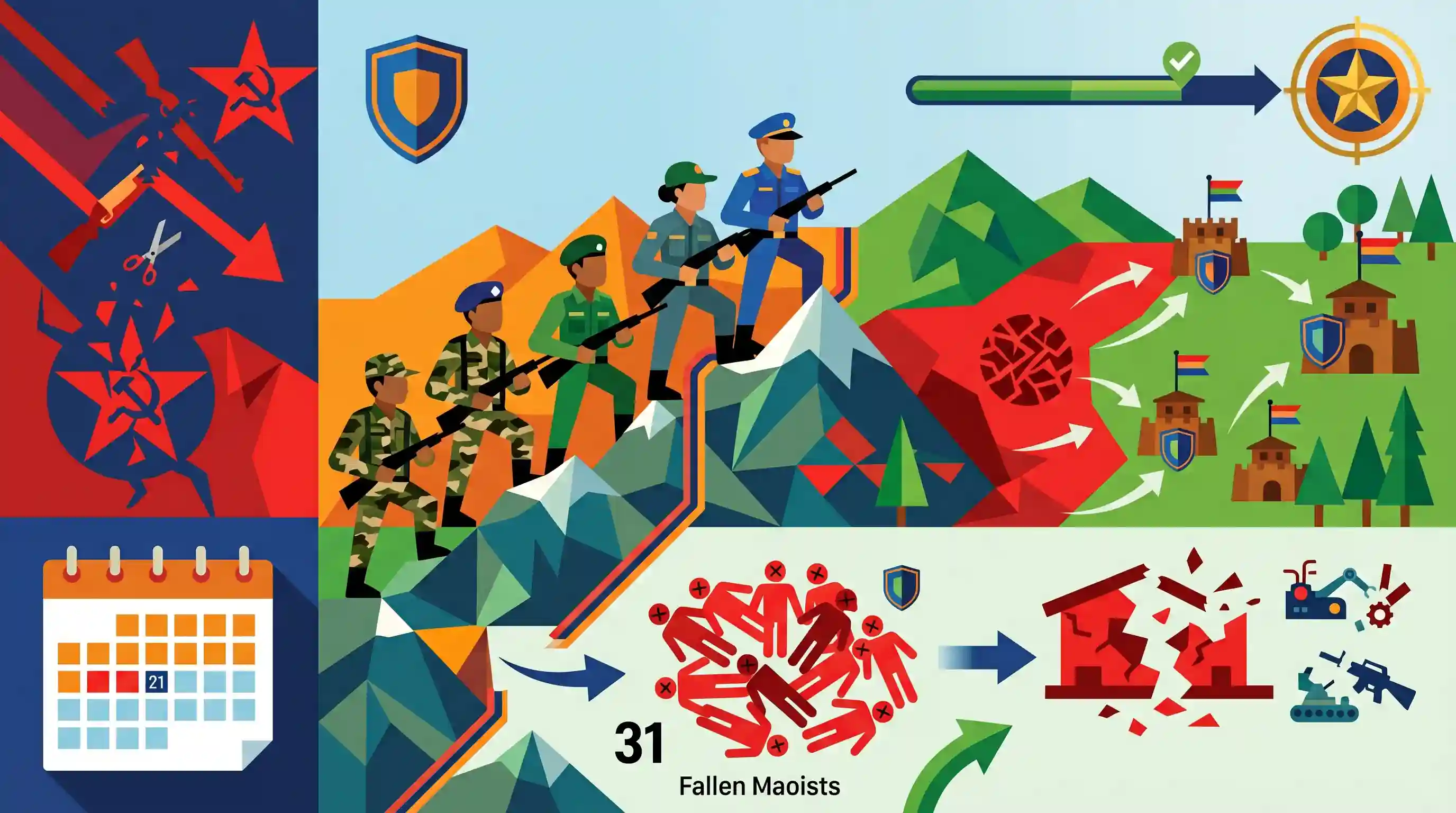
In a major success for internal security forces, a 21-day anti-Maoist operation on the Karregutta hills near the Chhattisgarh-Telangana border led to the elimination of 31 Maoists. Detailed by CRPF Director General Anish Dayal Singh, the joint offensive involved specialized central and state police units, including CoBRA, DRG, and Bastar Fighters. The forces targeted and destroyed an arms manufacturing unit and base belonging to the Maoists' People's Liberation Guerrilla Army (PLGA) Battalion 1. The operation marks a significant step towards the Union government's deadline to eradicate Left Wing Extremism (LWE) by March 2026. The establishment of Forward Operating Bases (FOBs) in remote strongholds previously controlled by the Dandakaranya Special Zonal Committee is systematically constricting Naxal operational space.
Key Points
- A 21-day joint anti-Naxal operation by the CRPF and local police forces at the Karregutta hills tri-junction resulted in the deaths of 31 Maoists.
- The offensive successfully dismantled a major tactical headquarters and weapon manufacturing unit of the Maoists' PLGA Battalion 1.
- Specialized units like the CRPF's CoBRA, Bastar Fighters, District Reserve Guard (DRG), and STF operated with high coordination deep inside previously inaccessible terrain.
- Security forces are pushing to establish Forward Operating Bases (FOBs) in core Maoist areas, like Puarti, to establish administrative control and deny safe havens.
- The operation aligns with the Union Home Ministry's stated objective to completely eradicate Left Wing Extremism (LWE) from India by March 31, 2026.
Important Terms
CRPF (Central Reserve Police Force)

India’s primary Central Armed Police Force (CAPF) for internal security. It lead counter-insurgency operations in Left Wing Extremism (LWE) areas and manages law and order across the country.
UPSC context
GS Paper 3: Internal Security. Essential for understanding the role of CAPFs in managing internal security challenges and insurgency.
CoBRA (Commando Battalion for Resolute Action)
An elite wing of the CRPF specifically trained in guerrilla warfare and jungle combat. Established in 2008, it is the specialized force for high-risk anti-Maoist operations in rugged terrains.
UPSC context
GS Paper 3: Security Forces. Relevant for discussing specialized agencies and their effectiveness in counter-insurgency and jungle warfare.
PLGA (People's Liberation Guerrilla Army)
The military wing of the banned CPI (Maoist). It conducts armed struggle and guerrilla warfare against the Indian state, primarily operating in remote, forested regions of the "Red Corridor."
UPSC context
GS Paper 3: Internal Security. Tests understanding of the structure and tactics of the primary Maoist threat actor in India.
District Reserve Guard (DRG)
A specialized Chhattisgarh police unit recruited from local tribal youth and surrendered Maoists. Known as "sons of the soil," they provide critical intelligence and terrain expertise for anti-Naxal operations.
UPSC context
GS Paper 3: Internal Security. Highlights the "local vs outsider" strategy and community-based policing in counter-insurgency models.
DKSZC (Dandakaranya Special Zonal Committee)
The most powerful organizational unit of the CPI (Maoist) in the Bastar region. It oversees Maoist operations, parallel governance, and logistics across the Chhattisgarh-Maharashtra-Odisha tri-junction.
UPSC context
GS Paper 3: Internal Security. Specific to the geography and organizational depth of Maoist strongholds in central India.
Bastar Fighters
A new specialized Chhattisgarh police unit (formed 2022) consisting of local tribal recruits, including transgenders. It aims to bridge the trust gap between security forces and the Bastar community.
UPSC context
GS Paper 3: Internal Security/Governance. Tests knowledge of inclusive recruitment and modern state strategies to counter extremist ideologies.
Prelims Trap
"District Reserve Guard (DRG) and Bastar Fighters are specialized battalions of the Central Reserve Police Force (CRPF)."
DRG and Bastar Fighters are actually localized State Police units raised by Chhattisgarh using local youth and surrendered insurgents, not Central forces.
Static Concepts Connected
What are the core components of the SAMADHAN doctrine for LWE?
- Comprehensive approach: It encompasses Smart Leadership, Aggressive Strategy, Motivation, Actionable Intelligence, Dashboard KPIs, Harnessing Technology, Action plan per theatre, and No access to financing.
- Shift in strategy: Marks a transition from defensive containment to aggressive, intelligence-led offensive operations combined with targeted development and choke-points.
- Lifeline choking: Focuses heavily on cutting off ideological, geographical, and financial lifelines of the Maoist networks through inter-agency coordination.
How does the Constitution mandate Central Force deployment in States?
- State Subject: Public Order and Police are exclusively State subjects under List II of the Seventh Schedule.
- Article 355: Empowers the Union to protect states against external aggression and internal disturbance, forming the basis for CAPF deployment in LWE areas.
- Aid to Civil Power: Central Armed Police Forces (like CRPF and its CoBRA unit) are deployed to assist and aid the State civil power, not replace it.
Cross-Topic Patterns
Topography + Internal Disturbance
Geography directly dictates security tactics. The Dandakaranya plateau's dense forests and complex river systems (e.g., Indravati) have historically provided natural safe havens and cross-border escape routes for PLGA battalions.
Internal Security + Infrastructure Initiatives
Forward Operating Bases (FOBs) in core Naxal areas enable the simultaneous execution of the Road Requirement Plan (RRP) and telecom saturation (USOF) in Aspirational LWE districts.

Expect a 2026 Mains question evaluating the SAMADHAN doctrine's efficacy and state police coordination against the 2026 zero-LWE target.
Linked PYQs · 3
Linked PYQs · 3
- 2022MainsGS3
Naxalism is a social, economic and developmental issue manifesting as a violent internal security threat. In this context, discuss the emerging issues and suggest a multilayered strategy to tackle the menace of Naxalism.
- 2020MainsGS3
What are the determinants of left-wing extremism in Eastern part of India? What strategy should Government of India, civil administration and security forces adopt to counter the threat in the affected areas?
- 2018MainsGS3
Left Wing Extremism (LWE) is showing a downward trend, but still affects many parts of the country. Briefly explain the Government of India's approach to counter the challenges posed by LWE.
