UPSC Clears UP PPS Officers for Promotion to IPS Cadre
Source:indianmasterminds ↗
Why It Matters
This article illustrates the administrative and statutory mechanism of promoting State Police Service officers to the All India Services (IPS), which is a key topic in Indian federal administration, federalism, and public services under the Constitution of India (specifically Article 312 and UPSC/State PSC regulations). Questions regarding All India Services and the Rajya Sabha's power to create them are frequently asked in the UPPSC PCS Prelims.
Summary
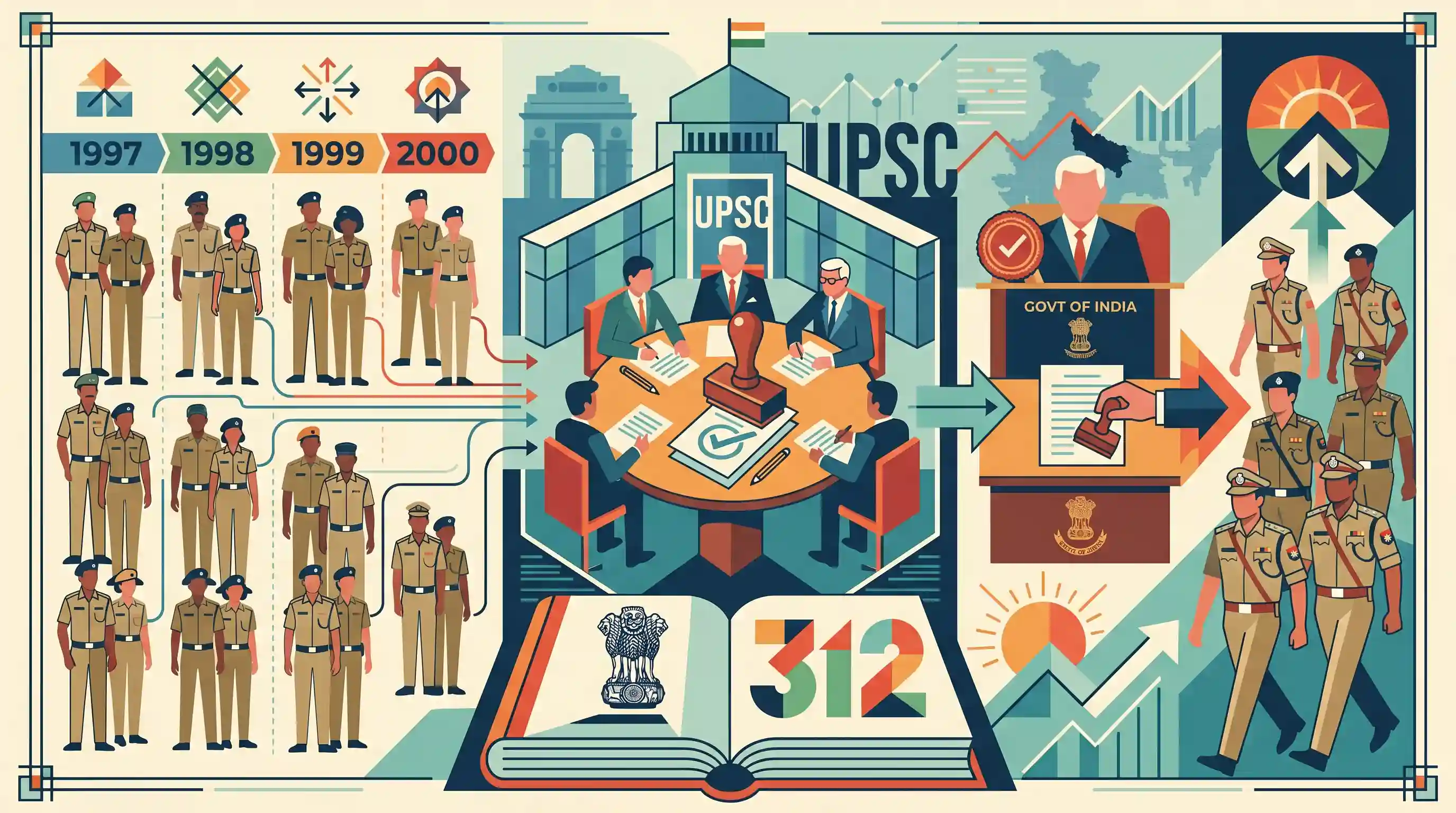
The Departmental Promotion Committee (DPC) at the UPSC headquarters in New Delhi has approved the promotion of 30 officers from the Uttar Pradesh Provincial Police Service (PPS) to the Indian Police Service (IPS) [1.1.1]. The approved officers belong to the 1997, 1998, 1999, and 2000 batches of the UP PPS [1.1.1]. Their formal induction into the IPS cadre is subject to final clearance and the issuance of official appointment orders by the Central Government [1.1.1].
Key Points
- A total of 30 officers of the Uttar Pradesh Provincial Police Service (PPS) from the 1997, 1998, 1999, and 2000 batches have been cleared for induction/promotion into the Indian Police Service (IPS) [1.1.1].
- The promotion was approved by the Departmental Promotion Committee (DPC) during a crucial meeting held at the UPSC headquarters in New Delhi [1.1.1].
- The UPSC Selection Committee assessed the eligibility, service records, and Annual Performance Appraisal Reports (APAR/ACR) of the PPS officers before compiling the recommended 'Select List' [1.1.1, 2.2.1].
- The promotions will formally take effect after the Central Government (Ministry of Home Affairs and DoPT) completes statutory processes and issues official appointment notifications [1.1.1].
- This process showcases the legal mechanism governed under the IPS (Appointment by Promotion) Regulations, 1955, which specifies the ratio of direct recruitment versus promotional induction for All India Services [2.1.3, 2.2.1].
Important Terms
Article 312 of the Constitution of India

Constitutional provision empowering Parliament to establish new All-India Services (common to the Union and States) subject to a Rajya Sabha resolution passed by a two-thirds majority.
UPSC context
GS Paper II: Polity and Federalism; tests the balance of power between Union-State relations and administrative structures.
Indian Police Service (Appointment by Promotion) Regulations, 1955
Legal regulations governing the detailed criteria, eligibility rules, and selection procedure for promoting senior state police service officers into the Indian Police Service.
UPSC context
GS Paper II: Governance/Administrative Reforms; tests recruitment mechanisms, civil service integration, and center-state personnel sharing.
Departmental Promotion Committee (DPC)
An official administrative panel that evaluates the performance, service records, and integrity of eligible employees to recommend them for promotions.
UPSC context
GS Paper II: Executive & Bureaucracy; evaluates administrative procedures, public personnel management, and promotion frameworks within civil services.
Union Public Service Commission (UPSC)
India's premier constitutional body under Articles 315-323, responsible for conducting civil service examinations and advising on recruitments, promotions, and disciplinary matters.
UPSC context
GS Paper II: Constitutional Bodies; evaluates constitutional mechanisms, civil service recruitment standards, and administrative oversight.
Uttar Pradesh Provincial Police Service (PPS)
The state-level Group A and B police civil service in Uttar Pradesh, acting as the primary executive-level force and feeder service for the IPS cadre.
UPSC context
GS Paper II: State-level administration; tests federal structure, center-state administrative coordination, and state civil services.
Indian Police Service (IPS)
One of the three All India Services, responsible for state and national-level public order, law enforcement, and internal security.
UPSC context
GS Paper II & III: Role of Civil Services / Internal Security; tests the administrative structure and security apparatus.
Prelims Trap
State government officers promoted to the Indian Police Service (IPS) receive their final appointment notifications from the respective State Governor.
While states manage state police cadres, All India Services fall under Union purview; the final appointment notifications are issued by the Central Government, not the state Governor.
Static Concepts Connected
What are the key constitutional and statutory frameworks governing All India Services (AIS) recruitment?
- Article 312 power: Empowers Rajya Sabha to initiate creation of new AIS with a two-thirds majority resolution.
- Statutory promotion cap: Limits the induction of State Service officers into IAS/IPS/IFoS to 33 1/3% of total cadre strength.
- Article 320 consultation: Mandates UPSC involvement in assessing suitability and preparing the final Select List for promotions.
How does the promotion process from State Police Service (SPS) to IPS operate?
- Selection Committee composition: Chaired by the UPSC Chairman or Member, containing representatives from both State and Central governments.
- Merit-based grading: Assessments are based on five years of APARs, grading candidates to prioritize merit over simple seniority.
Cross-Topic Patterns
Federalism and administrative integration
Central veto power over state officer promotions demonstrates the structural unitary bias designed to maintain uniform administrative standards across India.
Police reforms and performance metrics
The transition from pure seniority to APAR-based grading matches broader administrative reform goals to professionalize state police leadership cadres.

UPSC is likely to test the constitutional mechanics of AIS, specifically comparing Rajya Sabha's Article 312 power with the 33.3% state promotion cap.
Linked PYQs · 1
Linked PYQs · 1
- 2025UPPSC_PRELIMSGS1
With reference to creation of new All India Service, which of the following statements is/are correct ? 1. In the national interest, the Rajya Sabha can pass a resolution for creation of new All India Service. 2. The resolution for creation of new All India Service must be passed by the Rajya Sabha by two-third majority of the total members of the house. Select the correct answer from the code given below :
