Centre formulates action plan for Yamuna river cleanup
Source:Indian Express ↗
Why It Matters
River conservation and urban pollution management are core themes in environmental governance for UPPSC and UPSC exams, especially considering the ecological degradation of major northern river basins like the Yamuna.
Summary
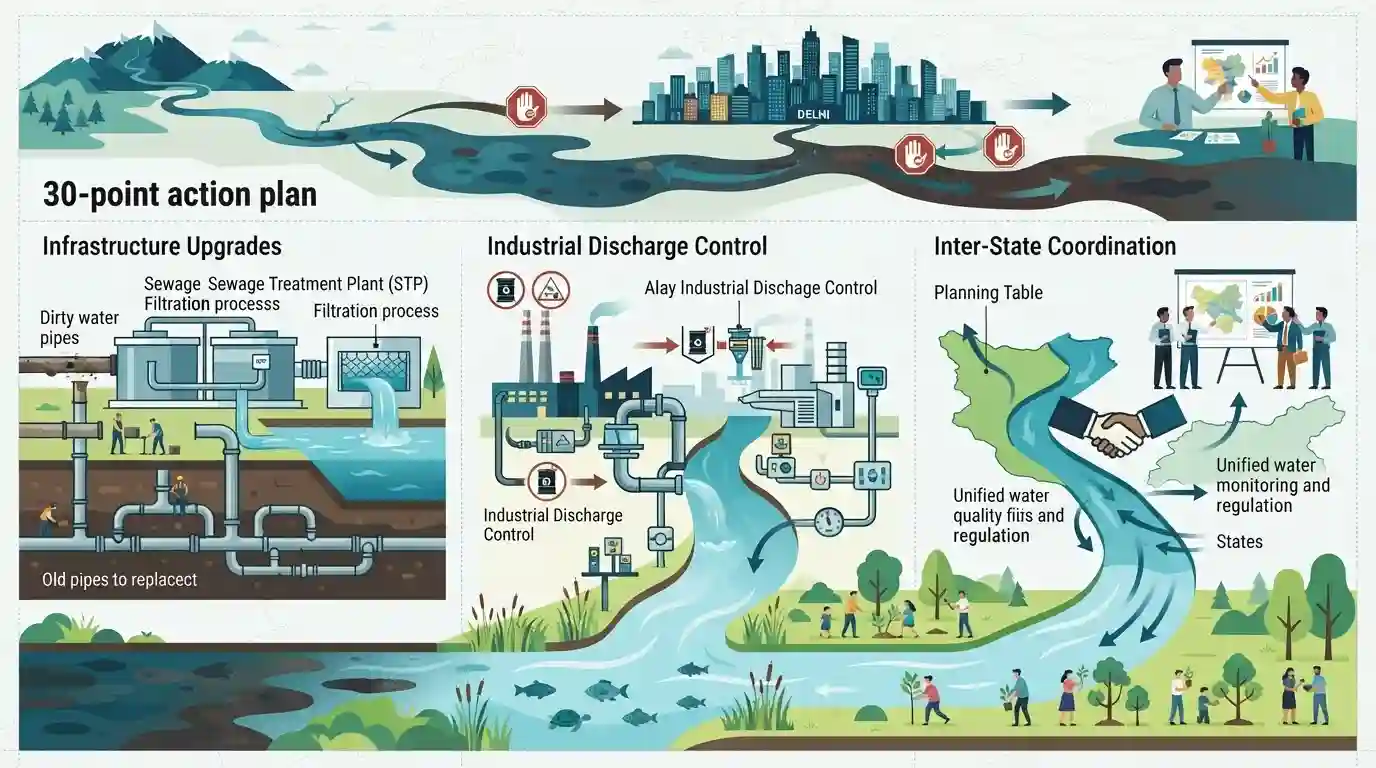
The central government has formulated a comprehensive 30-point action plan to tackle the severe pollution plaguing the Yamuna river. Focusing on infrastructure upgrades like Sewage Treatment Plants (STPs), checking industrial discharge, and enhancing inter-state coordination, the initiative aims to restore ecological health to the river system, which is severely impacted across Delhi and downstream regions.
Key Points
- The Centre has planned a comprehensive 30-point action plan aimed at cleaning up the heavily polluted Yamuna river.
- The strategy involves upgrading sewage treatment plants (STPs), plugging untreated wastewater drains, and regulating industrial effluents entering the river basin.
- The Yamuna river faces grave ecological crises, notably in the National Capital Region and downstream stretches, often classified as a biological disaster due to zero dissolved oxygen levels.
- Inter-governmental coordination between the Centre, Delhi, and neighboring states like Uttar Pradesh and Haryana forms a crucial pillar of this clean-up strategy.
Important Terms
30-point action plan

A comprehensive roadmap introduced by authorities to tackle severe pollution in the Yamuna through infrastructure upgrades, drain management, and enhanced environmental flow.
UPSC context
Relevant for GS Paper III (Environmental Pollution & Degradation, Conservation & Action Plans). Tests knowledge of specific government interventions for river rejuvenation.
Yamuna Cleaning Cell
A multi-agency administrative body established to expedite decision-making, coordinate execution of projects, and clear hurdles in cleaning the Yamuna.
UPSC context
Relevant for GS Paper II/III (Governance and River Basin Management). Tests institutional frameworks designed to address urban river pollution.
Ganga Action Plan
A bilateral river action plan launched in 1985 to clean the Ganga river, serving as a precursor and model for subsequent river conservation initiatives like Yamuna cleanup.
UPSC context
Relevant for GS Paper III (Conservation). Tests historical and ongoing government strategies for river pollution abatement and ecological restoration in India.
Static Concepts Connected
What are the key phases and objectives of the historical Yamuna Action Plan (YAP)?
- JBIC Assistance: Bilateral Funding: Started in 1993 with financial and technical assistance from the Japan Bank for International Cooperation (JBIC).
- Core Objective: Primary Goals: To intercept, divert, and treat municipal sewage and industrial effluents flowing from Delhi, Haryana, and Uttar Pradesh into the Yamuna.
- Phased Rollout: Subsequent Phases: Implemented across multiple phases (YAP-I, YAP-II, and YAP-III) to scale up Sewage Treatment Plant (STP) capacities.
Cross-Topic Patterns
Yamuna Clean-up & Interstate River Governance
Efforts to clean interstate rivers like the Yamuna require statutory river basin management boards, echoing provisions under the River Boards Act, 1956.
Urban Wastewater Infrastructure & Aquatic Ecosystems
Severe oxygen depletion (biological dead zones) in urban river stretches links urban municipal governance directly with aquatic biodiversity loss.

Expect statement-based questions pairing the Yamuna 30-point action plan with historical schemes like YAP or river pollution indicators.
Linked PYQs · 2
Linked PYQs · 2
- 2018UPPSC_PRELIMSGS1
Which of the following rivers of Uttar Pradesh has been declared a 'Biological Disaster' due to environmental pollution?
- 2022UPPSC_PRELIMSGS1
The main purpose of 'Ganga Action Plan' project, launched in 1985, was
