National E Governance Conference Concludes in Jaipur
Source:newsonair ↗
Why It Matters
The National e-Governance Conference represents India's apex platform for discussing digital administrative reforms, cooperative federalism in IT infrastructure, and state-level governance innovations. For RPSC and other state civil services, understanding the host state's digital milestones (like Rajasthan's Jan Aadhaar, Raj Nivesh, and RITI) and national awards is essential for governance-related questions.
Summary
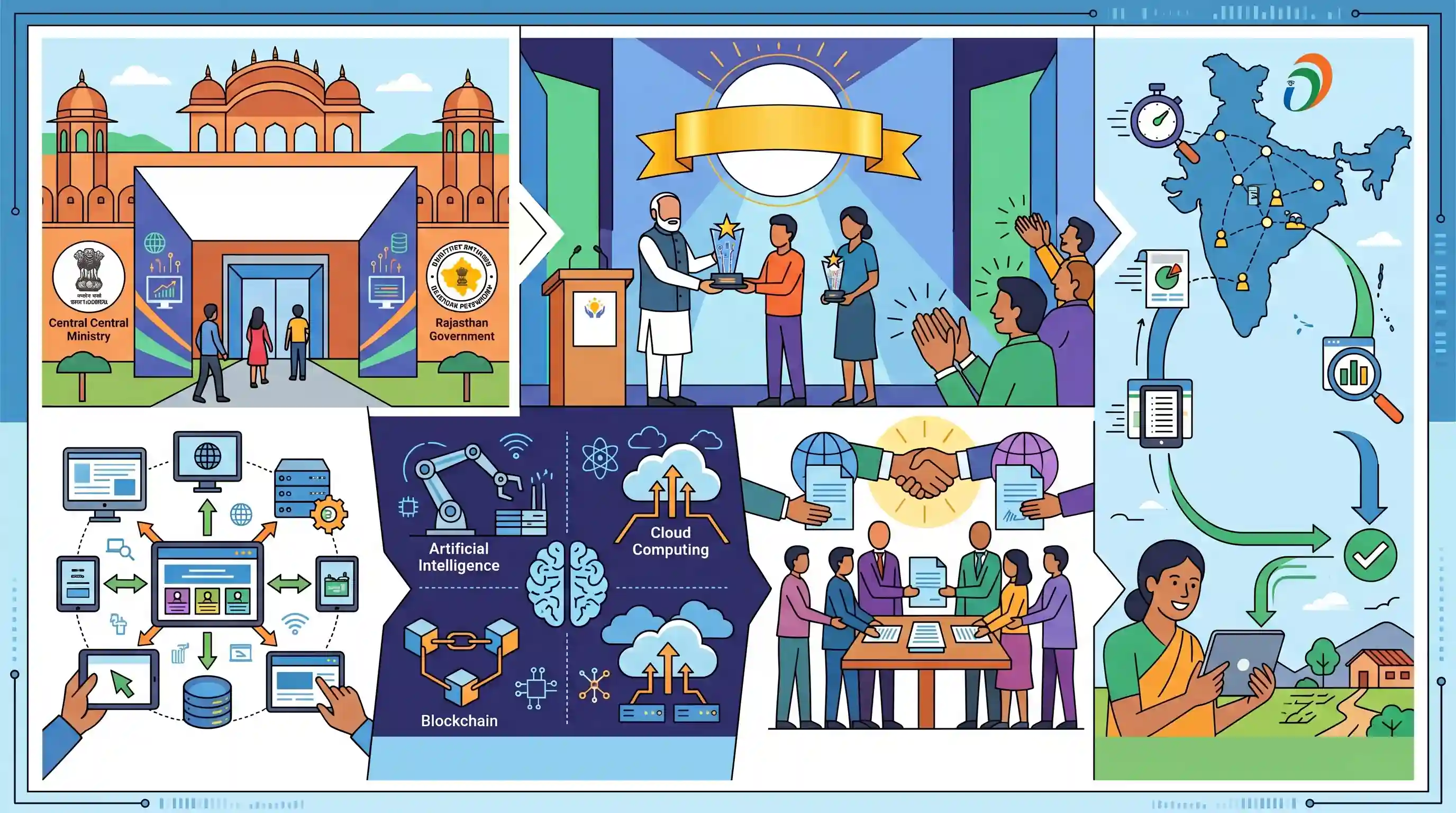
The 29th National e-Governance Conference concluded in Jaipur, Rajasthan, on July 2, 2026. Jointly organized by DARPG, MeitY, and the Government of Rajasthan, the conference concluded with the presentation of the National e-Governance Awards by Union Minister Dr. Jitendra Singh. The concluding day featured three plenary sessions focusing on digital governance, emerging technologies, and collaborative policy implementation, highlighting state-level and national administrative advancements.
Key Points
- The 29th National e-Governance Conference concluded in Jaipur, Rajasthan, on July 2, 2026.
- The conference was jointly organized by the Department of Administrative Reforms and Public Grievances (DARPG), the Ministry of Electronics and Information Technology (MeitY), and the Government of Rajasthan.
- Union Minister Dr. Jitendra Singh attended as the chief guest for the valedictory and presented the National e-Governance Awards to recognize excellence in digital public service delivery.
- The final day of the event featured three plenary sessions dedicated to discussing digital governance, emerging technologies, and standard administrative practices.
- Participants included senior central and state government officials, industry stakeholders, tech startups, and representatives from academic institutions.
Important Terms
National e-Governance Awards

An annual scheme by the Government of India to recognize and reward outstanding e-governance initiatives by central, state, and local bodies that transform public service delivery and promote citizen-centric administration.
UPSC context
GS Paper II: e-Governance. Tests knowledge of digital models, administrative innovation, and technology-driven public service delivery.
Department of Administrative Reforms and Public Grievances (DARPG)
A nodal department under the Ministry of Personnel, Public Grievances and Pensions responsible for promoting governance reforms, improving administrative structures, documenting best practices, and formulating citizen-centric grievance redressal frameworks.
UPSC context
GS Paper II: Citizens' Charters, grievance redressal, and administrative reforms. Tests administrative structure and institutional mechanisms for good governance.
Ministry of Electronics and Information Technology (MeitY)
The nodal Union ministry responsible for policy formulation, digital infrastructure promotion, cybersecurity, internet governance, and electronics manufacturing, serving as the core driver for the Digital India program.
UPSC context
GS Paper III: Science and Technology. Tests awareness of digital policy, cybersecurity frameworks, and technological indigenization.
National e-Governance Conference
An annual national platform jointly hosted by DARPG, MeitY, and state governments to deliberate on digital administrative reforms, emerging technologies, secure digital infrastructure, and collaborative public service delivery.
UPSC context
GS Paper II: Governance. Tests understanding of cooperative federalism, tech-driven administrative improvements, and scaling up of best practices.
Prelims Trap
CPGRAMS acts as a single-window portal for redressing all forms of public grievances, including RTI appeals and sub-judice disputes.
CPGRAMS is not an all-encompassing grievance portal. It explicitly excludes sub-judice cases, RTI matters, and religious issues, which must be routed through their respective judicial or statutory channels.
Static Concepts Connected
What is the National e-Governance Service Delivery Assessment (NeSDA)?
- Core Purpose: Biennial framework developed by DARPG to evaluate the depth and effectiveness of e-governance service delivery across States, UTs, and Central Ministries.
- Global Benchmark: Custom-modeled on the Online Service Index (OSI) of the United Nations E-Government Survey to ensure global benchmarking alignment.
- Evaluation Scope: Assesses 59 mandatory services for States/UTs and 43 services for Central Ministries across key sectors like finance, education, and social welfare.
What is CPGRAMS and what are its key exclusions?
- Function: An online platform enabling citizens to lodge grievances 24/7 against any public authority of Central or State governments.
- Nodal Agency: Administered by the Department of Administrative Reforms and Public Grievances (DARPG) under the Ministry of Personnel, Public Grievances and Pensions.
- Key Exclusions: Does not entertain grievances related to sub-judice cases, RTI matters, religious issues, or grievances against foreign governments.
Cross-Topic Patterns
NeSDA & Competitive Federalism
Using biennial benchmarking tools like NeSDA to rank state portals leverages competitive federalism to standardize public service delivery across states with uneven digital infrastructure.
AI and 2nd ARC Grievance Reforms
Integrating AI-driven analytics into CPGRAMS directly addresses the 2nd ARC recommendations on transforming grievance redressal from passive receipt to active systemic reform.

UPSC may contrast DARPG's NeSDA framework with global UN standards, or test explicit exclusions of the CPGRAMS portal in GS-II.
Linked PYQs · 3
Linked PYQs · 3
- 2021RPSC_PRELIMSGS1
The Rajasthan Jan Aadhar Authority Ordinance was implemented
- 2025RPSC_PRELIMSGS1
Which of the following statements regarding the Raj Nivesh Portal of Rajasthan is incorrect?
- 2025RPSC_PRELIMSGS1
What has been formed in place of the Chief Minister Rajasthan Economic Reforms Advisory Council (CMRETAC)?
