Electric bus fleet induction and e-depots in Himachal Pradesh
Source:thenewshimachal ↗
Why It Matters
Transitioning public transport fleets to electric vehicles (EVs) is a critical objective within India's broader climate commitments. This development offers a concrete regional case study for HPAS Prelims on state-level implementation of green mobility, which intertwines infrastructure modernization with environmental sustainability and air pollution control.
Summary
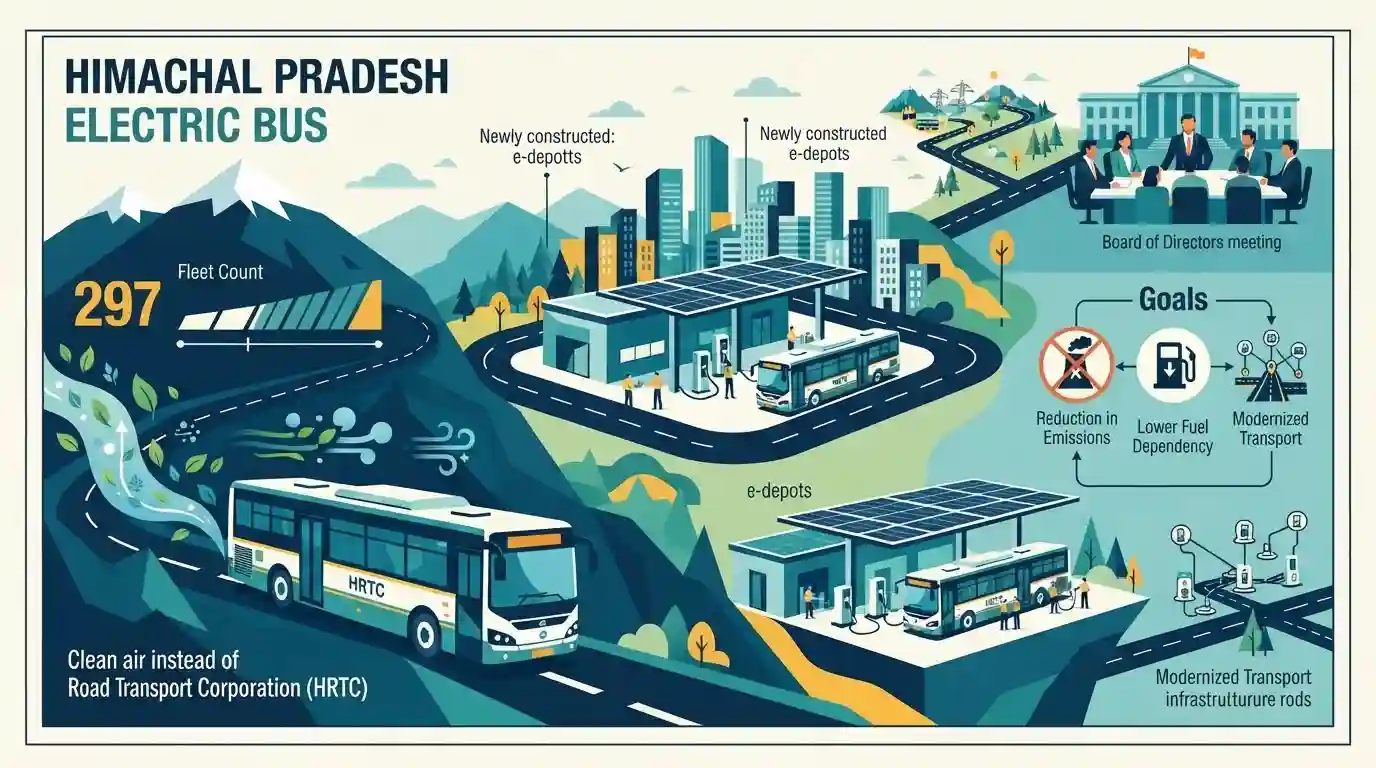
The Himachal Pradesh Road Transport Corporation (HRTC) plans to add 297 electric buses to its fleet in a phased manner as part of the state's push toward sustainable and green public transportation. During the 163rd Board of Directors meeting chaired by Deputy Chief Minister Mukesh Agnihotri, it was announced that four new electric bus depots (e-depots) will soon become operational. The initiative aims to reduce vehicular emissions, lower fuel dependencies, and modernize basic transport infrastructure in Himachal Pradesh. Additionally, directives were given to ensure an adequate supply of basic bus spares to maintain service efficiency.
Key Points
- Himachal Pradesh Road Transport Corporation (HRTC) will induct 297 electric buses in a phased manner to promote sustainable public transport.
- Four newly constructed electric bus depots (e-depots) are slated to go operational shortly to support the electric vehicle fleet.
- Deputy Chief Minister Mukesh Agnihotri emphasized the modernization of basic infrastructure and directed authorities to maintain adequate stocks of spares and tires for buses.
- The shift towards an electric fleet aims to lower vehicular emissions, curtail fuel consumption, and advance green mobility within the state.
Important Terms
State Road Transport Undertakings (SRTUs)

Public sector entities established by Indian state governments to provide coordinated, efficient, and economical passenger road transport services, governed under the Road Transport Corporations Act, 1950.
UPSC context
GS Paper III (Infrastructure & Economy); tests public transport governance, financial health of state PSUs, and public service challenges.
Himachal Pradesh Road Transport Corporation (HRTC)
The state-owned public transport undertaking of Himachal Pradesh, pioneering mountainous green transit through the deployment of zero-emission electric buses across ecologically sensitive Himalayan regions.
UPSC context
GS Paper III (State PSUs & Infrastructure); tests state-led green mobility transitions and public transport in hilly terrains.
PM-eBus Sewa Scheme
A central scheme designed to augment urban bus operations by deploying electric buses and building charging infrastructure, prioritizing city-wide green mobility and carbon footprint reduction.
UPSC context
GS Paper III (Infrastructure & Conservation); tests government schemes for sustainable transport, urban planning, and federal green initiatives.
Green Mobility
Sustainable transport practices and technologies, such as electric vehicles and mass transit, that minimize environmental impact, reduce air pollution, and decrease reliance on fossil fuels.
UPSC context
GS Paper III (Environment & Infrastructure); tests policies for urban decarbonization, climate change mitigation, and clean energy transition.
CAPEX and OPEX Models
Financial frameworks in public procurement; CAPEX involves upfront asset ownership and capital investment, while OPEX pays service providers for operation and maintenance over a contract period.
UPSC context
GS Paper III (Investment Models & Infrastructure); tests public-private partnership models, public finance, and infrastructure procurement strategies.
Prelims Trap
FAME-II provides demand incentives for all private electric vehicles, including personal four-wheelers (cars), to accelerate transition.
Under FAME-II, demand incentives for electric four-wheelers (4Ws) are strictly restricted to commercial fleets and public transport, whereas electric two-wheelers (2Ws) are incentivized for private personal use.
Static Concepts Connected
What is the Gross Cost Contract (GCC) model in public transport?
- Core Definition: A public-private partnership procurement framework where a private operator owns, runs, and maintains the vehicle fleet, while the public transport authority pays them on a per-kilometer basis.
- Fiscal Relief: It shifts the high upfront capital expenditure (CapEx) of purchasing electric buses from cash-strapped State Transport Undertakings (STUs) to private entities.
- Risk Allocation: The private operator absorbs the technology and maintenance risks (e.g., battery degradation), while the state retains the market/fare collection risk.
What is Behind-the-Meter (BTM) power infrastructure for EV depots?
- Definition: Refers to electrical infrastructure located on the user's side of the utility meter, including onsite solar panels, energy storage systems, and EV chargers.
- Grid Mitigation: Allows depots to manage electricity draw locally, reducing peak-load stress on the municipal or state grid during mass charging cycles.
Cross-Topic Patterns
Green Federalism and STU Fiscal Stress
State Transport Undertakings face severe balance-sheet stress; aggressive green mobility mandates require innovative PPP structures like GCC to avoid service collapse without overwhelming state budgets.
Topography and EV Technology Adoption
Hilly terrains in states like Himachal Pradesh require customized heavy-duty EV battery standards, linking climate mitigation policies directly with domestic manufacturing and technology transfer challenges.

PM-eBus Sewa's PPP funding model and GCC procurement mechanics are highly probable targets for analytical UPSC questions on infrastructure.
Linked PYQs · 1
Linked PYQs · 1
- 2023HPAS_PRELIMSGS1
Consider the following Acts and Policy : (1) Water (Prevention and Control of Pollution) Act (2) Water Cess Act (3) The National Water Policy (4) Air (Prevention and Control of Pollution) Act With reference to the Acts and Policy mentioned above, in terms of their starting year, which one of the following is the correct ascending order? Choose the correct answer from the options given below :
