Andhra Pradesh Social Welfare Expenditure and Fiscal Management
Source:The Hindu ↗
ఇది ఎందుకు ముఖ్యం
Data regarding the state's expenditure distribution (SC, ST, BC, Minorities), flagship socio-economic schemes, and fiscal discipline are highly relevant for APPSC Prelims questions focusing on the socio-economic status and governance of Andhra Pradesh.
సారాంశం
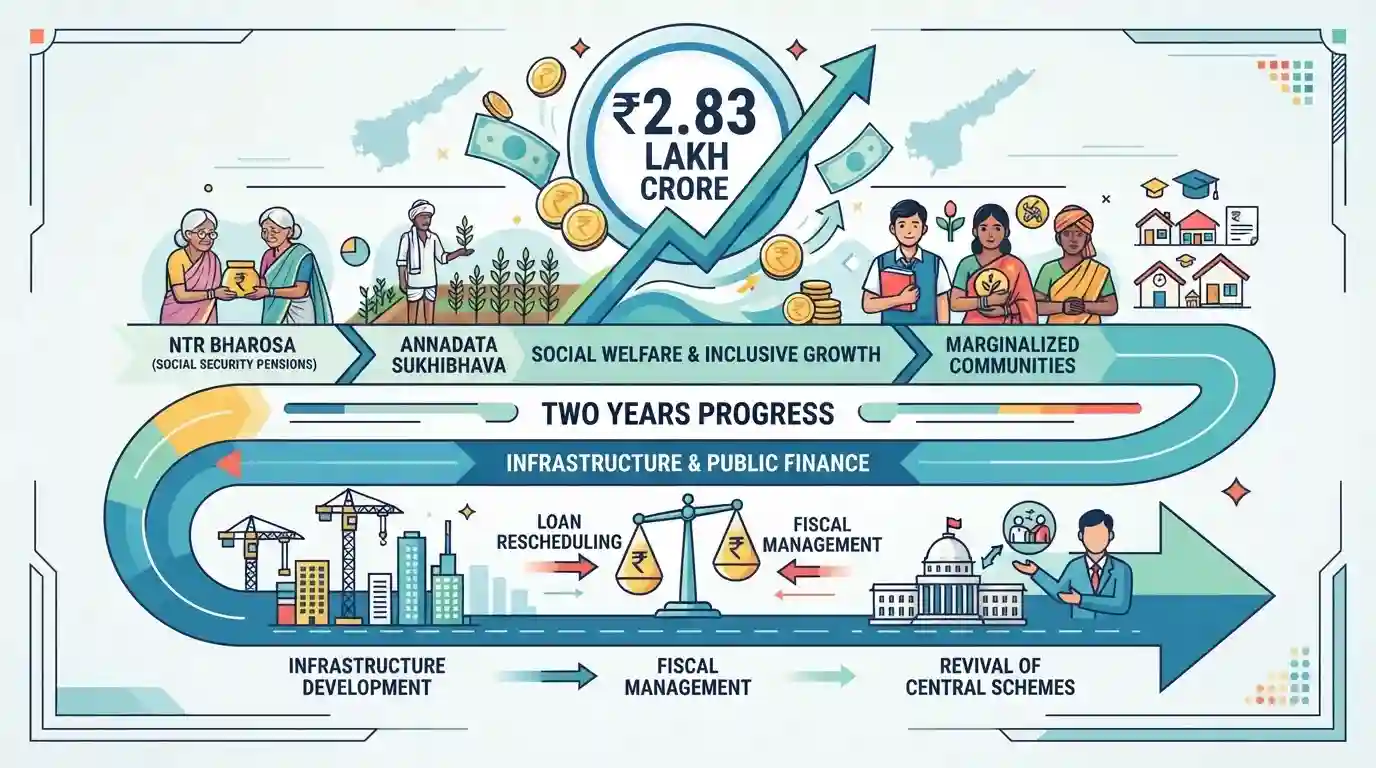
Over the past two years, the Andhra Pradesh government has prioritized dual tracks of social welfare and infrastructure development, recording an expenditure of ₹2.83 lakh crore. Social Welfare Minister Dola Sree Bala Veeranjaneya Swamy highlighted targeted spending for marginalized communities, execution of flagship schemes like NTR Bharosa and Annadata Sukhibhava, and successful fiscal management through loan rescheduling and the revival of Central schemes.
ముఖ్య అంశాలు
- The Andhra Pradesh government expended a total of ₹2.83 lakh crore over two years, dedicating ₹1.49 lakh crore to public welfare and ₹1.34 lakh crore to developmental initiatives.
- Major welfare allocations included ₹19,100 crore for Scheduled Castes, ₹32,534 crore for Backward Classes, ₹5,730 crore for Scheduled Tribes, and ₹4,856 crore for minorities.
- Prominent welfare schemes launched or sustained include Talliki Vandanam, Annadata Sukhibhava, NTR Bharosa, and the Deepam-2 free gas cylinder initiative.
- On the economic and development front, the state reported attracting investments exceeding ₹23 lakh crore and saving ₹8,269 crore via fiscal discipline and loan rescheduling.
- The state government successfully revived 86 Central government schemes to maximize public benefit.
ముఖ్యమైన పదాలు
Talliki Vandanam

An Andhra Pradesh government education welfare scheme providing ₹15,000 annually per eligible school-going child (Class I-XII) directly to mothers to alleviate financial burdens and improve school enrolment.
UPSC context
GS Paper II (Social Justice/Welfare Schemes), testing government initiatives for educational empowerment and inclusive development.
Annadata Sukhibhava
Andhra Pradesh’s flagship direct income support scheme for farmers, providing ₹20,000 annually per family (including ₹6,000 from Central PM-KISAN) to support agricultural input costs and boost rural livelihoods.
UPSC context
GS Paper III (Agriculture/Direct and Indirect Subsidies), testing agricultural support mechanisms and farmer welfare policies.
NTR Bharosa
Andhra Pradesh’s flagship social security pension scheme providing monthly financial assistance ranging from ₹4,000 to ₹15,000 to vulnerable groups, including senior citizens, widows, and persons with disabilities.
UPSC context
GS Paper II (Social Justice/Welfare Schemes), evaluating mechanisms for protecting vulnerable populations and ensuring social security.
Deepam-2
An Andhra Pradesh welfare scheme offering three free LPG cylinders annually (one every four months) to eligible below-poverty-line (BPL) families to promote clean cooking and improve indoor health.
UPSC context
GS Paper II (Social Justice) and Paper III (Environment), evaluating clean energy access and gender-focused health policies.
Rendella Nammakam, Abhivruddhi, Sankshemam
A public review initiative ("Two Years of Trust, Development, and Welfare") celebrating the accomplishments, fiscal reforms, and welfare delivery of the TDP-led NDA coalition government in Andhra Pradesh.
UPSC context
GS Paper II (Governance), analyzing administrative accountability, state-level performance reviews, and public welfare delivery models.
YSR Congress Party
A regional political party in Andhra Pradesh, led by Y.S. Jagan Mohan Reddy, which formed the state government from 2019 to 2024 before being succeeded by the TDP-led NDA coalition.
UPSC context
GS Paper II (Polity/Federalism), examining regional parties, democratic transitions, and state-level political dynamics in India.
ప్రిలిమ్స్ ఉచ్చు
Annadata Sukhibhava and Deepam-2 are Centrally Sponsored Schemes aimed at farmers and women.
These are state-specific initiatives of Andhra Pradesh. While they operate in tandem with Central schemes (PM-KISAN and PM Ujjwala), they are distinct state-funded programs.
అనుసంధానమైన స్థిర భావనలు
How does the Constitution regulate state government borrowings?
- Article 293(3): States cannot raise new loans without Union government consent if there is any outstanding loan owed to or guaranteed by the Centre.
- FRBM Framework: State borrowing is capped by fiscal deficit limits, typically 3% of GSDP, guided by the Finance Commission's recommendations.
What distinguishes Centrally Sponsored Schemes (CSS) from Central Sector Schemes?
- Central Sector Schemes: Fully funded and directly implemented by the Union Government on subjects primarily from the Union List (e.g., PM-KISAN).
- Centrally Sponsored Schemes: Jointly funded by the Centre and States (usually 60:40 ratio) but implemented by State governments to achieve broader national objectives.
అంతర-అంశ నమూనాలు
State Welfare vs FRBM Constraints
Balancing high welfare expenditure with state FRBM borrowing limits requires efficient debt management. This highlights the macro-economic challenge of funding state-level populism without triggering a debt trap.
SC/ST Sub-Plan Strategy
Targeted state budgetary allocations for marginalized groups reflect the legacy of the SCSP and TSP models, aiming to ensure proportional resource distribution and inclusive growth at the grassroots.

State-specific welfare schemes mirroring Union schemes (like PM-KISAN) often appear in Prelims as 'Match the State to Scheme' questions.
అనుసంధాన PYQలు · 4
అనుసంధాన PYQలు · 4
- 2023APPSC_PRELIMSGS1
One of the following welfare programmes implemented by Government of Andhra Pradesh is not part of Navaratnalu.
- 2024APPSC_PRELIMSGS1
Which of the following statements are valid regarding the interventions of the Government of Andhra Pradesh in the context of Healthcare ? I. Telemedicine facility is available in all Ayushman Bharat Health and Wellness Centres (AB-HWCs) to avail specialist services through district hub. II. The Family Doctor Programme has been planned to be implemented as a standalone project without the need to be integrated with Primary Health Centres (PHCs). III. Dr. YSR Aarogyasri Scheme has been revamped, by increasing the income limit from ₹ 2.5 lakh to ₹ 5 lakh per annum per family. IV. 'Aarogya Aasara' Scheme is intended to provide post-operative sustenance allowance with certain eligible conditions complied with. Select the correct answer using the codes given below :
- 2024APPSC_PRELIMSGS1
Which of the following statement/statements is/are incorrect regarding the Andhra Pradesh Industrial Policy 2023 - 27? I. To achieve a minimum contribution of 25% by industry in the State GDP II. To provide end-to-end facilitation in 2 weeks III. To envisage ten (10) priorities of accomplishment IV. To focus on becoming a 'Plug and Play State' for investments V. Ensuring land allotment by APIIC within a period of 2 weeks upon receipt of application Select the answer using the codes given below :
- 2024APPSC_PRELIMSGS1
Which of the following statement/statements is/are valid regarding the socio-economic status of Andhra Pradesh ? I. Andhra Pradesh won the Best State Award of ICAR - National Research Center for Banana (NRCB) for export promotion. II. Andhra Pradesh GSDP growth rate has been registering a decline in recent times owing to repeated lower returns in certain sub-sectors of the Service Sector. III. For the FY 2024 - 25, the Revenue Deficit is budgeted higher than the Fiscal Deficit in terms of percentage of Andhra Pradesh GSDP. IV. The technology used by the Government of Andhra Pradesh while conducting resurvey of landholdings is referred to as 'Continuously Operating Reference Stations (CORS)' technology. Select the correct answer using the codes given below :
