RSLSA Mediation Training Program For Retired Judges
Source:lawsandlegals ↗
Why It Matters
This initiative illustrates proactive state-level efforts in Rajasthan to address judicial pendency by utilizing trained retired judges as mediators under Supreme Court-approved standards. It serves as an important case study for judicial reforms, public dispute resolution systems, and the functional role of the State Legal Services Authority.
Summary
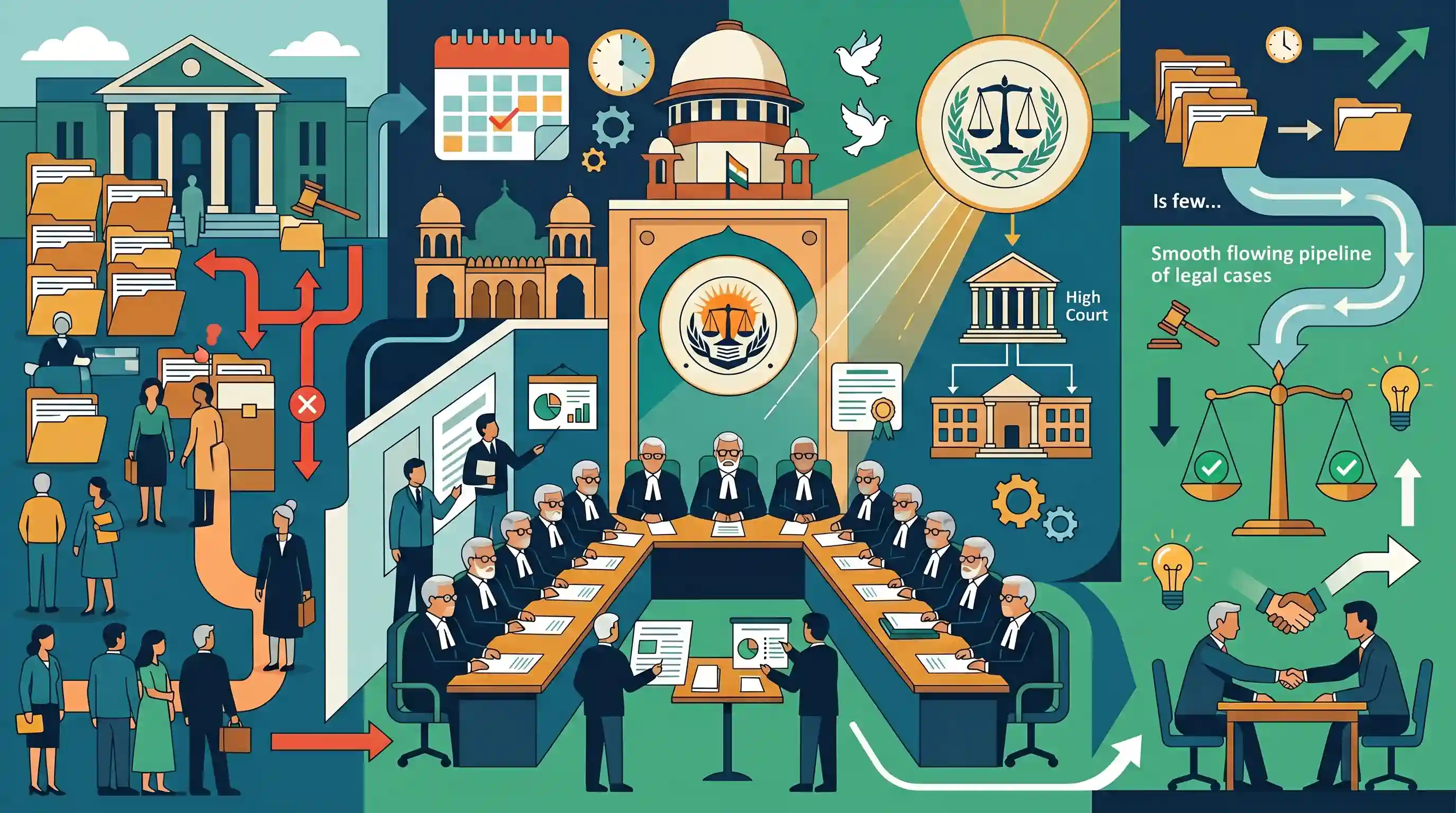
The Rajasthan State Legal Services Authority (RSLSA) successfully trained 28 retired judges from the Rajasthan High Court and subordinate judiciary in an intensive 40-hour mediation program from June 1 to June 5, 2026, in Jaipur. Conducted under the guidelines of the Supreme Court's Mediation and Conciliation Project Committee (MCPC), this initiative aims to strengthen Alternative Dispute Resolution (ADR) systems, lower the state's case backlog, and provide faster dispute resolution.
Key Points
- A special 5-day (40-hour) intensive mediation training program was organized by RSLSA from June 1 to June 5, 2026, at Legal Services Bhawan, Jaipur.
- The program trained 28 retired judges of the Rajasthan High Court and subordinate judiciary to act as mediators.
- The curriculum and instruction followed the benchmarks established by the Mediation and Conciliation Project Committee (MCPC) of the Supreme Court of India.
- Justice Mahendra Kumar Goyal, High Court Judge and Mediation In-charge, awarded the completion certificates to the retired judges.
- The program was led by expert national trainers, including Labour Court Judge Balkrishna Goyal and Senior Advocate Anuja Saxena, under the coordination of RSLSA Member Secretary Hariom Sharma Atri.
- The objective is to utilize the extensive judicial experience of retired judges to resolve pending litigation quickly and reduce backlogs via Alternative Dispute Resolution (ADR).
Important Terms
Legal Services Authorities Act, 1987

A landmark statute enacted to establish a nationwide network for providing free, competent legal aid to weaker sections and organizing Lok Adalats to ensure equal justice.
UPSC context
GS Paper II (Polity); tests statutory bodies, the legal aid framework, and DPSP Article 39A.
The Mediation Act, 2023
A comprehensive law regulating mediation in India, making pre-litigation mediation mandatory for civil/commercial disputes and establishing the Mediation Council of India.
UPSC context
GS Paper II (Judicial Reforms); tests alternative dispute resolution mechanisms and judicial pendency reduction.
Rajasthan State Legal Services Authority (RSLSA)
A statutory body constituted under the Legal Services Authorities Act, 1987, to provide free legal aid, organize Lok Adalats, and run literacy drives in Rajasthan.
UPSC context
GS Paper II (State Institutions); tests the federal legal aid structure and grassroots welfare implementation.
Mediation and Conciliation Project Committee (MCPC)
A specialized committee constituted by the Supreme Court of India in 2005 to oversee and implement court-annexed mediation and mediator training programs nationwide.
UPSC context
GS Paper II (Judiciary/ADR); tests court-annexed alternative dispute resolution and judicial administration.
Supreme Court of India
The highest judicial court of India established under Article 124 of the Constitution, functioning as the ultimate custodian of constitutional and fundamental rights.
UPSC context
GS Paper II (Judiciary); tests constitutional powers, jurisdictions, and landmark judicial doctrines.
Prelims Trap
The Chief Justice of the High Court serves as the Executive Chairman of the State Legal Services Authority.
Under the 1987 Act, the Chief Justice of the High Court is the Patron-in-Chief, whereas a serving or retired High Court Judge acts as the Executive Chairman.
Static Concepts Connected
What is the statutory framework of SLSAs under the 1987 Act?
- Patron-in-Chief: The Chief Justice of the respective High Court serves in this honorary role.
- Executive Chairman: A serving or retired High Court judge is nominated to manage executive functions.
- Lok Adalat awards: Their compromises are equivalent to civil court decrees and cannot be appealed.
Who is entitled to free legal services under Section 12?
- Universal eligibility: Women, children, SC/ST members, and industrial workmen qualify automatically irrespective of income.
- Income-ceiling limits: General citizens and certain other groups must fall below prescribed state-level income ceilings.
- OBC exclusion: This category is not explicitly listed as a default beneficiary group under the 1987 Act.
Cross-Topic Patterns
ADR and Ease of Doing Business
Strengthening mediation frameworks improves India's contract enforcement regime, reducing corporate litigation backlogs and boosting foreign investor confidence in domestic dispute resolution.
Tech-enabled ADR and Article 21
Integrating AI and digital platforms with traditional ADR creates Online Dispute Resolution (ODR) channels, expanding rural legal aid access under Article 21.

UPSC may couple the features of the Mediation Act 2023 with the statutory powers of SLSAs in a multi-statement 2026 Prelims question.
Linked PYQs · 2
Linked PYQs · 2
- 2024RPSC_PRELIMSGS1
According to the Rajasthan Lokayukta and Deputy Lokayukta Act, 1973, the Lokayukta in Rajasthan can investigate allegations against ministers and public servants in certain cases. Which of the following subject is included in such cases? (i) Involves grievance/any suffering caused by public servant. (ii) Used his position as a public servant to obtain, for himself or for any other person, any valuable thing or financial benefit. (iii) Sexual harassment of woman, cause injury to any person. (iv) Can be related to being guilty of corruption of the trust reposed in him as a public servant.
- 2025RPSC_PRELIMSGS1
Under Section 7 of the Rajasthan Lokayukta and Upa-Lokayukta Act, 1973, the Lokayukta has the power to investigate charges against ministers and public servants in certain cases. Which of the following is not part of those investigations?
