Constitutional Amendments and Military Hegemony in Pakistan
Source:Indian Express ↗
Why It Matters
Understanding Pakistan's internal political shifts is crucial for analyzing India's neighborhood policy, predicting cross-border security challenges, and comprehending the contrasting trajectories of democratic institutionalization and separation of powers in the subcontinent.
Summary
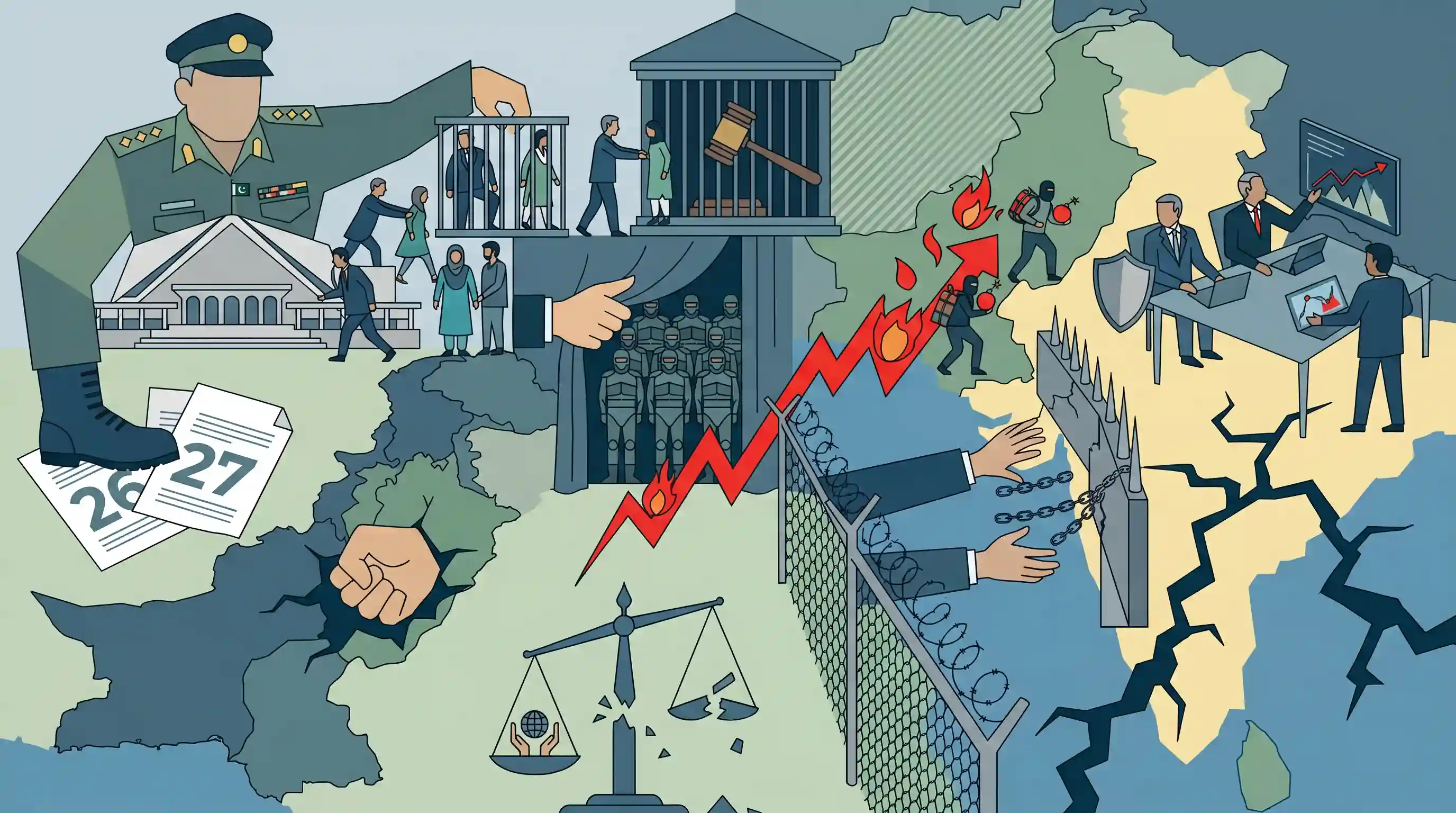
The proposed 27th Amendment to Pakistan's Constitution, following the recent 26th Amendment, seeks to formally entrench the military's authority within the country's governance structure. Expected to grant constitutional cover to military courts for trying civilians—specifically targeting political opponents—and potentially centralizing power by rolling back provincial autonomy, the amendment marks a definitive shift from covert military influence to overt constitutional control. This democratic backsliding and institutional imbalance pose significant concerns for India, as a military-dominated Pakistan historically leans towards anti-India policies, heightening risks of cross-border terrorism, complicating bilateral relations, and destabilizing the region.
Key Points
- Following the controversial 26th Amendment, which heavily curtailed judicial independence by granting parliament the power to appoint the Chief Justice, Pakistan's ruling coalition has proposed a 27th Amendment.
- The 27th Amendment aims to provide constitutional cover for military courts to try civilians, effectively institutionalizing the military's power to suppress political opposition, notably following the May 9 riots.
- It may also seek to centralize power by reversing parts of the 18th Amendment, which previously devolved significant powers and resources to Pakistan's provinces.
- This legislative shift transitions the Pakistan military from a covert 'behind-the-scenes' power broker to having overt, constitutionally mandated authority over civilian and judicial domains.
- For India, a constitutionally empowered Pakistani military implies continued anti-India posturing to justify its dominance, a prolonged freeze in bilateral dialogue, and sustained threats of cross-border terrorism along the LoC.
Important Terms
27th Amendment (Pakistan)

A 2025 constitutional change that formalizes military supremacy by creating a unified command under the Army Chief and establishing a new court to bypass Supreme Court jurisdiction.
UPSC context
GS-II (India and Neighborhood) and (Comparison of Constitutions); tests understanding of democratic backsliding and regional stability.
26th Amendment (Pakistan)
A 2024 reform that altered judicial appointments, capped the Chief Justice’s tenure at three years, and increased executive influence over the judiciary via parliamentary committees.
UPSC context
GS-II (Comparison of Constitutions); demonstrates the shift from judicial independence toward executive-legislative dominance in neighbor states.
18th Amendment (Pakistan)
A landmark 2010 reform that restored parliamentary democracy and granted significant legislative, administrative, and financial autonomy to Pakistan's provinces.
UPSC context
GS-II (Comparison of Constitutions); serves as the historical benchmark for federalism and democratic consolidation in the region.
Federal Constitutional Court (Pakistan)
A new judicial body established to handle constitutional matters, effectively stripping the Supreme Court of its role as the final arbiter of the Constitution.
UPSC context
GS-II (Comparison of Constitutions); highlights structural changes in the separation of powers and the erosion of judicial review.
Chief of Defence Forces (CDF)
A unified military command position created in 2025, permanently held by the Army Chief, granting him supreme command over the Navy and Air Force.
UPSC context
GS-II (Neighborhood relations) and GS-III (Security); analyzes the formalization of military-led governance and its impact on regional security.
Civil-Military Relations
The power dynamic between elected leaders and the armed forces; in Pakistan, recent amendments have shifted this from "hybrid" to formal military dominance.
UPSC context
GS-II (India and Neighborhood); critical for understanding the drivers of Pakistan’s foreign policy and cross-border security challenges.
Military Courts (Pakistan)
Tribunals run by the armed forces; recent amendments seek to grant them constitutional cover to try civilians, often targeting political dissidents.
UPSC context
GS-II (Effect of neighbor's policies on India); examines human rights concerns and the erosion of the civilian legal order.
Prelims Trap
"Under Article 34, Indian military courts are permanently empowered to try civilians for sedition and anti-national activities."
Article 34 only restricts Fundamental Rights while Martial Law is in force. India does not have a standing provision to try civilian political opponents in military courts during peacetime.
Static Concepts Connected
How does the Indian Constitution protect judicial independence from executive capture?
- Basic Structure Doctrine: Prevents Parliament from altering the Constitution's core features, including judicial independence and federalism, establishing a hard limit on legislative power.
- Collegium System: Evolved through the 'Three Judges Cases', ensuring judicial primacy in appointments and protecting the Supreme Court from direct political interference.
- Article 50: A Directive Principle of State Policy that explicitly directs the State to take steps to separate the judiciary from the executive in public services.
What are the constitutional provisions regarding military authority and Martial Law in India?
- Article 34: Allows Parliament to indemnify government servants for actions taken to restore order in areas where martial law is in force, temporarily restricting Fundamental Rights.
- Civilian Supremacy: The President is the Supreme Commander of the Armed Forces (Article 53), ensuring the military remains strictly subordinate to elected civilian authority.
- No Peacetime Military Courts: Armed Forces Tribunals handle service matters for military personnel, but military courts cannot try civilians for civil or political offenses during peacetime.
Cross-Topic Patterns
Democratic deficit & proxy warfare
As Pakistan centralizes military power and curbs civilian oversight, this historically correlates with heightened anti-India rhetoric, proxy warfare, and LoC instability to justify the military's domestic dominance.
Basic Structure as a safeguard
Pakistan's recent amendments underscore the vital role of India's Basic Structure doctrine, which effectively prevents a parliamentary majority from eroding judicial independence or federalizing structures.

Expect a GS-2 Mains question comparing constitutional safeguards protecting judicial independence in India versus democratic decay in neighbors.
Linked PYQs · 3
Linked PYQs · 3
- 2016MainsGS2
Increasing cross-border terrorist attacks in India and growing interference in the internal affairs of several member-states by Pakistan are not conducive for the future of SAARC (South Asian Association for Regional Cooperation)." Explain with suitable examples.
- 2024MainsGS3
India has a long and troubled border with China and Pakistan fraught with contentious issues. Examine the conflicting issues and security challenges along the border. Also give out the development being undertaken in these areas under the Border Area Development Programme (BADP) and Border Infrastructure and Management (BIM) Scheme.
- 2020MainsGS2
Judicial Legislation is antithetical to the doctrine of separation of powers as envisaged in the Indian Constitution. In this context justify the filing of large number of public interest petitions praying for issuing guidelines to executive authorities.
