ADB approves loan to boost sustainable tourism infrastructure in state
Source:fasi ↗
Why It Matters
Tourism is a primary engine of economic growth and employment in Himachal Pradesh. Understanding external financing (like ADB loans) for state-specific infrastructure projects is crucial for HPAS Prelims, as questions frequently target the state's economic surveys, tourism statistics, and major developmental initiatives funded by international bodies.
Summary
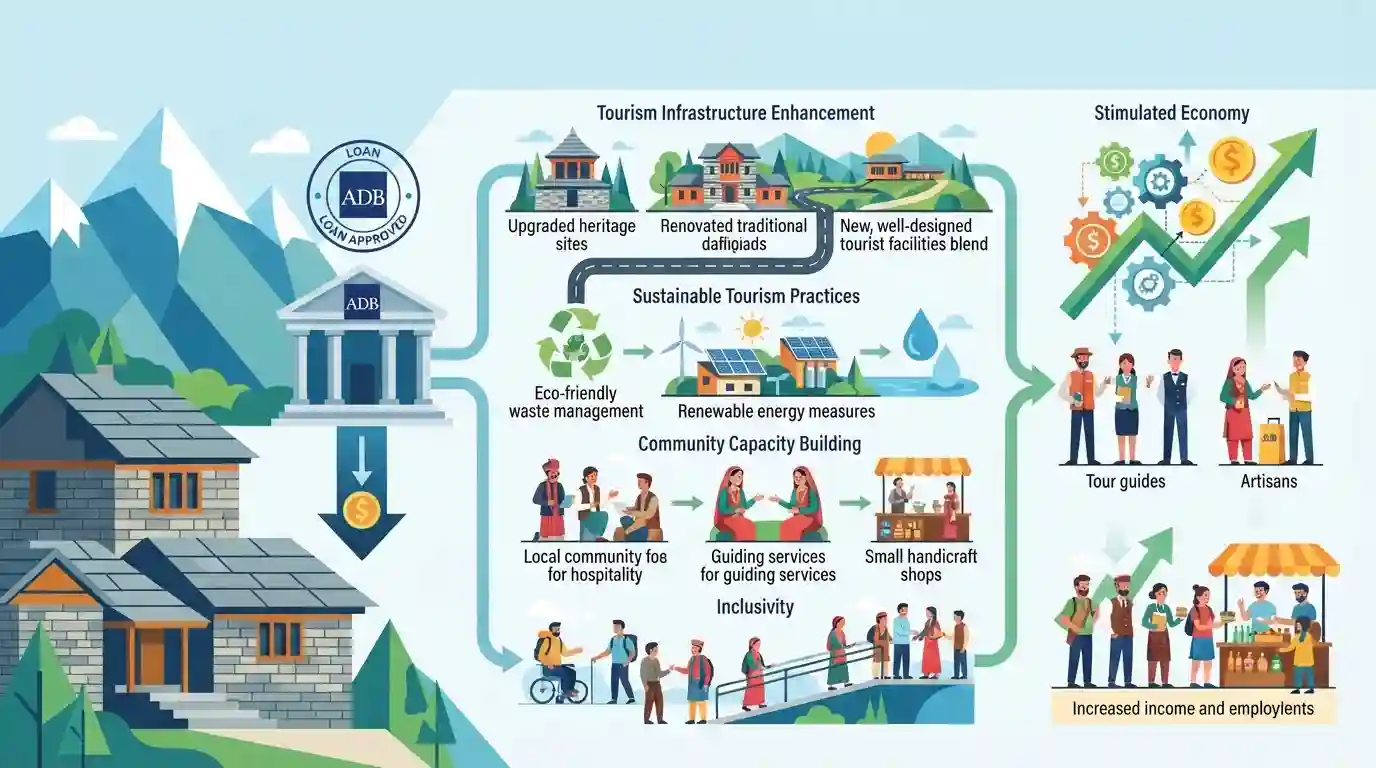
The Asian Development Bank (ADB) has approved a $162 million loan to enhance tourism infrastructure in Himachal Pradesh, India. The project focuses on developing sustainable and inclusive tourism by upgrading heritage and cultural sites, improving connectivity, and building the capacity of local communities. This initiative aims to stimulate the state's economy, which heavily relies on the tourism sector, by generating employment and promoting eco-friendly tourism practices.
Key Points
- The Asian Development Bank (ADB) has approved a $162 million loan to support tourism infrastructure in Himachal Pradesh.
- The funding focuses on upgrading heritage sites, improving tourist facilities, and establishing sustainable and eco-friendly tourism practices.
- The project aims to boost the local economy, generate employment opportunities, and enhance the capacity of local communities in the tourism sector.
- This highlights the significant role of multilateral development banks in financing state-level infrastructure and economic development projects in India.
Important Terms
Asian Development Bank (ADB)

A regional development bank established to promote economic and social progress in the Asia-Pacific by providing loans, grants, and technical assistance for infrastructure and policy projects.
UPSC context
GS Paper 2 (International Institutions). Crucial for evaluating multilateral financing mechanisms and their impact on India's infrastructure development.
Government of India
The federal sovereign authority governing the Republic of India, responsible for negotiating and serving as a guarantor for external developmental loans from multilateral financial institutions.
UPSC context
GS Paper 2 (Federalism). Tests the understanding of sovereign borrowing processes and Centre-State financial relations in externally aided projects.
Government of Himachal Pradesh
The sub-national executive authority of Himachal Pradesh, tasked with implementing localized economic policies and infrastructure programs, such as the ADB-funded sustainable tourism project.
UPSC context
GS Paper 2 (State Executive). Important for analyzing sub-national governance, policy implementation, and regional capacity in managing international development funds.
Prelims Trap
State governments can independently negotiate and secure foreign loans from multilateral banks like ADB.
Under Article 293, States cannot borrow externally on their own. Multilateral assistance is sovereign debt routed through and guaranteed by the Centre (DEA).
Static Concepts Connected
How does the Constitution regulate the borrowing powers of Indian States?
- Article 293(1): States can borrow within the territory of India upon the security of their Consolidated Fund, subject to legislative limits.
- Central Consent: States cannot borrow without Central Government consent if they have any outstanding loans owed to or guaranteed by the Centre.
- External Borrowings: States lack the constitutional power to directly raise external/foreign loans; these are secured via the Union Government.
What is the membership and shareholding structure of the ADB?
- Membership: Unlike some regional banks, it admits members from both the Asia-Pacific region and non-regional developed countries.
- Top Shareholders: Japan and the USA are the largest shareholders (~15.6% each), followed by China and India.
- Voting Power: Voting power is weighted based on capital subscriptions, not a one-member-one-vote system.
Cross-Topic Patterns
State External Borrowing & Fiscal Federalism
State-level multilateral funding (like this ADB loan) highlights the Centre's role (DEA) as an intermediary, linking India's sovereign external debt management with center-state fiscal relations under Article 293.
Himalayan Carrying Capacity & Disaster Mgmt
Tourism infrastructure in Himalayan states is increasingly evaluated against "ecological carrying capacity," linking economic development directly to disaster management following recent Himalayan land subsidence events.

Expect a 2026 Prelims statement combining ADB's non-regional membership rules with Article 293 restrictions on direct state external debt.
Linked PYQs · 2
Linked PYQs · 2
- 2025HPAS_PRELIMSGS1
Consider the following statements : (1) Accelerated Irrigation Benefits Programme was launched in 1996-97. (2) Command Area Development Programme was taken up in 2014-15 (3) Hydrology Project was launched by Government of India with the World Bank assistance in 1974-75 (4) Pradhan Mantri Krishi Sinchayee Yojana was launched during 2015-16. Choose the correct answer from the options given below :
- 2024HPAS_PRELIMSGS1
Arrange the following years based on the number of foreign tourist arrivals in Himachal Pradesh in descending order : (1) 2020 (2) 2021 (3) 2022 (4) 2023 (up to December 2023) Choose the correct option :
