Maharashtra Disaster Management and Himalayan Flood Evacuation
Source:theprint ↗
Why It Matters
This case study is vital for MPSC Combined Prelims as it combines the administrative functioning of disaster management bodies (Disaster Management Act, 2005), international/interstate coordination, and physical geography regarding transboundary Himalayan rivers, monsoon rainfall impacts, and regional border crossings.
Summary
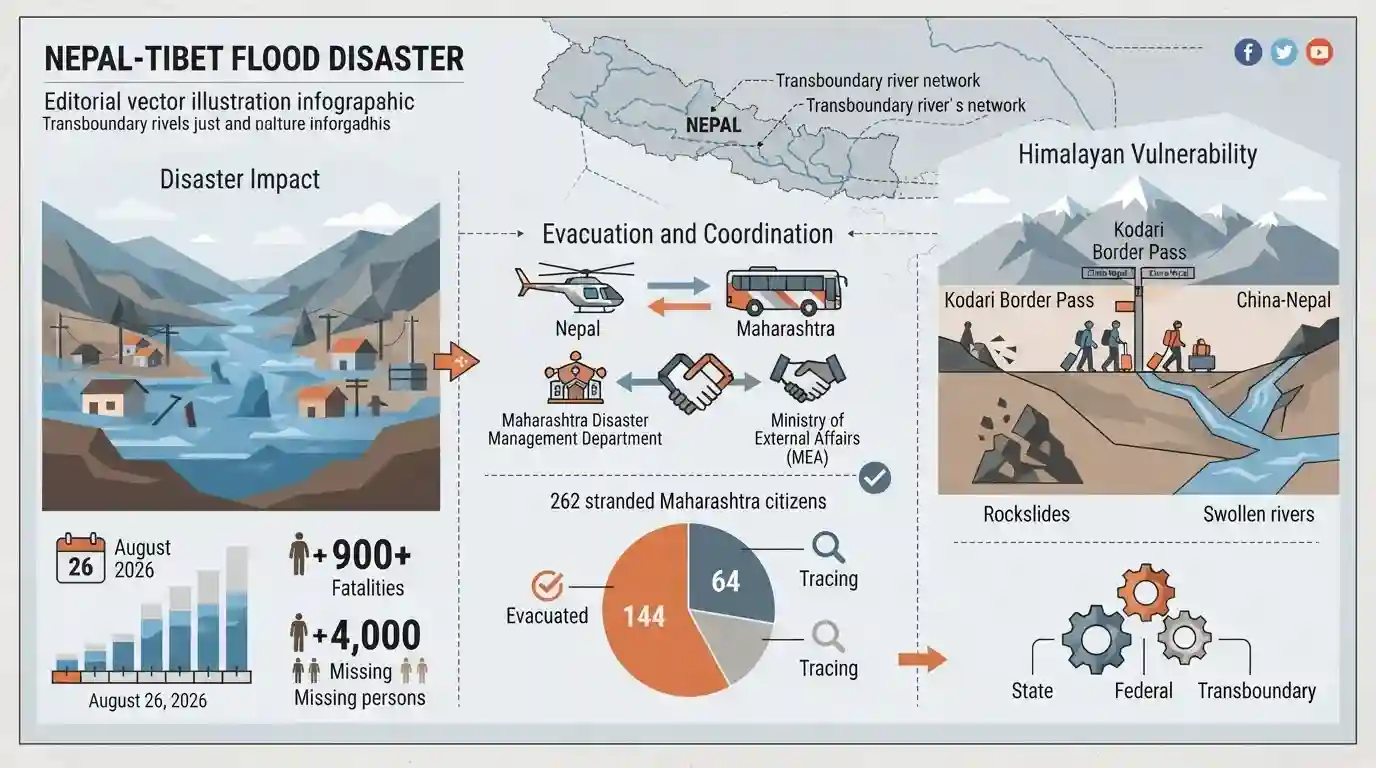
On August 26, 2026, devastating floods hit the Nepal-Tibet region, resulting in a death toll exceeding 900 and leaving over 4,000 people missing, according to Nepal's National Disaster Risk Reduction and Management Authority (NDRRMA). Among those affected, 262 citizens from Maharashtra remained stranded in Nepal and China as of August 31, 2026. The Maharashtra Disaster Management Department, along with the Ministry of External Affairs (MEA), has successfully evacuated 144 citizens and is actively tracing 64 missing individuals. Several stranded citizens entered Nepal through the crucial Kodari immigration centre on the China-Nepal border, highlighting the geopolitical and ecological vulnerability of the transboundary Himalayan corridors.
Key Points
- On August 26, 2026, severe floods struck the Nepal-Tibet region, causing extensive damage, claiming over 900 lives, and leaving more than 4,000 people missing.
- As of August 31, 2026, 262 citizens from Maharashtra remain stranded in Nepal and China, while 144 citizens have been successfully evacuated (105 arriving in Nagpur and 39 in Mumbai).
- Efforts are underway by the Maharashtra Disaster Management Department in coordination with the Ministry of External Affairs (MEA) to trace 64 missing and unreachable individuals.
- At least 69 citizens crossed the China-Nepal border through the Kodari immigration centre to reach Nepal, highlighting the critical role of this cross-border transit point in the Himalayan region.
- The event emphasizes the administrative coordination between state disaster cells and central agencies like the MEA to handle international evacuations and transboundary natural disasters.
Important Terms
Disaster Management Act, 2005

Indian legislation providing a comprehensive national framework for disaster management, establishing authorities at national (NDMA), state (SDMA), and district (DDMA) levels to coordinate risk mitigation, preparedness, and response.
UPSC context
GS Paper 2 (Polity) and GS Paper 1 (Geography); tests statutory frameworks for disaster risk reduction in India.
Maharashtra Disaster Management Department
The state-level administrative body (operating alongside MSDMA) responsible for formulating policy, coordinating rescue and relief operations, and managing emergency communication networks during natural crises in Maharashtra.
UPSC context
GS Paper 1 (Geography/Disasters) and GS Paper 2 (State Admin); tests regional disaster response systems.
Ministry of External Affairs (MEA)
The central government ministry responsible for conducting foreign relations, coordinating diplomatic missions, and executing emergency evacuation and repatriation operations for Indian nationals stranded overseas.
UPSC context
GS Paper 2 (IR/Polity); tests the constitutional role of Union ministries in executing overseas rescue operations.
National Disaster Risk Reduction and Management Authority (NDRRMA)
Nepal's prime statutory central agency responsible for managing disaster risk, executing relief, and coordinating rescue activities, critical for managing transboundary Himalayan ecological hazards.
UPSC context
GS Paper 1 (Geography) and GS Paper 2 (IR); tests transboundary disaster coordination with neighboring nations.
Prelims Trap
All Himalayan streams designated as 'Bhote Koshi' merge into the Kosi river basin before crossing into India.
In Nepal, Rasuwa Bhote Koshi belongs to the Gandak system, whereas Sindhupalchok Bhote Koshi is part of the Kosi system.
Static Concepts Connected
What is the legislative basis and composition of the Maharashtra State Disaster Management Authority?
- Statutory Basis: Established under Section 14 of the Disaster Management Act, 2005, to lay down plans and policies for disaster management.
- Chairmanship: Chaired ex-officio by the Chief Minister of Maharashtra.
- Membership Structure: Reconstituted in 2025 to include two Deputy CMs and a CEO, bringing total membership to 10.
What are the key features of the Gandak and Kosi transboundary river basins?
- Gandak Basin: Known as Narayani in Nepal; fed by Rasuwa Bhote Koshi and Trishuli; enters India at Valmikinagar, Bihar.
- Kosi Basin: Known as Sapta Koshi; fed by Sun Koshi (including Sindhupalchok Bhote Koshi) and Arun; notorious for shifting courses.
Cross-Topic Patterns
State Disaster Tech Autonomy
Integrating IITM's 'BharatFS' with state GeoDSS illustrates Maharashtra's transition toward decentralized, high-resolution meteorological warning systems separate from sole central reliance.
Sino-Nepal Border Corridors
The Kodari-Zhangmu transit point over the Sino-Nepal Friendship Bridge showcases China's strategic infrastructure dominance along India's northern buffer state.

Multi-statement question on Maharashtra's reconstituted 10-member SDMA paired with recent global rescue operations highly likely.
Linked PYQs · 3
Linked PYQs · 3
- 2025MPSC_PRELIMSGS1
As per the Hazardous Waste (Management, Handling and Transboundary Movement) Rules, 2008, the ________ shall be the nodal Ministry to deal with the transboundary movement of the hazardous wastes and to grant permission for transit of the hazardous wastes through any part of India.
- 2025MPSC_PRELIMSGS1
_______ Monsoon winds blow in Maharashtra from June to September.
- 2020MPSC_PRELIMSGS1
Match the following : | (River) | (Details) | |---|---| | (a) The Indus | (i) Rises from semi-arid highlands of Chhattisgarh. | | (b) The Tapi | (ii) Rises in Tibet, near lake Mansarowar. | | (c) The Narmada | (iii) Rises in the Satpura ranges, in the Betul district. | | (d) The Kaveri | (iv) Rises in the Amarkantak hills in Madhya Pradesh. | | | (v) Rises in the Brahmagiri range of the Western Ghats. | Answer Options : (a) (b) (c) (d)
