Vande Mataram Performance and India Unity in Diversity
Source:Indian Express ↗
Why It Matters
Events emphasizing 'unity in diversity' and national symbols like Vande Mataram are highly relevant to the GS Paper 1 syllabus, which covers both the cultural heritage of India and the distinct features of Indian society. Understanding how performing arts foster national integration helps address mains questions on safeguarding cultural heritage and analyzing India's diversity.
Summary
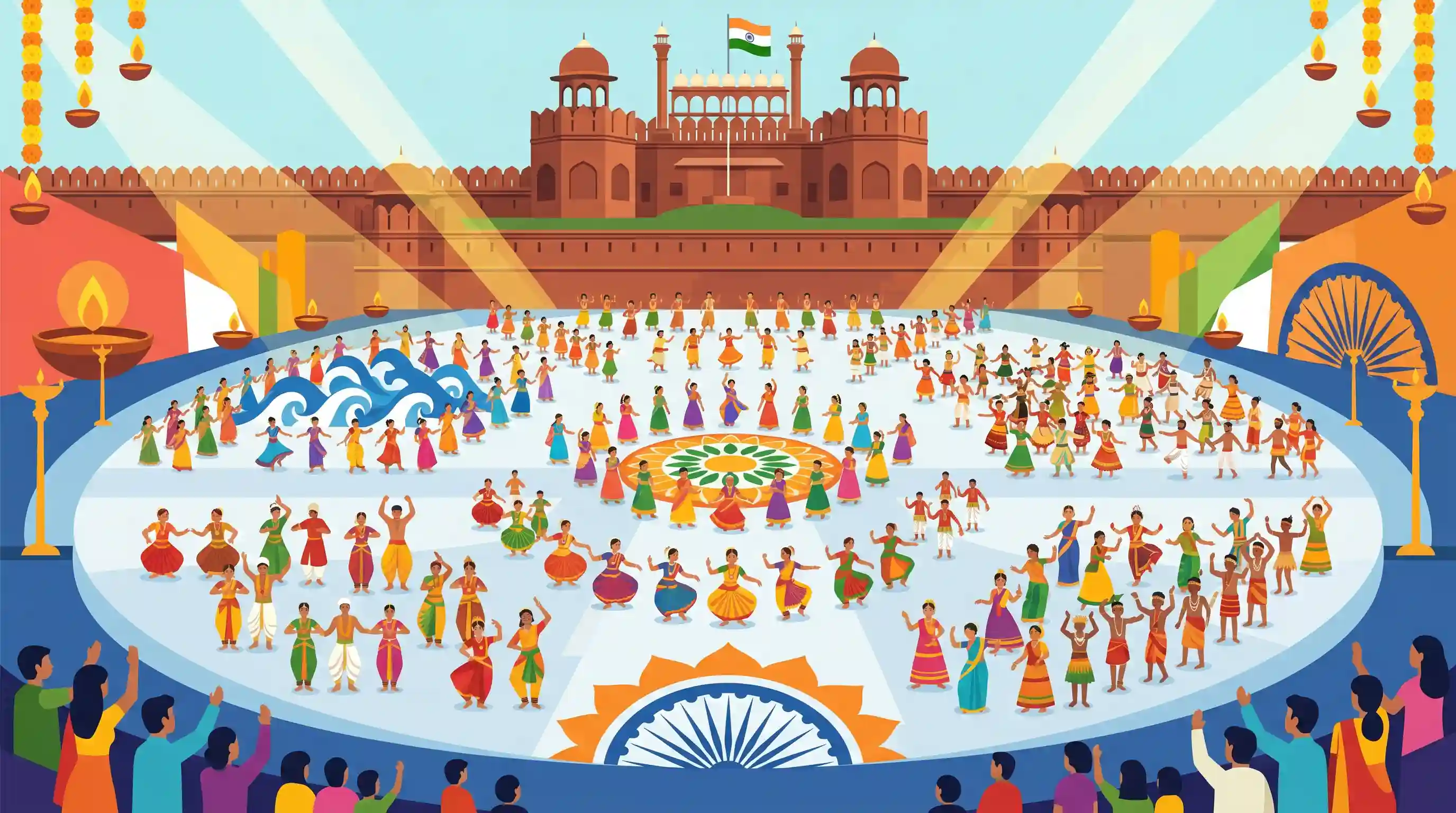
A massive cultural gathering in Delhi saw 2,500 artists come together to perform a dance set to India's national song, Vande Mataram. The event served as a vibrant showcase of the country's rich artistic heritage and its enduring spirit of unity in diversity, bringing together varied cultural elements in a synchronized tribute.
Key Points
- A large-scale cultural event took place in Delhi featuring a performance by 2,500 artists.
- The artists danced to the national song 'Vande Mataram'.
- The performance was designed to embody and celebrate India's core ethos of 'unity in diversity' through cultural expression.
Prelims Trap
Rabindranath Tagore translated both the National Anthem and the National Song into English.
Tagore translated the National Anthem into English at Madanapalle, but the English translation of the National Song (Vande Mataram) was done by Sri Aurobindo. This is a classic substitution trap.
Static Concepts Connected
What is the historical context of Bankim Chandra Chattopadhyay's novel Anandamath?
- Sanyasi Rebellion: Set against the backdrop of the Bengal famine of 1770 and the ascetic uprising against the British East India Company.
- Swadeshi Link: It introduced 'Vande Mataram', which later emerged as the mass rallying cry during the 1905 anti-partition protests.
- First Recitation: The song was first sung on a political platform by Rabindranath Tagore during the 1896 Calcutta session of the INC.
How does the adoption of the National Song compare to the National Anthem?
- Simultaneous Adoption: The Constituent Assembly adopted both Jana Gana Mana and Vande Mataram on January 24, 1950.
- Equal Status: Dr. Rajendra Prasad presided over the declaration that both hold equal constitutional and symbolic status in India.
- Stanza Limitation: Only the first two stanzas of the original Sanskrit-Bengali poem were adopted as the official National Song.
Cross-Topic Patterns
Mass mobilization through vernacular literature
Vande Mataram bridges modern history (Swadeshi Movement) and cultural polity. The British ban on its public recitation underscores the critical role of regional literature in early anti-colonial resistance.
State patronage of cultural integration
Mega-performances align with modern schemes like 'Ek Bharat Shreshtha Bharat', reflecting how the state actively curates art to project the constitutional ideal of 'Unity in Diversity' on national days.

Expect a chronological matching question in 2026 combining the adoption of National Symbols (Flag, Song) with key INC sessions (1896, 1911).
Linked PYQs · 4
Linked PYQs · 4
- 2003PrelimsGS1
Which one of the following statements is correct?
- 2018MainsGS1
Safeguarding the Indian art heritage is the need of the moment. Discuss.
- 2017MainsGS1
In the context of the diversity of India, can it be said that the regions form cultural units rather than the States ? Give reasons with examples for your viewpoint.
- 2024MainsGS1
Critically analyse the proposition that there is a high correlation between India's cultural diversities and socio-economic marginalities.
