Tukaram Mundhe Food Safety Enforcement and Civil Service Probity
Source:Indian Express ↗
આ શા માટે મહત્વનું છે
This profile is a classic case study for GS-4 (Ethics). It highlights the practical challenges—such as frequent transfers and political pushback—faced by civil servants who demonstrate absolute probity and strict adherence to regulations. It also touches upon GS-2 themes regarding the enforcement of public health standards by regulatory bodies like the FDA.
સારાંશ
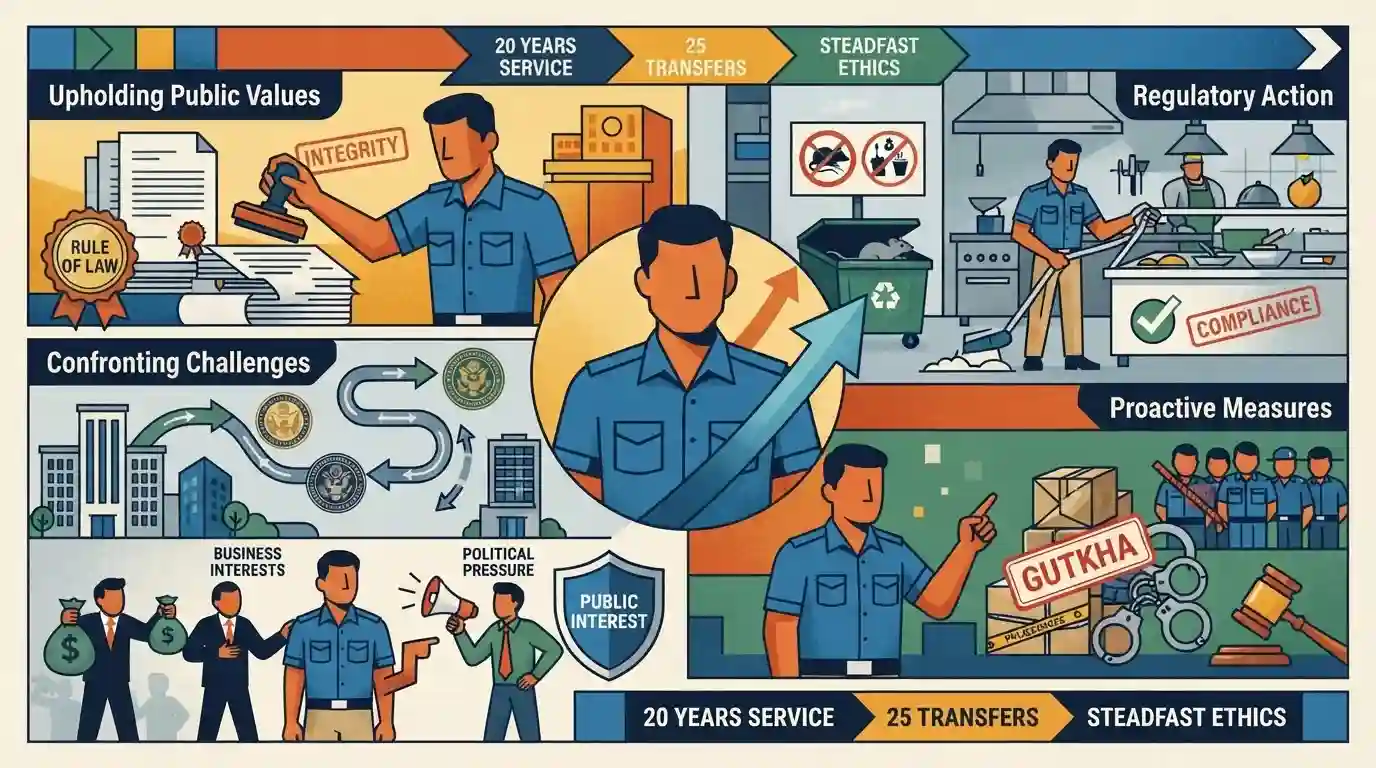
The article profiles Tukaram Mundhe, the current FDA Commissioner of Maharashtra, who has gained a formidable reputation for his strict enforcement of food safety regulations. Under his direction, the FDA has cracked down on several iconic Mumbai restaurants for non-compliance with hygiene standards. Known for his absolute integrity and rigid adherence to the rule of law, Mundhe has faced 25 transfers in a 20-year career. His willingness to employ stringent laws like MCOCA against organized gutkha syndicates demonstrates his proactive approach. The piece serves as a case study of the challenges faced by upright civil servants when confronting entrenched business interests and political pressures.
મુખ્ય મુદ્દા
- Tukaram Mundhe, a 2005-batch IAS officer, currently serves as the FDA Commissioner of Maharashtra, known for his unyielding enforcement of laws.
- During his tenure, the FDA has suspended the licenses of iconic Mumbai establishments for hygiene and food safety violations.
- Mundhe is noted for his uncompromising style, leading to 25 transfers in his 20-year career as a civil servant.
- He has innovatively used stringent laws like the Maharashtra Control of Organised Crime Act (MCOCA) to dismantle gutkha syndicates.
- His strict adherence to rules often places him at odds with political leaders and entrenched business lobbies, sparking debates on the politicization of bureaucracy and the administrative cost of uprightness.
મહત્વપૂર્ણ શબ્દો
Maharashtra Control of Organised Crime Act (MCOCA)

A stringent 1999 state law designed to combat organized crime and terrorism. It grants authorities special powers of surveillance, relaxed evidence rules, and strict bail provisions to dismantle criminal syndicates.
UPSC context
GS Paper III (Internal Security: Organized Crime). Tests knowledge of specialized state legislations and the balance between national security and human rights.
Maharashtra Food and Drug Administration (Maharashtra FDA)
The apex state-level regulatory body responsible for licensing, inspecting, and enforcing safety standards for food, drugs, and cosmetics to protect public health in Maharashtra.
UPSC context
GS Paper II (Regulatory Bodies). Tests understanding of executive enforcement, statutory oversight, and governance mechanisms in safeguarding public health.
Parsi Dairy Farm
An iconic 110-year-old dairy brand in Mumbai that recently had its license suspended by the FDA for severe hygiene and safety violations during a statewide food-safety drive.
UPSC context
GS Paper II/IV (Governance/Ethics). Used as a case study for impartial law enforcement, illustrating that historic legacy does not exempt entities from regulation.
K Rustom & Co.
A legendary 73-year-old ice cream parlor in Churchgate, Mumbai, which had its business license suspended by the Maharashtra FDA due to hygiene and food safety failures.
UPSC context
GS Paper II/IV (Ethics/Governance). Demonstrates the uncompromising application of the "rule of law" over public sentiment and commercial heritage in public health administration.
Noor Mohammadi
A century-old restaurant in Bhendi Bazar, Mumbai, whose food business license was suspended during the FDA’s crackdown on unhygienic practices, highlighting strict state compliance monitoring.
UPSC context
GS Paper II/IV (Governance/Ethics). Examines administrative challenges of food security and the impartial application of health regulations on celebrated local businesses.
પ્રિલિમ્સ ટ્રેપ
Recommendations of the state-level Civil Services Board (CSB) regarding premature transfers of IAS officers are legally binding on State Governments.
Under the IAS (Cadre) Rules, the CSB's role is recommendatory. The State Government remains the final authority but must record written reasons if it departs from the CSB's advice.
સંલગ્ન સ્થિર ખ્યાલો
What is the significance of the T.S.R. Subramanian v. Union of India (2013) judgment?
- Fixed Tenure: Mandated fixed minimum tenures for civil servants to insulate them from arbitrary, politically motivated frequent transfers.
- Civil Services Boards: Directed Centre and States to set up independent CSBs to guide appointments, promotions, and transfers.
- Written Instructions: Ruled that bureaucrats should not act on verbal instructions from political executives to ensure accountability.
આંતર-વિષય પેટર્ન
Cadre Rules vs State Autonomy
Examines how Central amendments mandating Civil Services Boards test federal boundaries, as States often bypass these rules to retain control over bureaucratic postings.
Article 47 vs Organized Crime
Links the DPSP on public health improvement (Article 47) with stringent anti-organized crime laws like MCOCA to tackle illicit gutkha syndicates.

GS4 case study in 2026 likely to test ethical dilemmas of frequent transfers, balancing rigid legal compliance with pragmatic public service.
સંલગ્ન PYQ · 2
સંલગ્ન PYQ · 2
- 2019MainsGS4
In a modern democratic polity, there is the concept of political executive and permanent executive. Elected people's representatives form the political executive and bureaucracy forms the permanent executive. Ministers frame policy decisions and bureaucrats execute these. In the initial decades after independence, relationship between the permanent executive and the political executive were characterized by mutual understanding, respect and co-operation, without encroaching upon each others domain. However, in the subsequent decades, the situation has changed. There are instances of the political executive insisting upon the permanent executive to follow its agenda. Respect for and appreciation of upright bureaucrats has declined. There is an increasing tendency among the political executive to get involved in routine administrative matters such as transfers, postings etc. Under this scenario, there is a definitive trend towards 'politicization of bureaucracy'. The rising materialism and acquisitiveness in social life has also adversely impacted upon the ethical values of both the permanent executive and the political executive. What are the consequences of this 'politicization of bureaucracy'? Discuss.
- 2017MainsGS4
You are an honest and responsible civil servant. You often observe the following: There is a general perception that adhering to ethical conduct one may face difficulties to oneself and cause problems for the family, whereas unfair practices may help to reach the career goals. When the number of people adopting unfair means is large, a small minority having a penchant towards ethical means makes no difference. Sticking to ethical means is detrimental to the larger developmental goals. While one may not involve oneself in large unethical practices, but giving and accepting small gifts makes the system more efficient. Examine the above statements with their merits and demerits.
