Ayushman Bharat Scheme Reach and Public Healthcare Milestones
Source:The Hindu ↗
Why It Matters
The article offers critical data points and milestones on flagship government schemes (Ayushman Bharat, PMJJBY, PMSBY, Sickle Cell Anaemia Mission). These facts are highly relevant for Prelims questions on scheme features/targets and are excellent fodder for Mains GS-2 answers regarding the reach of public healthcare, financial inclusion, and social security.
Summary
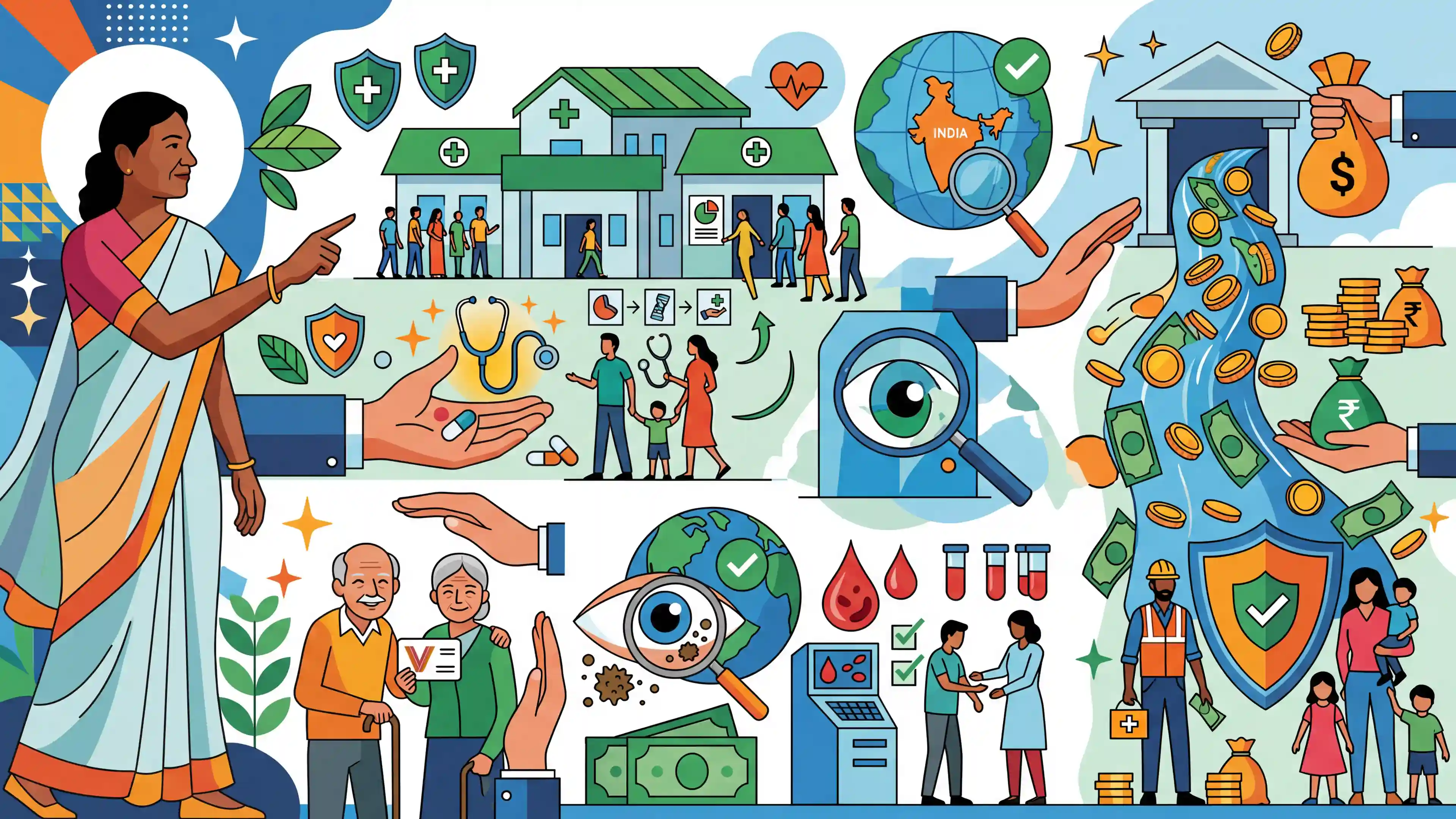
In her address to a joint sitting of Parliament, President Droupadi Murmu detailed the recent achievements of the government's flagship public health and social security initiatives. She highlighted that 2.5 crore people received free treatment under the Ayushman Bharat scheme in the last year alone. The establishment of 1,80,000 Ayushman Arogya Mandirs, the issuance of one crore Vay Vandana cards to senior citizens, and successful disease control programs—including the WHO declaring India free from Trachoma and the screening of 6.5 crore citizens for Sickle Cell Anaemia—demonstrate significant strides in public healthcare. Furthermore, social insurance schemes like PM Jeevan Jyoti Bima Yojana and PM Suraksha Bima Yojana disbursed over ₹24,000 crore in claims, ensuring financial protection for the vulnerable.
Key Points
- Over 2.5 crore people received free medical treatment in the last year under the Ayushman Bharat health scheme, contributing to over 11 crore total treatments.
- Approximately one crore 'Vay Vandana' cards have been issued to senior citizens in the past year and a half, expanding health coverage for the elderly.
- India has strengthened primary healthcare by establishing 1,80,000 'Ayushman Arogya Mandirs' across the country.
- Major public health milestones include screening over 6.5 crore citizens under the Sickle Cell Anaemia Elimination Mission, the WHO declaring India free from Trachoma, and effectively controlling Japanese Encephalitis in states like Uttar Pradesh.
- Financial inclusion and social security schemes like the Pradhan Mantri Jeevan Jyoti Bima Yojana and Pradhan Mantri Suraksha Bima Yojana disbursed claims exceeding ₹24,000 crore.
Important Terms
Ayushman Bharat (PM-JAY)

World's largest government-funded health assurance scheme providing ₹5 lakh annual coverage per family for secondary and tertiary hospitalization to over 12 crore poor and vulnerable families.
UPSC context
GS Paper II: Health/Welfare Schemes. Tests knowledge of universal health coverage and social safety nets for vulnerable populations.
Ayushman Arogya Mandir
Rebranded Ayushman Bharat-Health and Wellness Centres (AB-HWCs) delivering comprehensive primary healthcare, non-communicable disease screening, and wellness services like yoga closer to local communities.
UPSC context
GS Paper II: Health Infrastructure. Evaluates strategies for primary healthcare decentralization and preventive health management.
Ayushman Vaya Vandana Card
A specialized health card providing universal free hospital coverage up to ₹5 lakh annually for all Indian citizens aged 70 and above, regardless of income or socio-economic status.
UPSC context
GS Paper II: Welfare of Vulnerable Sections. Focuses on geriatric care and expanding social security for the elderly.
National Sickle Cell Anaemia Elimination Mission
Launched in 2023 to eliminate sickle cell disease by 2047 through universal screening of 7 crore people, awareness, and genetic counseling, primarily in high-prevalence tribal districts.
UPSC context
GS Paper II: Health/Tribal Welfare. Tests focus on targeted disease control and health equity for marginalized communities.
Pradhan Mantri Jeevan Jyoti Bima Yojana (PMJJBY)
A low-cost, renewable one-year life insurance scheme providing ₹2 lakh coverage for death due to any cause to bank account holders aged 18-50.
UPSC context
GS Paper II/III: Social Security/Financial Inclusion. Evaluates schemes designed for the financial protection of the unorganized sector.
Pradhan Mantri Suraksha Bima Yojana (PMSBY)
An affordable accidental insurance scheme offering ₹2 lakh for accidental death or total permanent disability to individuals aged 18-70 with a bank account.
UPSC context
GS Paper II/III: Social Security. Tests understanding of government-backed risk mitigation for low-income populations.
Prelims Trap
"Vay Vandana Card under Ayushman Bharat is restricted to senior citizens from BPL families."
The newly introduced Vay Vandana Card provides ₹5 lakh annual health coverage to ALL senior citizens aged 70 and above, absolutely irrespective of their socio-economic category or income status.
Static Concepts Connected
What are the two core pillars of the Ayushman Bharat programme?
- PM-JAY: Provides health assurance of ₹5 lakh per family per year for secondary and tertiary care hospitalization to over 12 crore vulnerable families.
- Ayushman Arogya Mandirs: Transforms existing sub-centres and Primary Health Centres to deliver free Comprehensive Primary Health Care (CPHC) closer to communities.
What are Trachoma and Sickle Cell Anaemia?
- Trachoma: A bacterial eye infection caused by Chlamydia trachomatis that can lead to irreversible blindness. WHO recently declared India free from it as a public health problem.
- Sickle Cell Anaemia: An inherited genetic blood disorder causing misshapen red blood cells. India targets its elimination by 2047, heavily focusing on large-scale screening in tribal areas.
Cross-Topic Patterns
Genetic Disease + Tribal Welfare
The Sickle Cell Anaemia Elimination Mission bridges basic science (genetic mutations) with social justice, as the disease disproportionately affects marginalized tribal populations in central and western India.
Financial Inclusion + Social Security
Micro-insurance schemes like PMJJBY and PMSBY demonstrate the maturation of the JAM trinity, converting basic bank accounts into active social safety nets for unorganized sector workers.

Expect a multi-statement Prelims question testing the universal eligibility of 70+ Vay Vandana cards alongside India's Trachoma-free status.
Linked PYQs · 5
Linked PYQs · 5
- 2022PrelimsGS1
With reference to Ayushman Bharat Digital Mission, consider the following statements: 1. Private and public hospitals must adopt it. 2. As it aims to achieve universal health coverage, every citizen of India should be part of it ultimately. 3. It has seamless portability across the country. Which of the statements given above is/are correct?
- 2024MainsGS2
In a crucial domain like the public healthcare system the Indian State should play a vital role to contain the adverse impact of marketisation of the system. Suggest some measures through which the State can enhance the reach of public healthcare at the grassroots level.
- 2018MainsGS2
Appropriate local community-level healthcare intervention is a prerequisite to achieve 'Health for All' in India. Explain.
- 2023PrelimsGS1
Consider the following statements in the context of interventions being undertaken under Anaemia Mukt Bharat Strategy: 1. It provides prophylactic calcium supplementation for pre-school children, adolescents and pregnant women. 2. It runs a campaign for delayed cord clamping at the time of child-birth. 3. It provides for periodic deworming to children and adolescents. 4. It addresses non-nutritional causes of anaemia in endemic pockets with special focus on malaria, hemoglobinopathies and fluorosis. How many of the statements given above are correct?
- 2024PrelimsGS1
With reference to the Pradhan Mantri Jan Dhan Yojana (PMJDY), which of the following statements is/are correct? 1. The scheme aims to open bank accounts for unbanked households. 2. There is a minimum balance requirement for accounts opened under this scheme. 3. Beneficiaries get a Rupay Debit Card with an inbuilt accident insurance cover. Select the correct answer using the code given below.
