Kalaburagi Crop Insurance Payout and Millet Hub Initiative
Source:The Hindu ↗
Why It Matters
Provides concrete examples of government interventions in agriculture, including the implementation of crop insurance payouts through DBT, promotion of sustainable crops (millets), and farm mechanization via Custom Hiring Centres and drones. Highly relevant for GS3 answers on rural distress, technology in agriculture, and nutritional security.
Summary
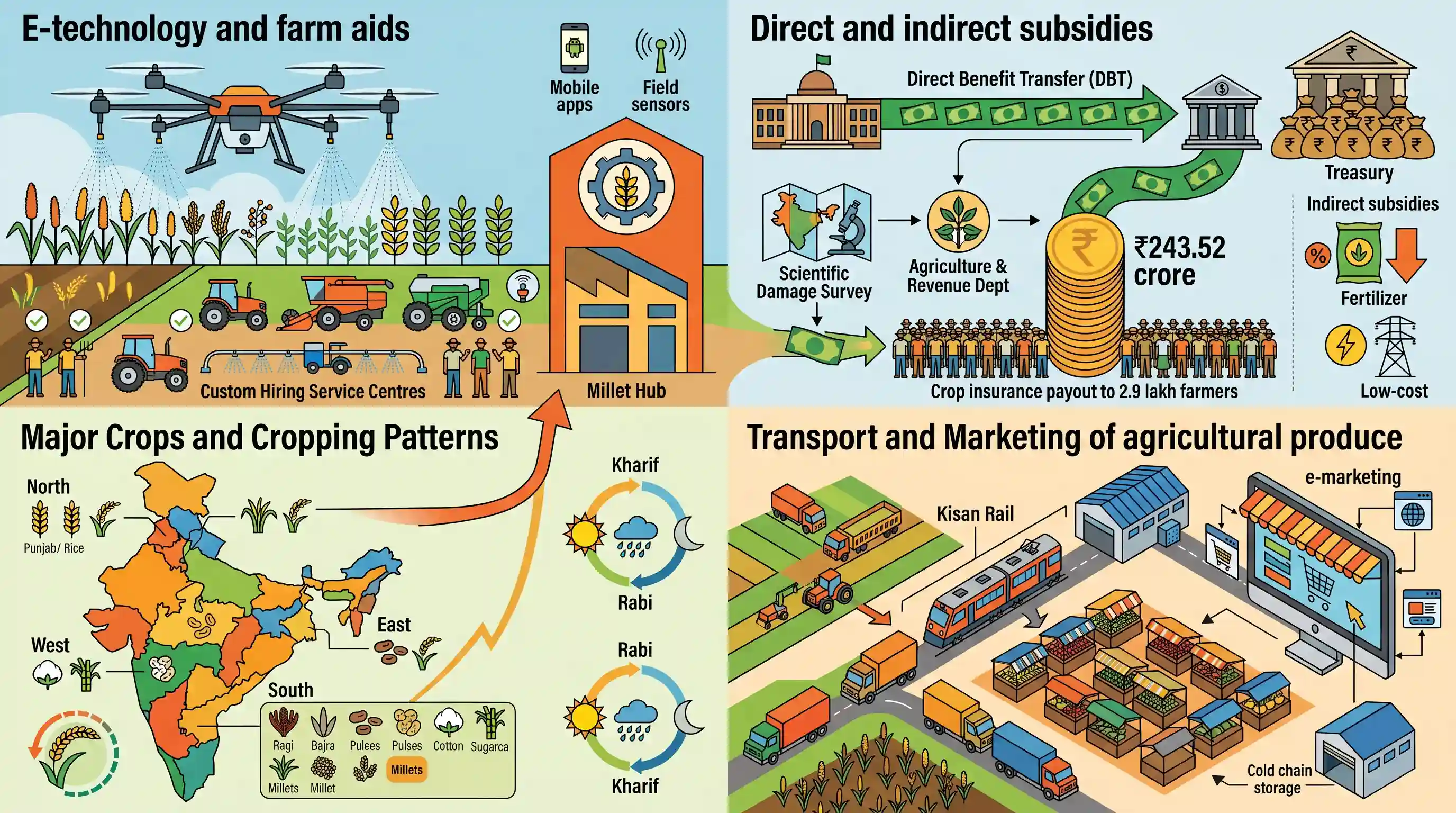
The Karnataka government has released ₹243.52 crore as an interim crop insurance payout to 2.9 lakh farmers in Kalaburagi via Direct Benefit Transfer (DBT), covering Kharif 2024 crop damage. The relief follows scientific damage surveys by the Agriculture and Revenue departments. In tandem with risk mitigation, the state is actively promoting agricultural sustainability and mechanization by proposing a ₹15-crore Millet Hub, expanding Custom Hiring Service Centres for farm machinery, and introducing drone-based agricultural spraying services.
Key Points
- The Karnataka government disbursed ₹243.52 crore as interim crop insurance compensation directly into the bank accounts of 2.9 lakh farmers in Kalaburagi for the Kharif 2024 season.
- Minister Sharanabasappa Darshanapur announced the state's proposal to establish a 'Millet Hub' in Kalaburagi, allocating 10 acres of land and a ₹15-crore budget to promote millet cultivation and processing.
- The district will host a 'Millets Fair-2026' to boost awareness, and plans are underway to add 73 new Custom Hiring Service Centres for renting agricultural machinery to farmers at subsidized rates.
- A scientific crop damage survey was jointly conducted by the Agriculture and Revenue departments to assess losses due to drought, heavy rainfall, and stem rot disease in redgram crops.
- Advanced agricultural technology, such as a drone-based agricultural spraying centre, is being established in the region.
Important Terms
Pradhan Mantri Fasal Bima Yojana (PMFBY)

Central crop insurance scheme providing financial support to farmers for crop loss due to non-preventable natural risks, pests, or diseases. It features uniform low premium rates.
UPSC context
GS III: Agriculture. Relevant for crop insurance, risk mitigation, and financial security of farmers.
Direct Benefit Transfer (DBT)
A mechanism to transfer subsidies and financial assistance directly into the Aadhaar-linked bank accounts of beneficiaries, reducing leakages and ensuring transparency.
UPSC context
GS III: Issues related to subsidies. Tests understanding of digital governance and direct farm support.
Kharif Crops
A cropping season in India where crops are sown with the onset of the southwest monsoon (June-July) and harvested in autumn (September-October).
UPSC context
GS III: Cropping patterns. Essential for understanding Indian agricultural cycles and food security.
Custom Hiring Service Centres (CHSCs)
Hobli-level facilities that provide modern farm machinery and equipment on a rental basis to small and marginal farmers who cannot afford individual ownership.
UPSC context
GS III: Agricultural mechanization. Focuses on technology to improve productivity for smallholders.
Millet Hub
Specialized facilities serving as a single-window system to promote millet cultivation, processing, branding, and market linkages to enhance farmer income and nutritional security.
UPSC context
GS III: Food security and diversification. Linked to climate-resilient agriculture and Nutri-cereals.
Agricultural Mechanization
The use of mechanical power and modern tools (like drones and tractors) to improve agricultural productivity, reduce labor drudgery, and ensure timely farm operations.
UPSC context
GS III: Input productivity. Important for discussions on farm efficiency and labor shortages.
E-technology in Agriculture
Application of digital tools, such as drones for spraying, satellite mapping for damage assessment, and mobile apps for farmer info, to modernize farming.
UPSC context
GS III: E-technology in the aid of farmers. A core syllabus topic for farm innovation.
Prelims Trap
PMFBY interim relief is disbursed only after the completion of final Crop Cutting Experiments (CCEs).
PMFBY explicitly allows mid-season interim relief (up to 25% of likely claims) if adverse seasonal conditions trigger immediate losses, long before final CCEs.
Static Concepts Connected
What are the key operational features of PMFBY?
- Premium Rates: Farmers pay 2% for Kharif crops, 1.5% for Rabi crops, and 5% for commercial/horticultural crops, with the remaining premium subsidized.
- Mid-Season Adversity: Allows prompt relief (up to 25% of sum insured) if prevented sowing or mid-season adversity occurs due to severe weather.
- Post-Harvest Losses: Covers specific perils like cyclones or unseasonal rains for up to 14 days post-harvest for crops kept in fields to dry.
How do Custom Hiring Centres act as an indirect subsidy?
- Accessibility: Allows small and marginal farmers to rent expensive farm machinery on an hourly or daily basis, avoiding heavy capital investments.
- Subsidized establishment: The government provides financial assistance (often 40-80% of project cost) to FPOs, cooperatives, or entrepreneurs to procure machines for these centres.
- Operational efficiency: Helps decentralize farm mechanization, reduces the overall cost of cultivation, and directly addresses peak-season agricultural labor shortages.
Cross-Topic Patterns
Millets + Climate-Smart Nutritional Security
The establishment of Millet Hubs connects GS3 cropping patterns (climate-resilient coarse cereals) with GS2 nutritional security (combating hidden hunger and micronutrient deficiencies).
Kisan Drones + Precision Agriculture
Subsidized drone usage via CHSCs merges 'e-technology in aid of farmers' with precision farming, drastically reducing agrochemical runoff and optimizing input costs.

Expect a multi-statement question in 2026 linking PMFBY interim relief triggers with drone-based damage assessments and DBT architecture.
Linked PYQs · 5
Linked PYQs · 5
- 2015MainsGS3
In what way could replacement of price subsidy with Direct Benefit Transfer (DBT) change the scenario of subsidies in India ? Discuss.
- 2016MainsGS3
Given the vulnerability of Indian agriculture to vagaries of nature, discuss the need for crop insurance and bring out the salient features of the Pradhan Mantri Fasal Bima Yojana (PMFBY).
- 2024MainsGS3
Explain the role of millets for ensuring health and nutritional security in India.
- 2023MainsGS3
How does e-Technology help farmers in production and marketing of agricultural produce? Explain it.
- 2016PrelimsGS1
With reference to 'Pradhan Mantri Fasal Bima Yojana', consider the following statements: 1. Under this scheme, farmers will have to pay a uniform premium of two percent for any crop they cultivate in any season of the year. 2. This scheme covers post-harvest losses arising out of cyclones and unseasonal rains. Which of the statements given above is/are correct?
