United States deports over two thousand Indian nationals this year
Source:The Hindu ↗
Why It Matters
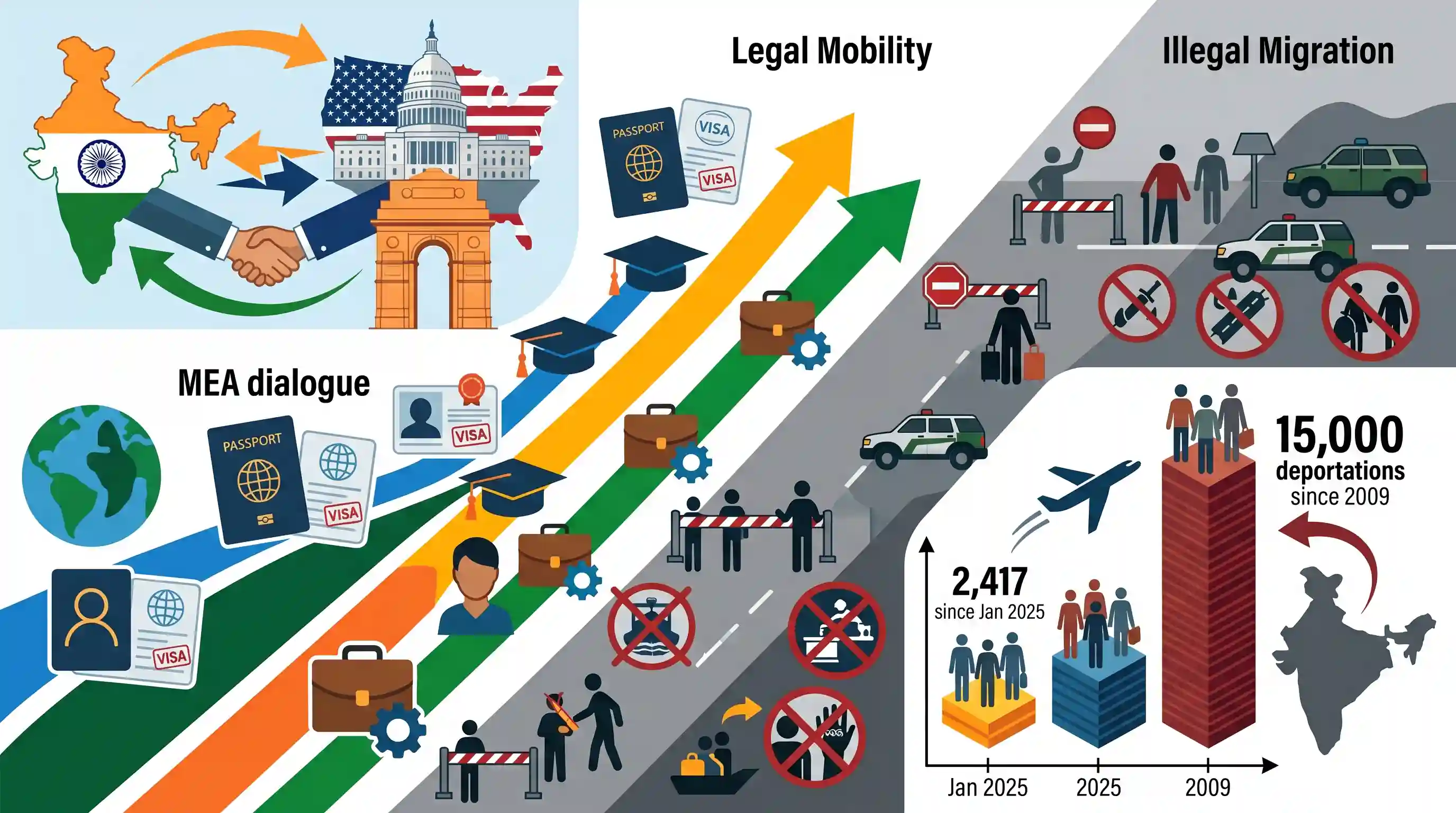
The article touches upon the shadow aspect of the Indian diaspora in the West. While diaspora achievements are widely celebrated, illegal migration and subsequent deportations strain bilateral consular relations and highlight systemic issues involving human trafficking networks (like 'Dunki' routes). It demonstrates the policy priority of the MEA to push for legal mobility frameworks.
Summary
According to the Ministry of External Affairs (MEA), the United States has deported 2,417 Indians since January 2025. MEA spokesperson Randhir Jaiswal affirmed that India opposes illegal migration and is actively seeking to promote pathways for legal mobility. Data shared previously by External Affairs Minister S. Jaishankar revealed that over 15,000 Indians have been sent back from the U.S. since 2009. The ongoing deportations highlight persistent issues with illegal immigration and human trafficking affecting Indian nationals seeking entry into Western nations.
Key Points
- 2,417 Indian nationals have been deported from the United States since January 2025.
- Historically, the U.S. has repatriated or deported over 15,000 Indians since 2009 according to External Affairs Minister S. Jaishankar.
- The Ministry of External Affairs (MEA) reiterated India's opposition to illegal migration.
- India emphasized its ongoing efforts to promote legal pathways and frameworks for international mobility.
Important Terms
Ministry of External Affairs (MEA)

The Government of India executive agency responsible for foreign relations, representing the nation at international forums, and ensuring the welfare of Indian citizens and the diaspora abroad.
UPSC context
GS-II (IR/Governance). Tests knowledge of institutional roles in foreign policy and the protection of Indian interests worldwide.
Illegal Migration
The entry, stay, or employment of foreign nationals in a country without valid travel documents or legal authorization, often causing bilateral diplomatic friction.
UPSC context
GS-II (International Relations) and GS-III (Internal Security). Tests understanding of border management challenges and diplomatic negotiations.
Indian Diaspora
The global community of over 32 million Non-Resident Indians (NRIs) and Persons of Indian Origin (PIOs) who act as a "living bridge" for India.
UPSC context
GS-II (Syllabus: Diaspora). Tests the strategic role of overseas Indians in remittances, lobbying, and soft power.
Human Trafficking
The recruitment or transportation of individuals through force, deception, or coercion for exploitative purposes, such as forced labor or commercial sexual exploitation.
UPSC context
GS-II (Social Justice) and GS-III (Organized Crime). Tests awareness of human rights violations and cross-border security threats.
Legal Mobility Pathways
Formal bilateral frameworks, including Migration and Mobility Partnership Agreements (MMPA), that facilitate safe, documented, and skill-based movement for students and professionals.
UPSC context
GS-II (International Relations). Tests knowledge of modern diplomatic tools used to manage migration and discourage undocumented entry.
Repatriation
The process of returning a foreign national—voluntarily or through deportation—to their country of origin, often requiring nationality verification by the home government.
UPSC context
GS-II (Consular Services). Tests technical understanding of international migration law and the procedural role of diplomatic missions.
Prelims Trap
The UN Global Compact for Migration (GCM) is a legally binding framework signed by India to curb illegal migration.
The UN GCM is a non-binding multilateral framework. Also, UPSC often traps candidates by asserting illegal migration stems solely from absolute poverty, ignoring aspirational migration.
Static Concepts Connected
What are Migration and Mobility Partnership Agreements (MMPAs)?
- Purpose: Bilateral frameworks India signs with developed nations to promote safe, legal pathways for professionals and students.
- Dual Focus: Agreements balance 'brain circulation' (talent exchange) with strict readmission and deportation clauses for undocumented nationals.
- Recent Pacts: India has operationalized these with the UK, Germany, Australia, France, and Italy, replacing informal networks with regulated mobility.
Which Constitutional provisions govern international migration and deportation?
- Seventh Schedule: Entry 17 (Citizenship, naturalisation and aliens) and Entry 19 (Admission into, emigration and expulsion from India) fall exclusively under the Union List.
- Foreigners Act 1946: Empowers the Central Government with absolute authority to regulate the entry, presence, and departure of foreigners in India.
Cross-Topic Patterns
Demographic Dividend vs. 'Dunki' Route
Surging undocumented migration from prosperous states (Punjab, Gujarat) highlights a structural gap between domestic employment quality and youth aspirations, challenging the 'demographic dividend' narrative.
Diaspora Remittances & Current Account
Despite lacking legal status, irregular migrants actively contribute to India's position as the top global remittance recipient, which indirectly cushions India's Current Account Deficit.

Expect a mains question linking the "Dunki" phenomenon to jobless growth, or a prelims statement testing the non-binding nature of UN GCM.
Linked PYQs · 2
Linked PYQs · 2
- 2020MainsGS2
Indian diaspora has a decisive role to play in the politics and economy of America and European Countries'. Comment with examples.
- 2023MainsGS2
Indian diaspora has scaled new heights in the West. Describe its economic and political benefits for India.
