Global Coalition Warns Iran Over Extraterritorial State Terrorism
Source:The Hindu ↗
Why It Matters
Provides a critical contemporary example of the 'state-sponsored terrorism and organized crime nexus' relevant to GS-3 security, while also highlighting the diplomatic complexities of extraterritorial state violence and sovereignty in GS-2 International Relations.
Summary
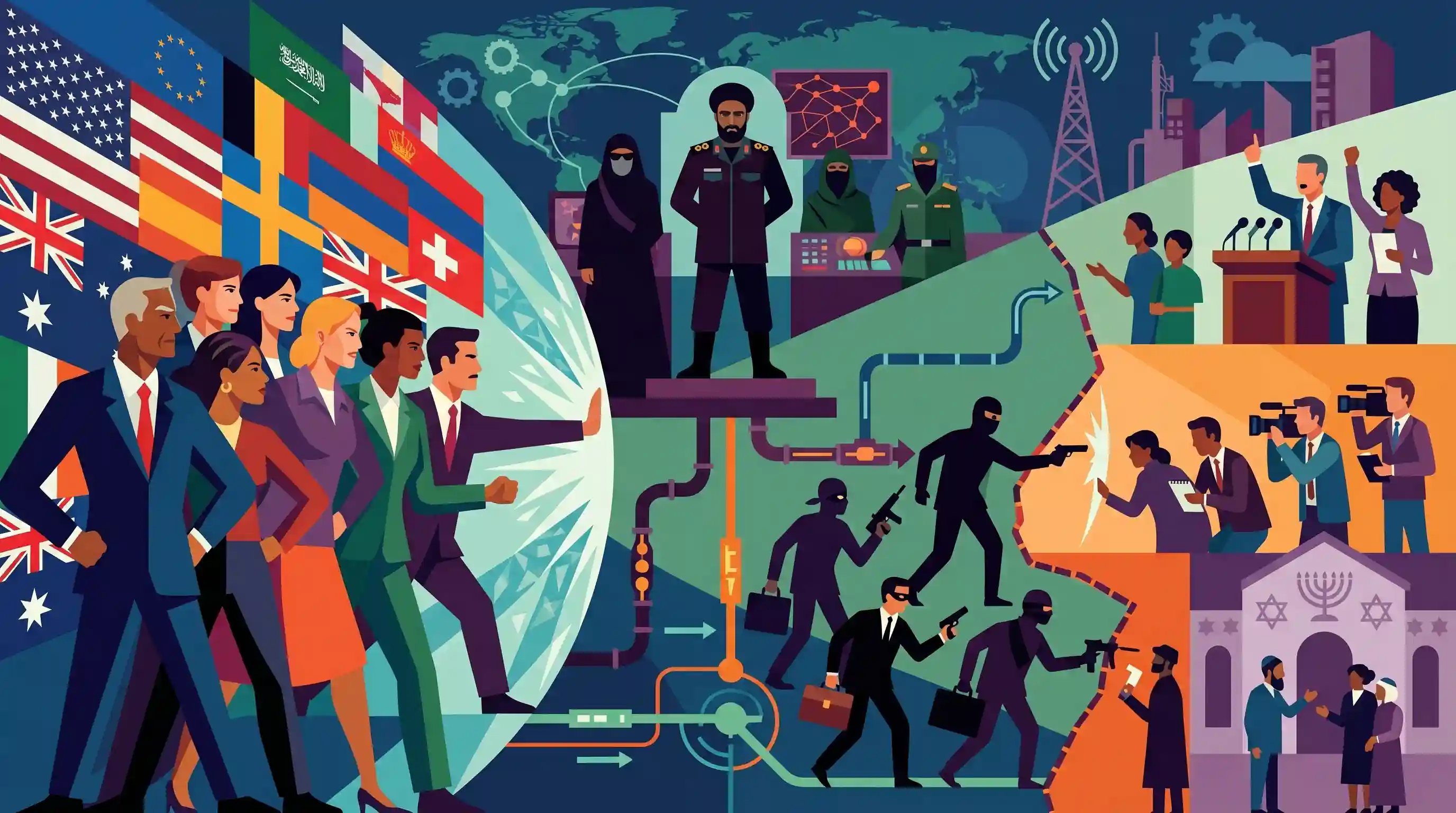
A coalition of 22 countries, including the US, European nations, and Australia, has issued a joint diplomatic warning demanding Iran halt state-sponsored attacks, kidnappings, and assassinations on their sovereign soil. The statement explicitly condemns Iran's intelligence services—including the Islamic Revolutionary Guard Corps (IRGC) and Quds Force—for utilizing organized criminal syndicates to execute lethal plots against Iranian dissidents, journalists, and Jewish communities abroad. The concerted diplomatic rebuke underscores escalating global friction over extraterritorial violence and highlights the increasingly prominent nexus between state intelligence apparatuses and transnational organized crime.
Key Points
- A coalition of 22 nations issued a joint statement demanding Iran cease state-sponsored extraterritorial attacks, assassinations, and kidnappings on their sovereign territories.
- Iran's security services, notably the IRGC and Quds Force, are accused of increasingly outsourcing lethal operations to organized criminal gangs.
- The targeted individuals primarily include Iranian dissidents, journalists, and members of Jewish or Israeli communities.
- The terrorist group Harakat Ashab al-Yamin al-Islamiya (HAYI) has claimed responsibility for recent attacks targeting Jewish communities in the UK, Belgium, and the Netherlands.
- In response to escalating threats, Australia previously expelled the Iranian ambassador and officially designated the IRGC as a state sponsor of terrorism.
Important Terms
Islamic Revolutionary Guard Corps (IRGC)

A major branch of the Iranian Armed Forces established after the 1979 Revolution to protect the country's Islamic system. It operates its own army, navy, air force, and intelligence apparatus.
UPSC context
GS-II/GS-III; essential for understanding West Asian geopolitics, state-sponsored militancy, and India's strategic balancing in the Middle East.
Quds Force
The elite external operations wing of the IRGC, specializing in unconventional warfare and military intelligence. It manages Iran's regional proxy networks, known as the 'Axis of Resistance.'
UPSC context
GS-III: Internal Security/Terrorism; relevant for studying extraterritorial security threats, asymmetrical warfare, and global counter-terrorism efforts.
Harakat Ashab al-Yamin al-Islamiya (HAYI)
A pro-Iranian Islamist group active in 2026, suspected of being a 'fabricated front' for the IRGC to conduct deniable attacks against dissidents and Jewish communities in Europe.
UPSC context
GS-III: Internal Security; illustrates the 'plausible deniability' tactic where state actors utilize shadow groups for transnational violence.
Organized Crime-Terrorism Nexus
A symbiotic relationship where state-sponsored or terrorist groups collaborate with criminal syndicates for funding, logistics, or to execute lethal plots with high deniability.
UPSC context
GS-III: Linkages of organized crime with terrorism; a critical concept for evaluating modern hybrid security threats and intelligence challenges.
Extraterritoriality
The exercise of a state's legal authority or actions beyond its own physical borders, often controversial when involving law enforcement or military operations on another state's soil.
UPSC context
GS-II: International Relations; pertains to national sovereignty, international law, and the diplomatic frictions caused by cross-border state actions.
Prelims Trap
The UN Security Council universally designates Iran's Islamic Revolutionary Guard Corps (IRGC) as a global terrorist organization.
The UN Security Council has not designated the IRGC universally as a terrorist organization; such designations (e.g., by the US or Australia) are unilateral or regional legal mechanisms.
Static Concepts Connected
How do state and non-state actors exploit the organized crime-terrorism nexus?
- Outsourcing violence: State intelligence agencies use criminal syndicates for plausible deniability in executing assassinations and sabotage abroad.
- Financial symbiosis: Terror groups rely on drug, human, and arms smuggling cartels for funding and securing logistical routes.
- Shared infrastructure: Both entities utilize the same hawala channels, money laundering networks, and forged-document rings to evade global law enforcement.
What is the principle of non-intervention in international law?
- UN Charter: Article 2(4) explicitly prohibits the threat or use of force against the territorial integrity or political independence of any sovereign state.
- Customary Law: It forbids states from conducting coercive operations, including targeted assassinations or kidnappings, on another state's soil without explicitly granted consent.
Cross-Topic Patterns
FATF Black List and state proxies
Iran's continued presence on the FATF Black List for terrorism financing is directly linked to the activities of state entities like the Quds Force funding proxy networks and militant groups globally.
Extraterritorial killings and sovereign rights
This mirrors recent global friction over diaspora politics, such as the India-Canada diplomatic row. The weaponization of dissidents on foreign soil is an emerging flashpoint in international law.

The organized crime-terror nexus outsourced by state intelligence (like IRGC) is highly probable as a GS3 Mains 15-marker in 2026.
Linked PYQs · 3
Linked PYQs · 3
- 2022MainsGS3
Discuss the types of organised crimes. Describe the linkages between terrorists and organised crime that exist at the national and transnational levels.
- 2021MainsGS3
Analyse the complexity and intensity of terrorism, its causes, linkages and obnoxious nexus. Also suggest measures required to be taken to eradicate the menace of terrorism.
- 2025MainsGS2
"With the waning of globalization, post-Cold War world is becoming a site of sovereign nationalism.” Elucidate.
