Trans Persons Amendment Bill and Constitutional Morality
Source:Indian Express ↗
हे का महत्त्वाचे आहे
The debate surrounding transgender rights legislation highlights critical issues of constitutional morality, bodily autonomy, and the protection of vulnerable minorities against paternalistic state overreach, directly feeding into GS-2 syllabus themes on social justice and governance.
सारांश
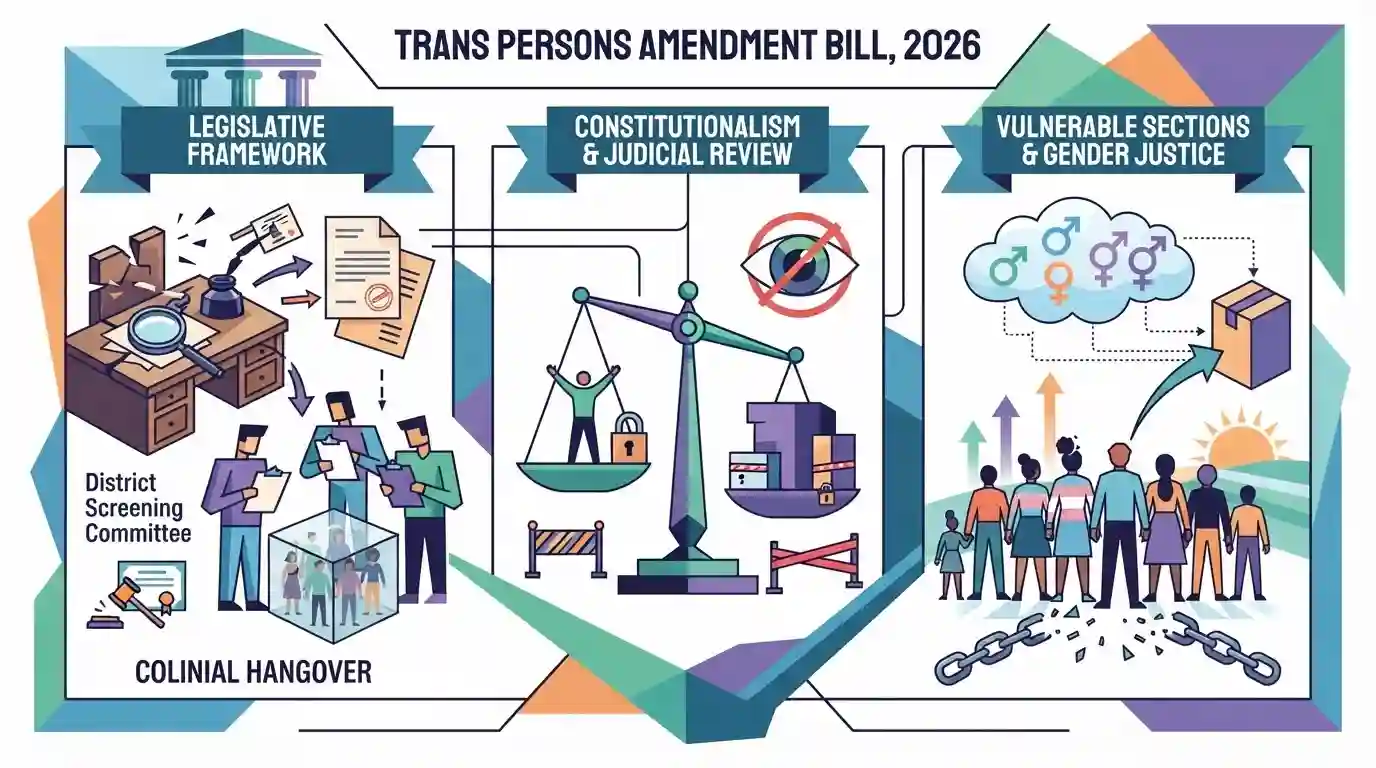
An analysis of the Trans Persons Amendment Bill, 2026, critiquing its provisions as reflective of a colonial hangover, over-surveillance, and a failure to respect transgender self-determination in line with constitutional jurisprudence.
मुख्य मुद्दे
- The Trans Persons Amendment Bill, 2026 has drawn criticism for containing provisions that activists argue reflect a colonial mindset and over-regulate transgender identities.
- Concerns focus on medical surveillance, intrusive verification mechanisms, and state interference in self-determination of gender identity, conflicting with constitutional guarantees under Articles 14, 19, and 21.
- The debate underscores the tension between progressive judicial precedents (such as the NALSA judgment recognizing self-identified gender) and restrictive legislative frameworks.
- The article highlights the ongoing struggle of marginalized gender groups against paternalistic state policies and penal provisions reminiscent of historical criminalization.
महत्त्वाच्या संज्ञा
Trans Persons Amendment Bill 2026

A 2026 legislative proposal modifying India's 2019 transgender framework by narrowing identity definitions and reintroducing restrictive medical requirements, facing criticism for undermining self-determination and constitutional jurisprudence.
UPSC context
GS Paper II (Social Justice / Vulnerable Sections): Tests critical evaluation of legislative measures concerning transgender rights, state overreach, and constitutional guarantees.
Transgender Persons (Protection of Rights) Act 2019
The primary statute enacted in India to protect transgender rights, prohibit discrimination, and outline identity recognition processes, though criticized by activists for paternalistic procedural hurdles.
UPSC context
GS Paper II (Governance & Social Justice): Important for evaluating statutory frameworks, executive implementation, and the rights of gender-minority groups in India.
National Legal Services Authority (NALSA) v. Union of India
A landmark 2014 Supreme Court judgment recognizing transgender persons as a third gender, affirming self-identified gender identity, and establishing fundamental rights protection under Articles 14, 19, and 21.
UPSC context
GS Paper II (Constitution & Judiciary): Core precedent on judicial review, right to privacy, dignity, self-determination, and fundamental rights of vulnerable groups.
पूर्वपरीक्षा सापळा
The NALSA judgment empowered District Screening Committees to medically verify and certify a person's acquired gender identity before legal recognition.
Aspirants often assume the 2014 NALSA judgment mandated a medical board for gender certification, whereas it explicitly affirmed self-identification without surgical or medical intervention.
संबंधित स्थिर संकल्पना
What are the key constitutional underpinnings and judicial rulings governing transgender rights in India?
- NALSA Judgment (2014):: Recognized the right to self-identify gender as an integral part of Article 21 (Right to Life and Personal Liberty) and human dignity.
- Third Gender Status:: Declared transgender persons as the 'Third Gender' for safeguarding their rights under Part III of the Constitution and relevant laws.
- Positive Obligations:: Mandated both Central and State Governments to take steps for social welfare, inclusive education, public health, and affirmative action.
आंतर-विषय नमुने
Judicial Self-Determination vs. Statutory Bureaucracy
Judicial pronouncements upholding fundamental rights under Article 21 frequently clash with executive-led statutory frameworks that mandate bureaucratic verification and administrative gatekeeping.
Colonial Penal Legacies and Modern Welfare
Paternalistic state surveillance over marginalized identity groups echoes historical criminalization statutes, challenging the foundational tenets of constitutional morality.

NALSA judgment principles vs statutory verification mechanisms will feature in a statement-based Polity question on transgender rights.
संबंधित PYQ · 3
संबंधित PYQ · 3
- 2023MainsGS2
Explain the constitutional perspectives of Gender Justice with the help of relevant Constitutional Provisions and case laws.
- 2024PrelimsGS1
Under which of the following Articles of the Constitution of India, has the Supreme Court of India placed the Right to Privacy ?
- 2021PrelimsGS1
'Right to Privacy' is protected under which Article of the Constitution of India?
