Progress report evaluates National Clean Air Programme implementation
Source:energyandcleanair ↗
Why It Matters
Crucial for understanding national environmental governance, pollution control strategies, and the implementation efficacy of key frameworks like NCAP in high-burden regions.
Summary
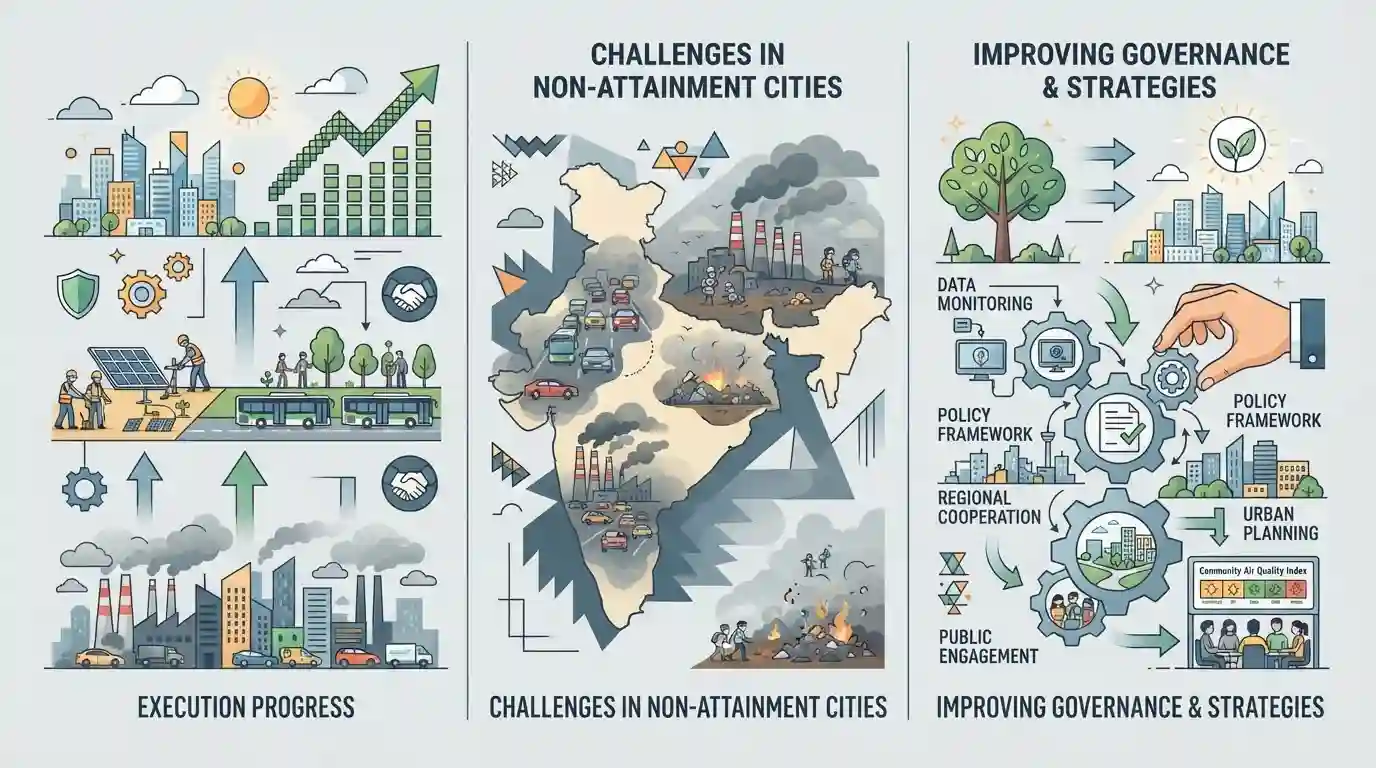
The publication provides an evaluation of the National Clean Air Programme (NCAP), analyzing its execution progress, challenges in non-attainment cities, and strategies for improving air quality governance in India.
Key Points
- The 2026 progress report on the National Clean Air Programme (NCAP) evaluates the performance and implementation gaps of India's flagship air quality initiative.
- NCAP aims to reduce particulate matter (PM10 and PM2.5) concentrations in targeted non-attainment cities.
- Persistent challenges include monitoring coverage, funding utilization, and emission reduction targets across heavily polluted regions like the Indo-Gangetic Plain.
Important Terms
National Clean Air Programme

India's flagship national strategy launched in 2019 by MoEFCC to reduce particulate pollution (PM10 and PM2.5) across targeted non-attainment cities through multi-sectoral city action plans and performance-based funding.
UPSC context
Important for GS Paper III (Environment, Conservation & Pollution Control); frequently tested regarding air quality targets, funding utilization, and urban governance challenges.
National Ambient Air Quality Standards
Nationwide legal standards notified by the Central Pollution Control Board (CPCB) under the Air Act of 1981, defining permissible ambient concentration limits for 12 key air pollutants across India.
UPSC context
Relevant for GS Paper III (Environment Pollution); tests understanding of statutory pollution parameters, CPCB mandates, and ecological standards.
Centre for Research on Energy and Clean Air
An independent, non-profit research organization that tracks air pollution trends, energy sector emissions, and evaluates government policy effectiveness like India's NCAP.
UPSC context
Useful for GS Paper III answers on analytical reports, civil society oversight, and critique of government environmental indices.
Prelims Trap
NCAP aims solely for a 20% reduction in PM10 by 2024 across all Indian districts.
Aspirants often confuse the initial 2024 target with the revised 2025-26 target (40% reduction in PM10) or assume PM2.5 is excluded from the main reduction targets.
Static Concepts Connected
What are the key parameters and targets of the National Clean Air Programme (NCAP)?
- Nodal Ministry: Launched by the Ministry of Environment, Forest and Climate Change (MoEFCC) in January 2019.
- Revised Target: Initially targeted 20-30% reduction in PM10 and PM2.5 concentrations by 2024, later revised to 40% reduction in PM10 by 2025-26 taking 2017 as base year.
- Target Scope: Covers 131 non-attainment and million-plus cities that failed to meet National Ambient Air Quality Standards (NAAQS) for 5 consecutive years.
Cross-Topic Patterns
NCAP & Federal Air Governance
Air quality management across the Indo-Gangetic Plain requires coordinated interstate strategies, linking environmental federalism with Fifth Schedule and river basin governance themes.

NCAP targets (40% reduction by 2026, PM10/PM2.5 baseline 2017) and non-attainment city criteria are prime targets for matching statements.
Linked PYQs · 2
Linked PYQs · 2
- 2020UPPSC_PRELIMSGS1
National Clean Air Programme has been launched by the Central Government in the year
- 2021UPPSC_PRELIMSGS1
Which of the following is indicator of air pollution ?
