Climate Change Increases Heat Risk for 2026 FIFA World Cup
Source:Indian Express ↗
Why It Matters
Illustrates the intersection of climate change with public health and international events. The concept of Wet Bulb Globe Temperature (WBGT) is frequently tested in UPSC regarding heat waves, humidity, and the physiological limits of human survival in a warming world.
Summary
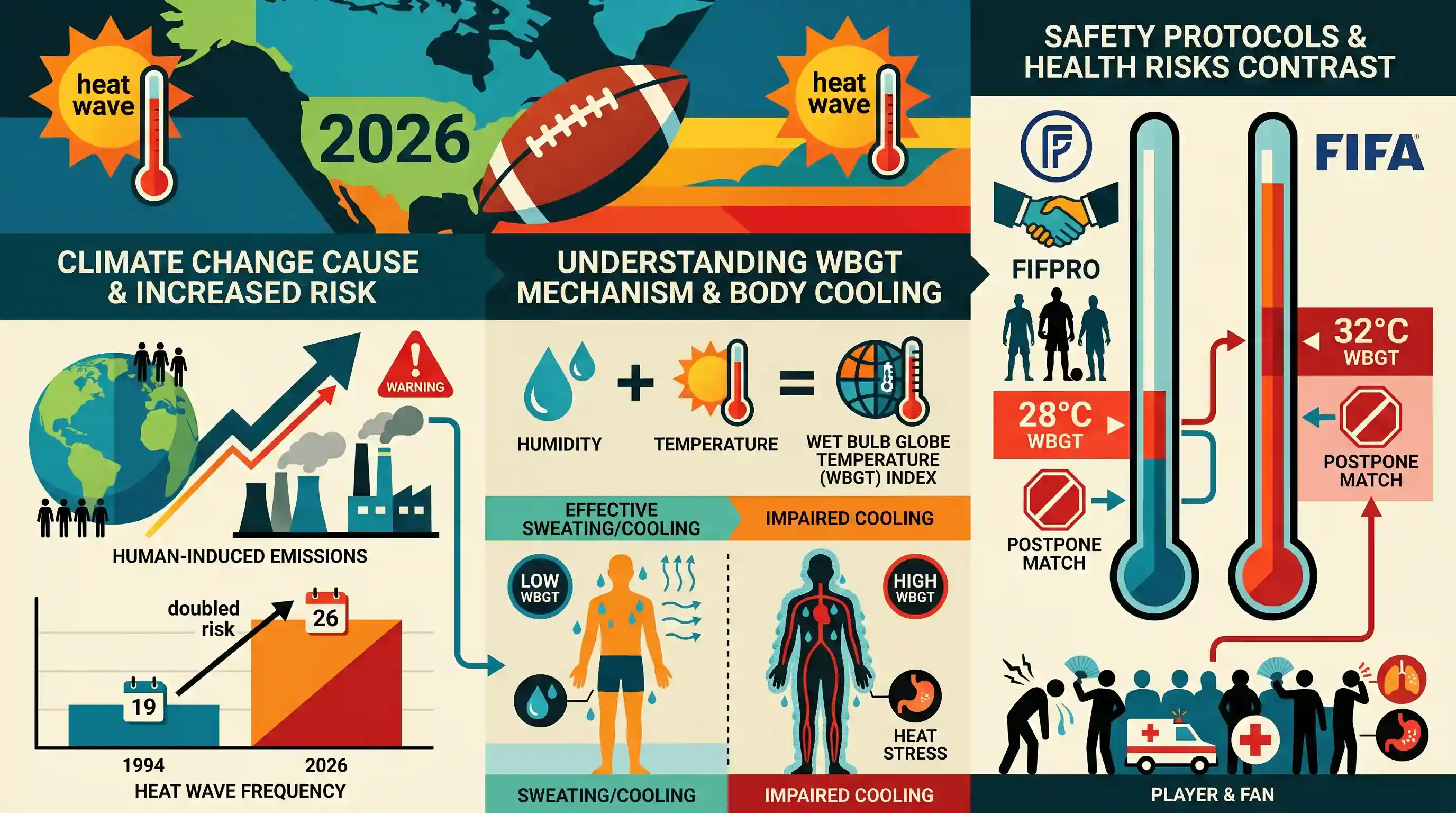
The 2026 FIFA World Cup in North America faces heightened heat stress risks exacerbated by human-induced climate change, according to a World Weather Attribution study. Researchers used the Wet Bulb Globe Temperature (WBGT) index, which accounts for humidity alongside temperature, to assess the dangers. High WBGT levels impair the body's ability to cool down through sweating, risking severe heat-related illnesses among players and fans. The study highlights the need for stringent safety protocols, contrasting player unions' recommendations for match postponements at 28°C WBGT against FIFA's higher threshold of 32°C.
Key Points
- The 2026 FIFA World Cup hosted in North America will face increased heat stress risks, primarily driven by human-induced climate change.
- Researchers utilized the Wet Bulb Globe Temperature (WBGT) index, which factors in humidity, sunlight, and wind, as a more accurate gauge of dangerous heat conditions for athletes.
- High WBGT significantly restricts the human body's ability to shed heat through sweat evaporation, leading to increased risks of heat exhaustion and fatal heatstroke.
- While player unions like FIFPRO recommend cooling breaks at a WBGT of 26°C and postponements at 28°C, current FIFA guidelines only mandate considering postponements at a higher threshold of 32°C.
Important Terms
World Weather Attribution (WWA)

An international scientific collaboration that performs rapid attribution studies to quantify the influence of human-induced climate change on specific extreme weather events.
UPSC context
GS Paper III (Environment); relevant for climate change impacts and attribution science in disaster management.
Wet Bulb Globe Temperature (WBGT)
A composite temperature index measuring heat stress by accounting for air temperature, humidity, wind speed, and solar radiation (radiant heat).
UPSC context
GS Paper I/III (Geography/Disaster Management); critical for modern Heat Action Plans and public health safety thresholds.
FIFPRO
The global representative organization for professional footballers, acting as a trade union to defend players' rights, health, and safety.
UPSC context
GS Paper II/III (Social Justice/Health); relates to labor rights and occupational safety standards in extreme environments.
Attribution Science
A scientific field quantifying the link between human-caused global warming and the likelihood or intensity of specific individual weather events.
UPSC context
GS Paper III (Environment); vital for "loss and damage" frameworks and climate litigation in international forums.
Heat Stress
A state of physiological strain when the body cannot dissipate heat effectively, leading to symptoms ranging from exhaustion to fatal heatstroke.
UPSC context
GS Paper III (Disaster Management); important for studying climate resilience and health impacts on vulnerable populations.
FIFA
The international governing body for association football, overseeing global tournaments and establishing international safety and governance protocols for the sport.
UPSC context
GS Paper II (International Relations); examines the role and influence of global INGOs in international governance.
Prelims Trap
Wet Bulb Globe Temperature (WBGT) is calculated using only ambient air temperature and relative humidity.
WBGT is a comprehensive index that integrates wind speed and solar radiation (sun angle/cloud cover) alongside temperature and humidity. Standard Wet-Bulb Temperature (WBT) only uses the latter two.
Static Concepts Connected
What are the components and limits of the Wet Bulb Globe Temperature (WBGT)?
- Four components: WBGT factors in ambient air temperature (dry bulb), humidity (wet bulb), wind speed, and solar radiation (globe thermometer) for a complete outdoor heat stress profile.
- Survival threshold: A wet-bulb temperature (WBT) of 35°C is the absolute physiological limit; beyond this, the human body cannot cool itself via sweating, leading to fatal heatstroke.
How does extreme humidity alter the human body's thermoregulation?
- Evaporative cooling failure: The body cools primarily through sweat evaporation. High humidity limits the air's capacity to absorb more moisture, destroying the vapor pressure gradient needed for evaporation.
- Hyperthermia risk: When sweating fails to cool the skin, the cardiovascular system strains to shed heat, causing core temperatures to spike and rapidly inducing hyperthermia.
Cross-Topic Patterns
WBT & India's Heat Action Plans
NDMA guidelines are increasingly focusing on wet-bulb metrics rather than dry-bulb temperatures, as humid heat in coastal and eastern India causes fatalities even at lower absolute temperatures.
Heat stress & labour productivity
Rising WBGT links climate change directly to economic output, disproportionately affecting India’s agricultural and construction sectors by forcing mandatory reductions in safe outdoor working hours.

Expect a Prelims statement confusing Wet Bulb Temperature with WBGT, or testing the 35°C WBT survivability threshold in human physiology.
Linked PYQs · 3
Linked PYQs · 3
- 2025PrelimsGS1
The World Bank warned that India could become one of the first places where wet-bulb temperatures routinely exceed 35 °C. Which of the following statements best reflect(s) the implication of the above-said report? I. Peninsular India will most likely suffer from flooding, tropical cyclones and droughts. II. The survival of animals including humans will be affected as shedding of their body heat through perspiration becomes difficult. Select the correct answer using the code given below.
- 2022MainsGS3
Discuss global warming and mention its effects on the global climate. Explain the control measures to bring down the level of greenhouse gases which cause global warming, in the light of the Kyoto Protocol, 1997.
- 2017MainsGS3
'Climate change' is a global problem. How India will be affected by climate change? How Himalayan and coastal states of India will be affected by climate change?
