Economics Nobel Prize and Human Centric Macroeconomics
Source:The Hindu ↗
Why It Matters
It provides a theoretical and policy-oriented perspective on inclusive growth, shifting the focus of economic policy from mere GDP numbers to human welfare and equity, which is vital for GS3 economics syllabus.
Summary
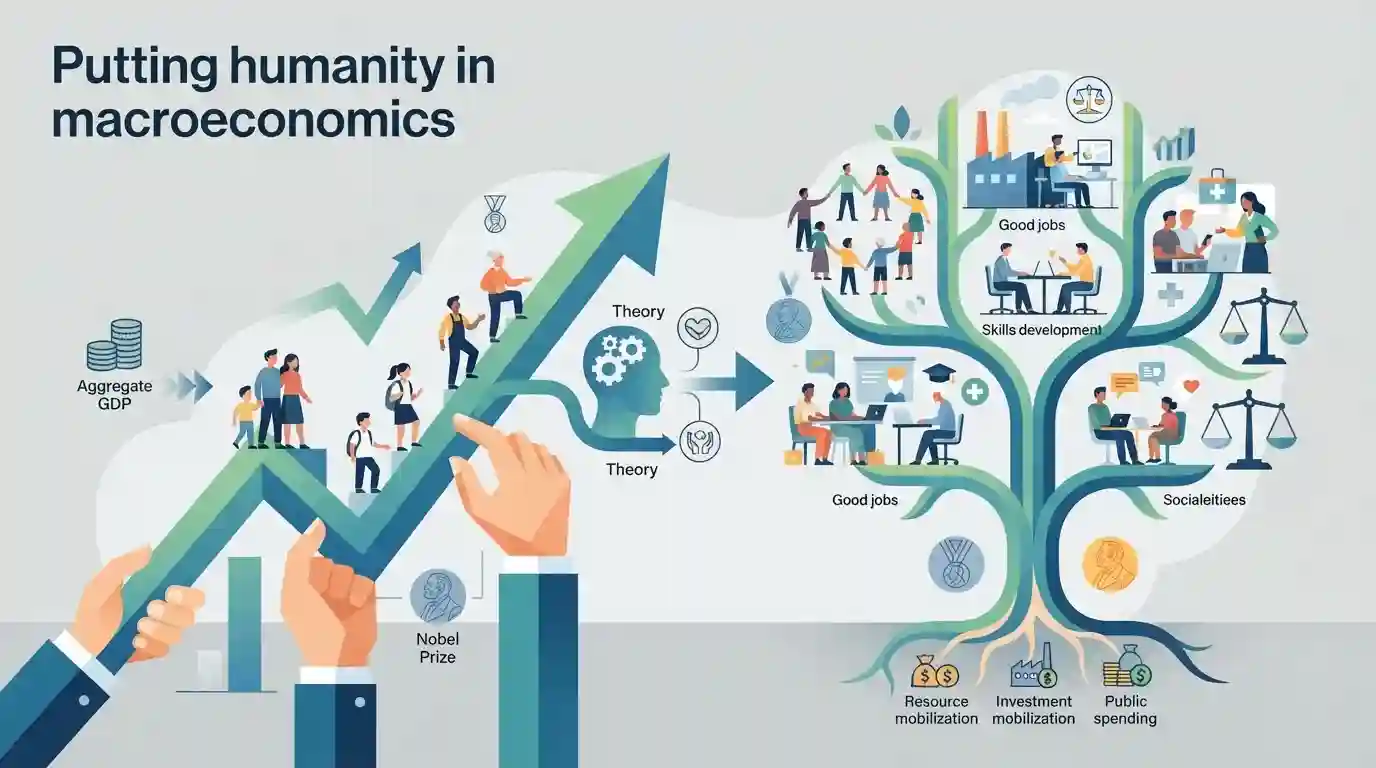
The 2026 Nobel Prize in Economics focused on 'putting humanity in macroeconomics', rewarding research that bridges macroeconomic theory with human welfare, equity, and labor dynamics rather than just focusing on aggregate GDP growth.
Key Points
- The 2026 Economics Nobel Prize highlights macroeconomics that incorporates human welfare, emphasizing that economic growth must directly benefit people and account for human dimensions.
- Shifts the traditional purely quantitative macroeconomic models toward integrating human behavior, labor markets, inequality, and living standards.
- Emphasizes policy frameworks that balance aggregate economic indicators with human-centric outcomes like poverty reduction, job creation, and equity.
Important Terms
Nobel Prize Committee

Bodies appointed by award-granting institutions in Sweden and Norway to evaluate nominations and select laureates for the various Nobel Prizes.
UPSC context
Important for international relations, global awards, and general awareness regarding major intellectual recognitions.
Prelims Trap
The 2026 Economics Nobel focused exclusively on poverty alleviation and inequality metrics without macroeconomic modeling.
Aspirants often assume Nobel laureates in Economics are always honored for pure welfare economics or poverty measurement, missing that New Keynesian macro stabilization and micro-foundations were central here.
Static Concepts Connected
What are the core pillars and policy implications of New Keynesian economics?
- Sticky Prices: Market imperfections assumes sticky prices and wages, allowing monetary policy to have real effects on output and employment in the short run.
- Micro Foundations: Micro-foundations builds macroeconomic models explicitly on utility-maximizing households and profit-maximizing firms rather than arbitrary aggregate equations.
- Monetary Rule: Monetary policy emphasizes the critical role of central bank credibility, forward guidance, and interest rate rules (like the Taylor Rule) in stabilizing business cycles.
Cross-Topic Patterns
GDP vs Human Welfare in Development Economics
Shifting from GDP-centric growth to human welfare frameworks links economic development models with multi-dimensional poverty indices and social sector spending allocations.
Monetary Transmission & New Keynesian Economics
Monetary policy transmission mechanisms through New Keynesian models bridge macro stabilization with central bank communication strategies and financial inclusion.

Expect statement-based questions contrasting traditional IS-LM/real business cycle models with New Keynesian micro-founded macroeconomics.
Linked PYQs · 3
Linked PYQs · 3
- 2020MainsGS3
Explain intra-generational and inter-generational issues of equity from the perspective of inclusive growth and sustainable development.
- 2022MainsGS3
Economic growth in the recent past has been led by increase in labour productivity." Explain this statement. Suggest the growth pattern that will lead to creation of more jobs without compromising labour productivity.
- 2023MainsGS3
Faster economic growth requires increased share of the manufacturing sector in GDP, particularly of MSMEs. Comment on the present policies of the Government in this regard.
