Supreme Court Jurisprudential Shifts and Constitutional Review in 2025
Source:The Hindu ↗
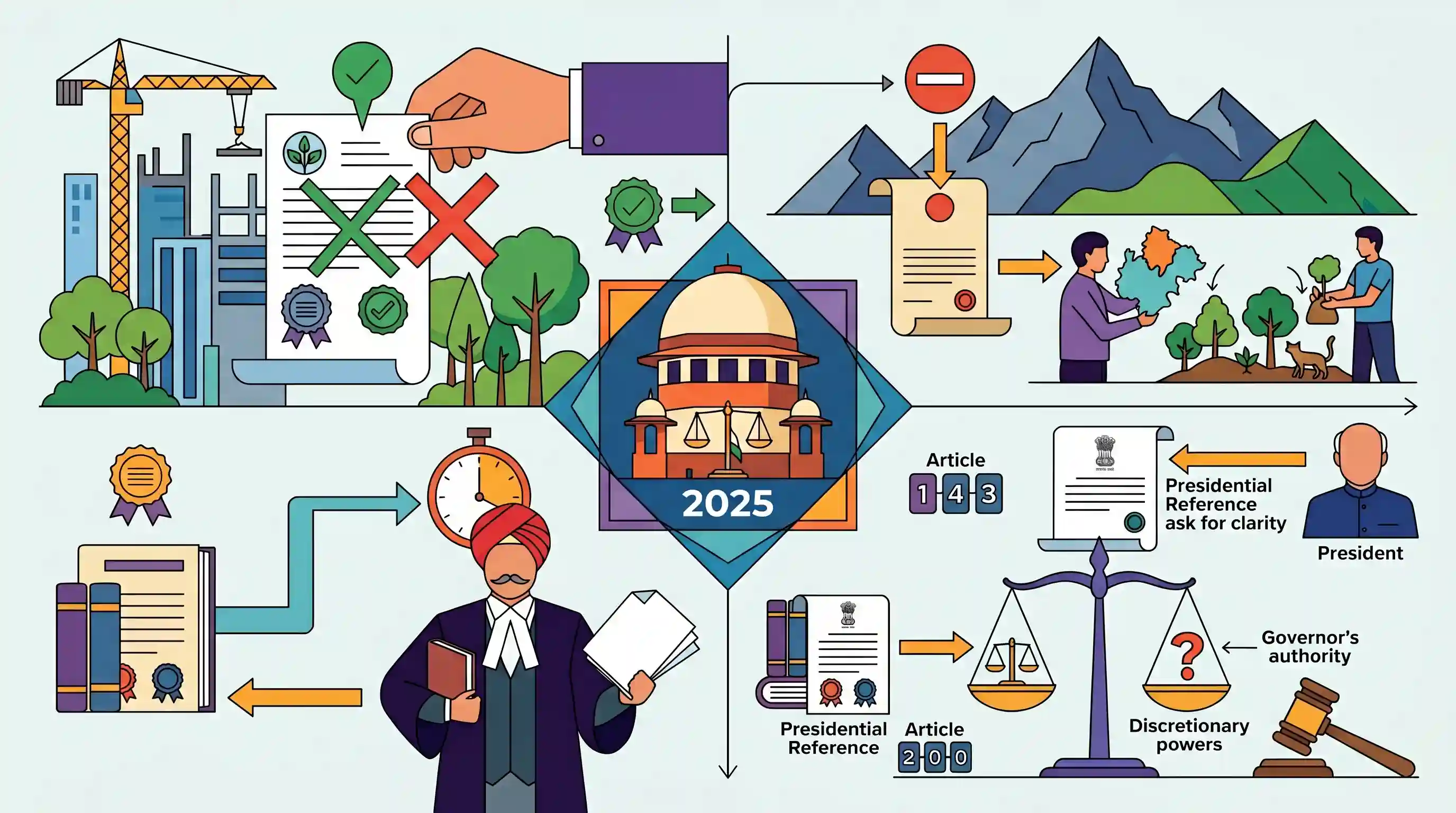
Why It Matters
The article intersects three crucial UPSC themes: the Supreme Court's power to review its own decisions (Article 137), the constitutional friction between Governors and State Governments over Bill assent (Article 200) complicated by the President's advisory jurisdiction (Article 143), and evolving environmental jurisprudence regarding ex-post facto clearances under the EIA framework.
Summary
The year 2025 witnessed the Supreme Court of India exercising its power to recall, modify, or clarify several of its own significant orders. Key examples include the recall of a judgment granting retrospective environmental clearances to construction projects, and keeping in abeyance an order impacting the Aravalli hill ranges to allow states to formulate conservation plans. Furthermore, the Court grappled with the constitutional role of Governors withholding assent to State Bills, balancing a prior judgment directing timely decisions against a new Presidential Reference under Article 143 seeking clarity on a Governor's discretionary powers under Article 200.
Key Points
- The Supreme Court of India in 2025 demonstrated institutional reflexivity by recalling, modifying, or putting in abeyance several of its past judgments.
- In November 2025, a three-judge Bench recalled a May judgment that had allowed ex-post facto environmental clearances for building projects, ruling that prior clearance is a non-derogable condition under the Environment Protection Act.
- The Court kept in abeyance a November 2024 judgment concerning the Aravalli hill ranges, giving state governments an opportunity to frame effective conservation plans.
- A significant constitutional friction emerged over Governors withholding assent to State Bills (Tamil Nadu, Kerala, Punjab); the Court's April judgment mandating timely decisions was challenged by a subsequent Presidential Reference under Article 143 seeking clarity on Governor's powers under Article 200.
- The Court also issued notices on a curative petition to review orders concerning the registration of BS-IV vehicles, and clarified procedures for catching and releasing stray dogs.
Important Terms
Article 200 of the Constitution

Outlines options for Governors regarding State Bills: grant assent, withhold it, return for reconsideration, or reserve for the President's consideration under Article 201.
UPSC context
GS Paper II (Polity); tests understanding of federalism, gubernatorial discretion, and legislative-executive deadlocks.
Article 143 of the Constitution
Empowers the President to seek the Supreme Court's advisory opinion on questions of law or fact of public importance. Opinions are non-binding but carry significant constitutional weight.
UPSC context
GS Paper II (Judiciary); tests knowledge of the Court's advisory jurisdiction and its role in resolving institutional disputes.
Environment Protection Act, 1986
Umbrella legislation providing the framework for protecting and improving the environment. It grants the Central Government power to regulate industrial activities through environmental clearances.
UPSC context
GS Paper III (Environment); key for legal frameworks governing conservation and sustainable development.
National Board for Wildlife (NBWL)
Statutory body under the Wildlife (Protection) Act, 1972, chaired by the Prime Minister. It is the apex authority for approving projects in and around protected areas.
UPSC context
GS Paper III (Biodiversity); tests understanding of institutional mechanisms for wildlife protection and environmental clearances.
Ex Post Facto Environmental Clearance
Approvals granted after a project has already commenced construction or operation without prior mandatory clearance. This practice was reinstated by the Supreme Court in late 2025.
UPSC context
GS Paper III (Environment); tests the balance between the Precautionary Principle and economic development interests.
Environmental Impact Assessment (EIA)
A mandatory process to evaluate the environmental consequences of a proposed project, ensuring mitigation of negative impacts before approval is granted.
UPSC context
GS Paper III (Environment); fundamental concept for environmental governance and administrative decision-making.
Review Jurisdiction
The power of the Supreme Court (under Article 137) to review its own judgments to correct "apparent errors" or address grave injustices.
UPSC context
GS Paper II (Judiciary); tests the self-correcting nature of the highest court and the concept of judicial finality.
Prelims Trap
A State Bill receives 'deemed assent' if a Governor indefinitely delays their decision under Article 200.
The Supreme Court explicitly clarified in its 2025 Presidential Reference that 'deemed assent' is unconstitutional. While Governors must act quickly, automatic assent is invalid.
Static Concepts Connected
What are the Governor's options when presented with a State Bill under Article 200?
- Grant Assent: The Bill becomes an Act and is placed on the statute book.
- Withhold Assent: The Bill ends and does not become an Act. Often used for private members' bills or if the cabinet resigns before assent.
- Return for Reconsideration: Valid only for non-Money Bills. If the legislature passes it again (with or without amendments), the Governor must give assent.
- Reserve for President: Mandatory if the bill endangers High Court powers. Discretionary if it opposes DPSP, national interest, or constitutional provisions.
What is the scope of the Supreme Court's Advisory Jurisdiction (Article 143)?
- Public Importance Questions: The President can seek SC's opinion on questions of law or fact of public importance. The SC is not bound to give an opinion.
- Pre-Constitution Disputes: On disputes arising from pre-constitution treaties, agreements, or covenants, the Supreme Court MUST tender its opinion to the President.
- Non-Binding Nature: The opinion given is advisory. It is not a judicial pronouncement and is not legally binding on the President or the government.
Cross-Topic Patterns
EIA norms vs. Precautionary Principle
Recalling ex-post facto clearances pits the Environment Protection Act's 'precautionary principle' against ease-of-doing-business policies. This executive vs. ecology friction is a high-yield Mains GS3 theme.
Article 200 & Federal Friction
Governor's discretionary power to withhold assent links directly to center-state relations (GS2), tracking with recent controversies where opposition-ruled states (Kerala, TN, Punjab) faced legislative paralysis.

Expect a tough 2026 Prelims statement linking Art 200 (Governor's assent) with Art 143 (Advisory jurisdiction) and judicial review limits.
Linked PYQs · 4
Linked PYQs · 4
- 2021PrelimsGS1
With reference to Indian judiciary, consider the following statements : 1. Any retired judge of the Supreme Court of India can be called back to sit and act as a Supreme Court judge by the Chief Justice of India with prior permission of the President of India. 2. A High Court in India has the power to review its own judgement as the Supreme Court does. Which of the statements given above is/are correct?
- 2022MainsGS2
Discuss the essential conditions for exercise of the legislative powers by the Governor. Discuss the legality of re-promulgation of ordinances by the Governor without placing them before the Legislature.
- 2020MainsGS3
How does the draft Environment Impact Assessment (EIA) Notification, 2020 differ from the existing EIA Notification, 2006?
- 2024MainsGS3
What role do environmental NGOs and activists play in influencing Environmental Impact Assessment (EIA) outcomes for major projects in India? Cite four examples with all important details.
