Supreme Court Jurisprudential Shifts and Constitutional Review
Source:The Hindu ↗
Why It Matters
The article serves as an excellent repository of recent case law relevant to UPSC aspirants studying the Judiciary's review powers (Article 137), the President's advisory jurisdiction (Article 143), gubernatorial powers (Article 200/201), and the balancing act in environmental governance (EIA and urban pollution).
Summary
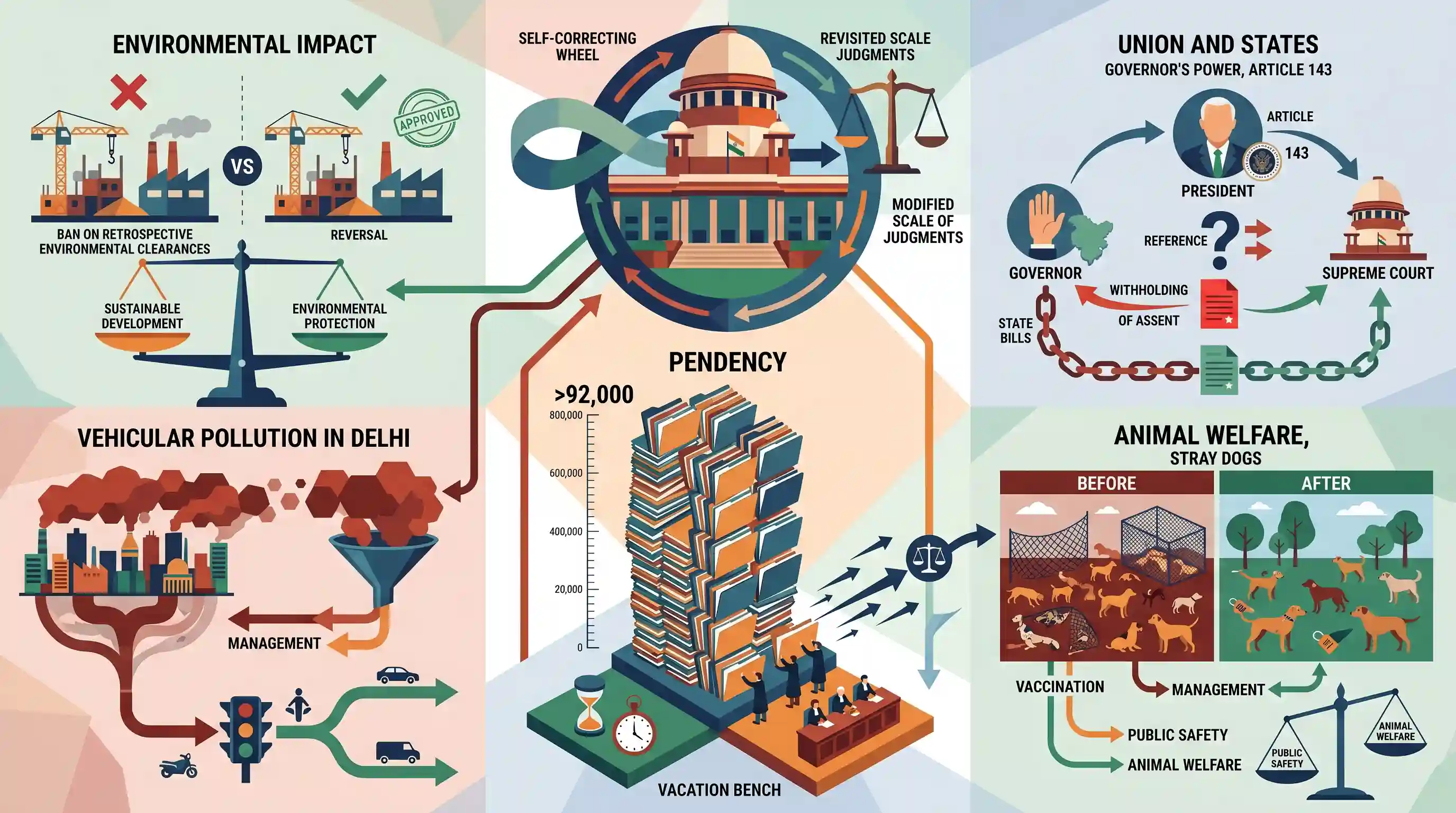
The year 2025 was defined by the Supreme Court of India actively revisiting, modifying, and recalling its own judgments across several constitutional and environmental domains. Notable shifts included reversing a ban on retrospective environmental clearances, altering directives on managing Delhi's severe vehicular pollution, and changing protocols in animal welfare cases. Additionally, the Court addressed a crucial Presidential Reference under Article 143 regarding the powers of Governors to withhold assent to State Bills, diverging from a previous ruling. Despite an all-time high pendency of over 92,000 cases, the Court defended its continuous self-correction and the use of vacation benches to ensure justice delivery.
Key Points
- The Supreme Court's judicial pendency reached an all-time high of 92,118 cases in 2025, even as vacation benches actively convened to manage urgent matters.
- A five-judge Constitution Bench answered a Presidential Reference under Article 143 concerning the timeline for Governors and the President to handle State Bills, altering a prior Division Bench ruling.
- The Court displayed significant shifts in environmental jurisprudence, initially banning retrospective environmental clearances in May before recalling the judgment in November to prevent economic and ecological harm from demolitions.
- In response to severe Air Quality Index (AQI) levels in Delhi, the Court modified its orders on vehicular pollution, pausing coercive action against older BS-IV vehicles.
- The frequent review of its own judgments by the Supreme Court highlighted the institutional mechanism of self-correction under its review jurisdiction.
Important Terms
Presidential Reference

Advisory jurisdiction of the Supreme Court under Article 143, allowing the President to seek the Court's opinion on questions of law or fact of public importance.
UPSC context
GS Paper II (Judiciary). Tests understanding of the Supreme Court's advisory jurisdiction and federal executive-judicial relations.
Article 137
Constitutional provision empowering the Supreme Court to review its own judgments or orders to correct errors apparent on the record or prevent grave injustice.
UPSC context
GS Paper II (Judiciary). Tests knowledge of judicial accountability and the finality of apex court rulings.
Vacation Benches
Special benches constituted by the Chief Justice of India to hear 'urgent matters' during summer or winter recesses, ensuring the court remains technically operational.
UPSC context
GS Paper II (Judiciary functioning). Relevant for debates on judicial pendency and administrative reforms.
Retrospective Environmental Clearance
Environmental approval granted to projects after construction has already commenced; its legality was debated and eventually reinstated by the Supreme Court in 2025.
UPSC context
GS Paper III (Environment). Key for topics like Environmental Impact Assessment (EIA) and Sustainable Development.
Article 200
Constitutional article outlining the Governor's options regarding State Bills: granting assent, withholding it, returning for reconsideration, or reserving it for the President.
UPSC context
GS Paper II (Structure and Functioning of States). Vital for understanding federal tensions and gubernatorial powers.
Deemed Assent
A legal doctrine suggesting a Bill is automatically approved if a Governor fails to act within a timeline; explicitly rejected by the SC in 2025.
UPSC context
GS Paper II (Separation of Powers). Tests knowledge of constitutional boundaries between the judiciary and executive.
Prelims Trap
"The Supreme Court is bound to give its advisory opinion when a reference is made by the President."
Under Art 143(1), the SC may decline to answer. It is only bound under 143(2) (pre-constitutional treaties). The advice is never binding on the President.
Static Concepts Connected
How does the Advisory Jurisdiction of the Supreme Court function?
- Article 143: Allows the President to refer questions of law or fact of public importance to the SC.
- Bench strength: Advisory opinions must be heard by a Constitution Bench comprising a minimum of five judges.
- Discretionary nature: The SC is not obligated to answer references under 143(1), and its advisory opinion is not legally binding on the President.
What are the Governor's options regarding State Bills under Article 200?
- Grant or withhold: The Governor can grant assent or withhold it (which terminates the bill).
- Return: Can return non-Money Bills for reconsideration. If the legislature passes it again, the Governor must grant assent.
- Reserve: Can reserve the bill for the President's consideration (mandatory if the bill derogates High Court powers).
Cross-Topic Patterns
Ex-post facto clearance vs. Environment Jurisprudence
The SC's fluctuating stance on retrospective environmental clearances touches upon the 'Precautionary Principle' vs 'Sustainable Development' debate, a frequent theme in GS3 environment questions.
Governor's Assent & Federal Friction
The lack of a specific timeframe in Article 200 for Governors to act on Bills has required judicial intervention, connecting static Polity with contemporary Centre-State friction.

Expect a multi-statement Prelims question testing the nuances of Article 143 (Advisory) alongside Article 137 (Review Jurisdiction).
Linked PYQs · 5
Linked PYQs · 5
- 2017MainsGS2
Examine the scope of Fundamental Rights in the light of the latest judgement of the Supreme Court on Right to Privacy.
- 2016MainsGS2
What was held in the Coelho case? In this context, can you say that judicial review is of key importance amongst the basic features of the Constitution?
- 2022MainsGS2
Discuss the essential conditions for exercise of the legislative powers by the Governor. Discuss the legality of re-promulgation of ordinances by the Governor without placing them before the Legislature.
- 2014MainsGS3
Environmental Impact Assessment studies are increasingly undertaken before a project is cleared by the Government. Discuss the environmental impacts of coal-fired thermal plants located at coal pitheads.
- 2024MainsGS3
What role do environmental NGOs and activists play in influencing Environmental Impact Assessment (EIA) outcomes for major projects in India? Cite four examples with all important details.
