2025 Physics Nobel Prize and macroscopic quantum effects demonstration
Source:The Hindu ↗
Why It Matters
For UPSC aspirants, tracking Nobel-winning research is critical as it highlights the frontiers of global science. The manifestation of quantum effects at a macroscopic scale is fundamental to understanding how future technological disruptions, specifically quantum computing and communications, will operate and impact national security and the digital economy.
Summary
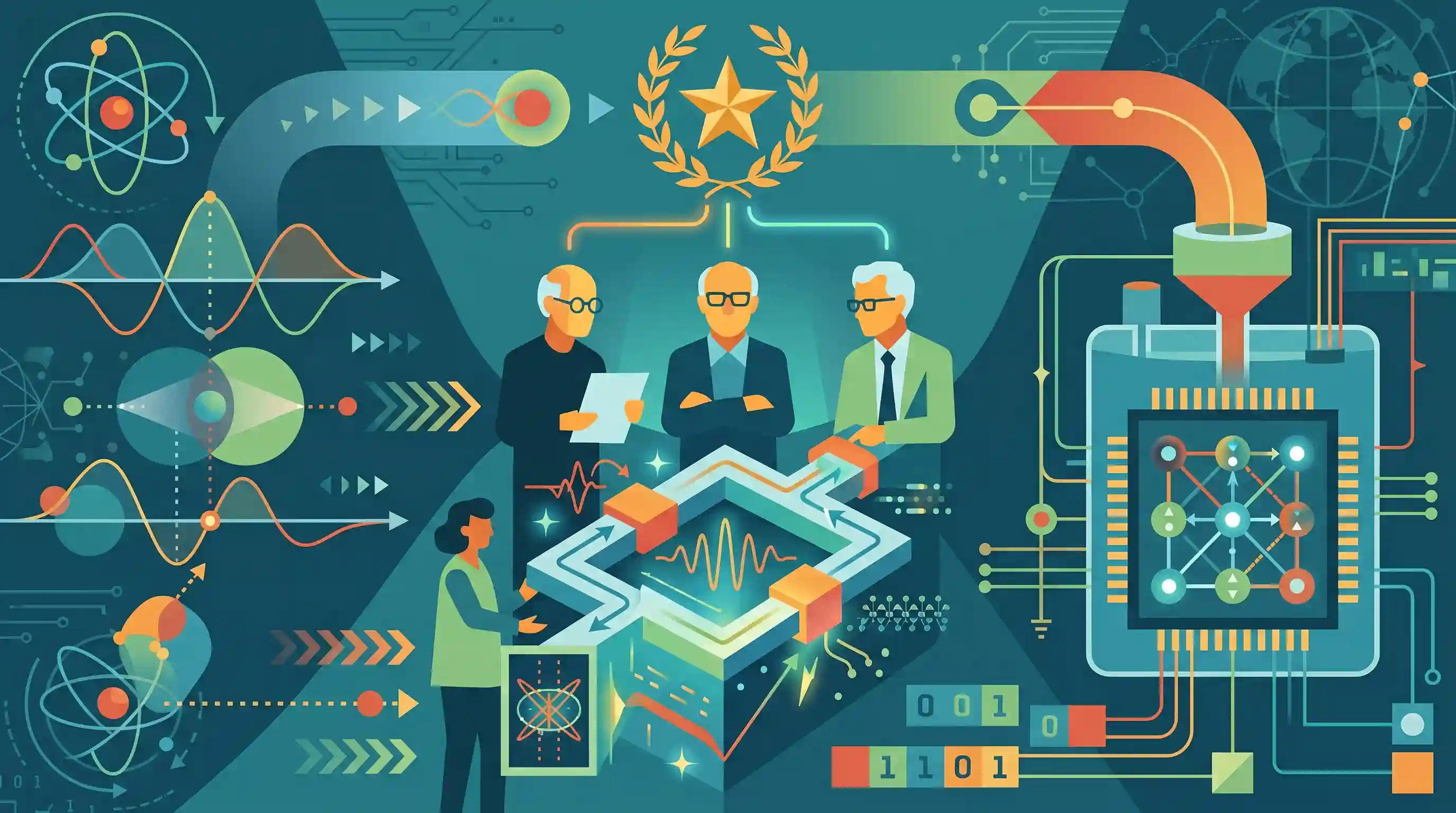
The 2025 Nobel Prize in Physics has been jointly awarded to John Clarke, Michel H. Devoret, and John M. Martinis for their pioneering experimental demonstrations of quantum effects in macroscopic systems. By providing tangible evidence that quantum theory governs phenomena across all scales—bridging the gap between the microscopic and macroscopic realms—their research reinforces the fundamental universality of quantum mechanics. Their contributions are also central to translating theoretical quantum physics into practical engineering, particularly in the advancement of robust quantum computing technologies.
Key Points
- The 2025 Nobel Prize in Physics was awarded jointly to John Clarke, Michel H. Devoret, and John M. Martinis.
- Their award-winning work involves the experimental demonstration of quantum effects occurring within macroscopic systems.
- This confirms that the principles of quantum theory are universal and govern physical phenomena at all scales, rather than being restricted solely to microscopic particles.
- Such advancements form the underlying technological foundation for applied quantum mechanics, most notably the development of superconducting qubits in quantum computing.
Important Terms
Nobel Prize in Physics 2025

Awarded to John Clarke, Michel Devoret, and John Martinis for discovering macroscopic quantum mechanical tunnelling and energy quantisation in electric circuits, bridging the gap between microscopic and macroscopic quantum behavior.
UPSC context
GS Paper III: Recent scientific discoveries; tests awareness of international awards and their impact on global technology trends.
Macroscopic Quantum Tunnelling (MQT)
A phenomenon where a large-scale system (like a superconducting circuit) crosses an energy barrier without having sufficient classical energy, demonstrating that quantum laws apply to visible, engineered systems.
UPSC context
GS Paper III: Applied Physics; crucial for understanding the transition from theoretical quantum mechanics to practical engineering applications.
Josephson Junction
A device consisting of two superconductors separated by a thin insulating barrier. It allows Cooper pairs to 'tunnel' through, serving as the fundamental building block for superconducting qubits.
UPSC context
GS Paper III: S&T Developments; represents the hardware core of current quantum computing technologies and India's National Quantum Mission.
Superconducting Qubits
The basic unit of information in a quantum computer, created using superconducting circuits. Unlike classical bits (0 or 1), qubits utilize quantum properties to perform complex calculations.
UPSC context
GS Paper III: IT and Computers; vital for questions on the future of computation, data security, and encryption.
Energy Quantisation
The principle that energy exists in discrete units or 'packets' rather than a continuous flow. The 2025 laureates demonstrated this effect within macroscopic electrical circuits.
UPSC context
GS Paper III: Fundamental Science; tests understanding of the core differences between classical and quantum physics in technological applications.
National Quantum Mission (NQM)
An Indian government initiative (launched in 2023) to seed, nurture, and scale up R&D in quantum technology, aligning with global breakthroughs like those recognized by the 2025 Nobel Prize.
UPSC context
GS Paper III: Government Policies/S&T; links international discoveries to India's strategic technological goals and self-reliance (Atmanirbharta).
Prelims Trap
"Quantum effects like tunnelling can exclusively occur at the microscopic or subatomic level."
The 2025 Physics Nobel explicitly recognized experimental proof of quantum tunnelling and energy quantisation occurring in macroscopic systems, not just isolated microscopic particles.
Static Concepts Connected
How do superconductors function and what are Cooper pairs?
- Zero Resistance: Materials that conduct electricity with absolutely no electrical resistance when cooled below a specific critical temperature.
- Cooper Pairs: Bound pairs of electrons that move through the superconductor lattice together, enabling frictionless current flow without scattering.
- Meissner Effect: The complete expulsion of magnetic field lines from the interior of the superconducting material.
What is Quantum Tunnelling?
- Classical barrier: In classical mechanics, a particle needs sufficient energy to overcome a physical or potential energy barrier.
- Quantum probability: Due to wave-particle duality, particles have a finite probability of passing "through" a solid barrier they classically shouldn't be able to cross.
- Macroscopic scale: The 2025 Nobel laureates proved this tunnelling phenomenon can occur collectively in systems with billions of particles (macroscopic scale).
Cross-Topic Patterns
India's National Quantum Mission
The Nobel-winning foundational work on superconducting qubits directly underpins the hardware and computing objectives of India’s Rs 6,000-crore National Quantum Mission (2023-2031).
Superconductors & Critical Minerals
Advanced superconducting circuits rely on specific rare earths and critical metals (like Niobium), intimately linking quantum computing advancements to geopolitical critical mineral supply chains.

Macroscopic quantum effects, Josephson junctions, and India's National Quantum Mission will likely merge into a 2026 multi-statement question.
Linked PYQs · 4
Linked PYQs · 4
- 2022PrelimsGS1
Which one of the following is the context in which the term "qubit" is mentioned ?
- 2024PrelimsGS1
Consider the following statements: I. It is expected that Majorana 1 chip will enable quantum computing. II. Majorana 1 chip has been introduced by Amazon Web Services (AWS). III. Deep learning is a subset of machine learning. Which of the statements given above are correct?
- 2008PrelimsGS1
Who among the following scientists shared the Nobel Prize in Physics with his son?
- 2018PrelimsGS1
Consider the following phenomena : 1. Light is affected by gravity. 2. The Universe is constantly expanding. 3. Matter warps its surrounding space-time. Which of the above is/are the prediction/predictions of Albert Einstein's General Theory of Relativity, often discussed in media ?
