Parliament Monsoon Session Clears Key Legislation Amid Disruptions
Source:The Hindu ↗
Why It Matters
Tracking the passage of major Bills is crucial for understanding current legislative trends and policy shifts in areas like shipping, mining, taxation, and sports governance. It also exemplifies the practical functioning of Parliament amidst political friction, a key theme in GS-II Polity.
Summary
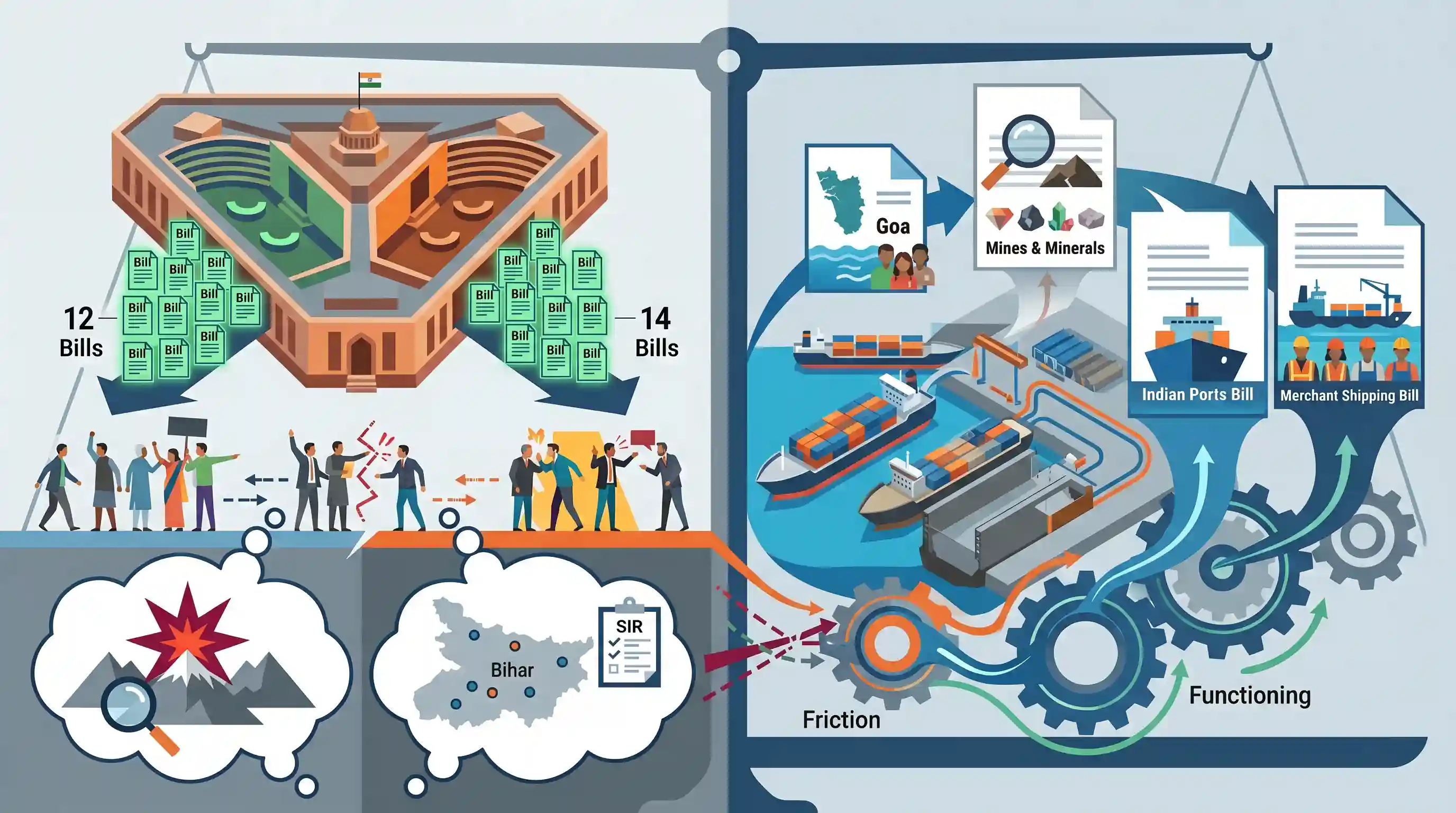
During the 2025 Monsoon Session of Parliament, the Lok Sabha passed 12 Bills and the Rajya Sabha passed 14 Bills, despite frequent disruptions, protests, and walkouts by the Opposition. The disruptions primarily centered around Opposition demands for discussions on 'Operation Sindoor' and the Special Intensive Revision exercise in Bihar. Among the key pieces of legislation cleared were the Readjustment of Representation of Scheduled Tribes in Assembly Constituencies of the State of Goa Bill, the Mines and Minerals (Development and Regulation) Amendment Bill, the Indian Ports Bill, and the Merchant Shipping Bill. The session highlights the ongoing friction in the legislative process, balancing sweeping policy enactments with parliamentary accountability.
Key Points
- The 2025 Monsoon Session concluded with the Lok Sabha passing 12 Bills and the Rajya Sabha clearing 14 Bills.
- Legislative proceedings were heavily marked by persistent Opposition protests and walkouts over demands to discuss Operation Sindoor and the Special Intensive Revision exercise in Bihar.
- Significant economic and infrastructure legislation passed includes the Indian Ports Bill, Merchant Shipping Bill, and Mines and Minerals (Development and Regulation) Amendment Bill.
- Other notable bills address representation and governance, such as the Readjustment of Representation of Scheduled Tribes (Goa) Bill and the National Sports Governance Bill.
- The session underscores the continuing challenge of balancing the government's legislative agenda with the Opposition's demands for debate and accountability.
Important Terms
Readjustment of Representation of Scheduled Tribes in Assembly Constituencies of the State of Goa Bill, 2025

Legislation redrawing Goa's assembly boundaries to reserve four seats for Scheduled Tribes, reflecting their population growth from ~500 in 2001 to over 1.5 lakh today.
UPSC context
GS Paper 2: Elections, Representation, and Constitutional provisions (Article 332) for vulnerable sections. Tests knowledge of delimitation and ST rights.
Merchant Shipping Bill, 2025
A landmark bill replacing the 1958 Act to modernize India's maritime framework, aligning it with IMO standards and easing vessel ownership rules for NRIs and OCIs.
UPSC context
GS Paper 3: Infrastructure and Economic Development. Relevant for maritime security, trade facilitation, and global logistics rankings.
National Sports Governance Bill, 2025
A bill establishing a statutory framework for sports bodies, creating a regulatory National Sports Board and a Dispute Resolution Tribunal to ensure transparency and RTI compliance.
UPSC context
GS Paper 2: Statutory and Regulatory bodies. Tests governance of social sectors and institutional reforms in administration.
Indian Ports Bill, 2025
Legislation replacing the 1908 Act to unify port governance. It formalizes the Maritime State Development Council and mandates State Maritime Boards to improve inter-state coordination.
UPSC context
GS Paper 3: Infrastructure/Ports and GS Paper 2: Federalism. Focuses on Centre-State coordination in maritime administration.
Mines and Minerals (Development and Regulation) Amendment Bill, 2025
Amendment to the 1957 Act to fast-track exploration of critical minerals like lithium and cobalt. It removes captive mine sale limits and establishes electronic mineral exchanges.
UPSC context
GS Paper 3: Natural Resources and Economic Growth. Critical for resource security and 'Atmanirbhar Bharat' in the energy transition.
Manipur Appropriation (No.2) Bill, 2025
A financial bill authorizing the Union to withdraw funds from the Consolidated Fund of Manipur for state expenditure while under President's Rule (Article 356).
UPSC context
GS Paper 2: Indian Constitution and Federalism. Tests understanding of Parliament’s role during the suspension of state legislative powers.
National Anti-Doping (Amendment) Bill, 2025
Amends the 2022 Act to guarantee the operational independence of the National Anti-Doping Agency (NADA) from government influence, aligning India with WADA and UNESCO standards.
UPSC context
GS Paper 2: Governance and International Obligations. Concerns India’s compliance with global conventions and ethical standards in sports.
Prelims Trap
"The National Mineral Exploration and Development Trust (NMEDT) is mandated exclusively for domestic mineral mapping and exploration."
The 2025 MMDR Amendment expands the Trust's mandate to include overseas exploration to secure critical mineral supply chains.
Static Concepts Connected
How is the administration of Major vs. Non-Major ports divided in India?
- Major Ports: Listed in the Union List, these are administered directly by the Central Government under the Major Port Authorities Act, 2021.
- Non-Major Ports: Falling under the Concurrent List, these are governed by State Maritime Boards which are empowered to plan, develop, and fix tariffs.
What differentiates a 'captive' mine from a 'merchant' mine?
- Captive Mines: Allocated for a specific end-use by the leaseholder (e.g., an iron ore mine feeding the owner's steel plant).
- Merchant Mines: Leased purely for commercial mining to sell the extracted minerals in the open market for profit.
- Policy Shift: Successive MMDR amendments (now culminating in the 2025 removal of the 50% cap) have blurred this distinction by allowing open-market sales from captive mines.
Cross-Topic Patterns
Overseas mining + Critical mineral security
The NMEDT's new mandate for overseas exploration aligns directly with India's KABIL joint ventures, aiming to secure critical minerals like lithium and cobalt from Australia and South America.
Port infrastructure + Tribunalization of disputes
Barring civil court jurisdiction in favor of statutory Dispute Resolution Committees for non-major ports reflects the broader governance trend of tribunalization to expedite infrastructure rollout.
Goa ST representation + Delimitation freeze
The Readjustment of ST Representation in Goa links directly to the constitutional freeze on constituency delimitation (84th Amendment) and the broader debate on equitable legislative representation.

MMDR Amendment's removal of captive mine sale limits and overseas exploration mandate makes it a high-probability 2026 Prelims question.
Linked PYQs · 5
Linked PYQs · 5
- 2025MainsGS2
Indian Constitution has conferred the amending power on the ordinary legislative institutions with a few procedural hurdles. In view of this statement, examine the procedural and substantive limitations on the amending power of the Parliament to change the Constitution.
- 2023MainsGS2
Discuss the role of Presiding Officers of state legislatures in maintaining order and impartiality in conducting legislative work and in facilitating best democratic practices.
- 2025PrelimsGS1
Consider the following statements : Statement I: In India, State Governments have no power for making rules for grant of concessions in respect of extraction of minor minerals even though such minerals are located in their territories. Statement II: In India, the Central Government has the power to notify minor minerals under the relevant law. Which one of the following is correct in respect of the above statements?
- 2016PrelimsGS1
What is/are the purpose/purposes of 'District Mineral Foundations' in India? 1. Promoting mineral exploration activities in mineral-rich districts 2. Protecting the interests of the persons affected by mining operations 3. Authorizing State Governments to issue licences for mineral exploration Select the correct answer using the code given below.
- 2023PrelimsGS1
Consider the following pairs: Port Well known as 1. Kamarajar Port: First major port in India registered as a company 2. Mundra Port: Largest privately owned port in India 3. Visakhapatnam Port: Largest container port in India How many of the above pairs are correctly matched?
