Global Climate Extreme Events and Disaster Management Trends
Source:The Hindu ↗
Why It Matters
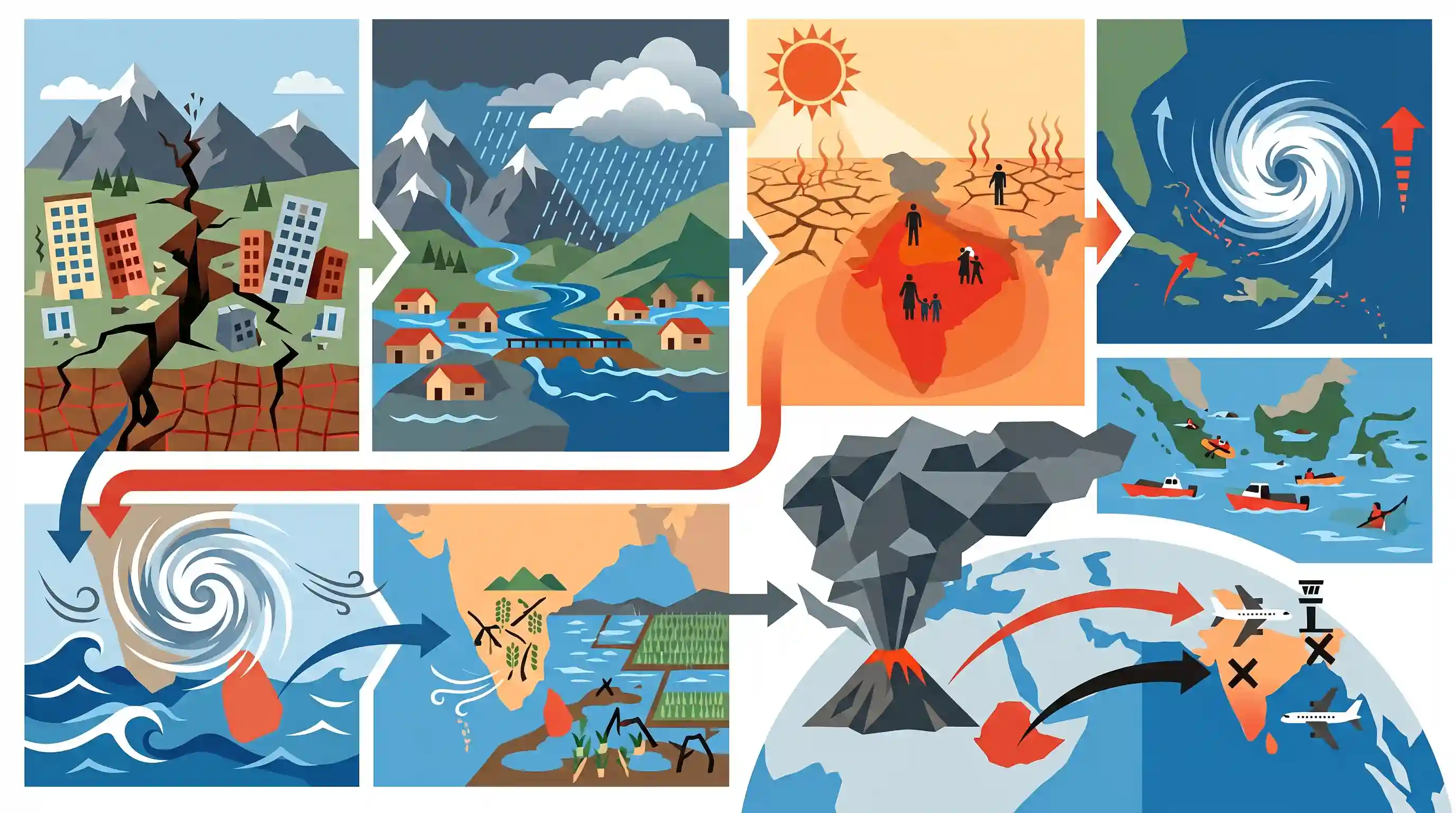
This comprehensive overview of 2025's natural disasters provides vital contemporary examples for Mains answers in GS1 (Geography/Geophysics) and GS3 (Disaster Management). It illustrates cascading hazards, such as cloudbursts causing debris flows in the Himalayas, and demonstrates transnational impacts, like African volcanic ash disrupting Indian aviation.
Summary
The year 2025 was defined by a relentless series of extreme natural disasters across the globe, driven by climate change and geological volatility. Key events included highly destructive earthquakes in Tibet and Myanmar, catastrophic flash floods and cloudbursts in North India (affecting Punjab, Uttarakhand, and Himachal Pradesh), and a prolonged pre-monsoon heatwave impacting over half of India's districts. Other notable disasters were the extreme rapid intensification of Hurricane Melissa in the Caribbean, catastrophic floods in Indonesia's Sumatra, and Cyclone Ditwah, which devastated Sri Lanka before causing significant agricultural losses in South India. Furthermore, an eruption of the long-dormant Hayli Gubbi volcano in Ethiopia sent ash plumes that drifted thousands of kilometers to disrupt Indian aviation, demonstrating the far-reaching transnational impacts of geological phenomena.
Key Points
- The year 2025 witnessed a succession of devastating global natural disasters, inflicting over $200 billion in economic losses worldwide according to Swiss Re.
- Powerful earthquakes in Tibet (magnitude 7.1) and Myanmar (magnitude 7.7) highlighted the high seismic vulnerability of the Himalayan and Southeast Asian regions due to tectonic plate collisions.
- India endured extreme, early pre-monsoon heatwaves, with studies finding that 57% of Indian districts face high to very high heat risk, marking it as a widespread disaster.
- North India suffered catastrophic monsoon impacts in August, including unprecedented flooding of the Sutlej, Beas, and Ravi rivers in Punjab, a devastating debris flow in Dharali (Uttarakhand), and severe cloudbursts and landslides in Himachal Pradesh.
- In a rare geological event, the Hayli Gubbi volcano in Ethiopia erupted after 12,000 years, sending ash clouds across West Asia that directly disrupted Indian airspace and aviation.
- Cyclone Ditwah triggered 1,200 landslides and caused $4.1 billion in damages in Sri Lanka before heavily impacting southern India and ruining extensive paddy cultivation in Tamil Nadu's Cauvery delta.
Important Terms
India Meteorological Department (IMD)

The nodal agency under the Ministry of Earth Sciences responsible for meteorological observations, weather forecasting, and seismology in India. It issues critical alerts for cyclones, heatwaves, and monsoons.
UPSC context
GS Paper I (Geography) & III (Disaster Management). Key for institutional preparedness and early warning systems.
Swiss Re
A leading global reinsurance company whose 'Sigma' reports provide authoritative data on economic and insured losses from natural and man-made catastrophes worldwide.
UPSC context
GS Paper III (Economy/Disaster Management). Relevant for understanding 'protection gaps' and the economic impact of climate change.
Cloudburst
Sudden, intense localized rainfall exceeding 100 mm per hour over a small area (typically 20-30 sq. km), often triggered by orographic lifting in mountainous regions like the Himalayas.
UPSC context
GS Paper I (Physical Geography). Tests understanding of extreme weather events and their impact on hilly terrains.
Heatwave
A period of abnormally high temperatures. IMD declares it when maximum temperatures reach ≥40°C in plains or ≥30°C in hills, or when departure from normal is ≥4.5°C.
UPSC context
GS Paper I/III (Climate Change/Environment). Tests vulnerability, health impacts, and IMD's declaration criteria.
Rapid Intensification (RI)
A phenomenon where a tropical cyclone's maximum sustained winds increase by at least 30 knots (55 km/h) within a 24-hour period, often driven by high sea surface temperatures.
UPSC context
GS Paper I (Geography). Important for understanding how climate change alters cyclone behavior and complicates forecasting.
Flash Flood
A rapid onset flood that occurs within a short period (usually <6 hours) of intense rainfall, cloudbursts, or dam breaches, characterized by high-velocity water flow.
UPSC context
GS Paper III (Disaster Management). Focuses on hazard identification and the management of sudden-onset disasters.
Prelims Trap
Volcanic eruptions in the African Rift Valley cannot impact Indian airspace due to the intervening Arabian Sea.
Volcanic ash plumes can travel thousands of kilometers, carried by upper tropospheric winds, posing severe engine stall hazards to aviation far beyond the source.
Static Concepts Connected
What geographical mechanisms drive high seismic vulnerability in the Himalayan region?
- Continental collision: Ongoing tectonic convergence of the Indian Plate subducting beneath the Eurasian Plate builds immense continuous strain.
- Fault lines: Stress release occurs along major geological thrust zones like the Main Central Thrust and Main Boundary Fault.
- Shallow focus: Himalayan earthquakes are typically shallow-focus, causing significantly higher surface devastation compared to deep-focus tremors.
Why are volcanic ash plumes highly dangerous to commercial aviation?
- Engine failure: Silica in the ash melts inside hot jet engines, forming glass that coats and stalls moving turbine blades.
- Abrasive damage: Microscopic, jagged rock particles severely scratch forward-facing plane surfaces, including windshields, obscuring pilot vision.
- Sensor blockage: Ash clogs pitot tubes and static ports, providing pilots with false and dangerous airspeed readings.
Cross-Topic Patterns
Heatwaves + Disaster Funding mechanics
Despite 57% of districts facing severe heat risk, heatwaves remain unnotified as national disasters under the NDRF, sparking ongoing debates on the 10% flex-fund limit under SDRF.
Geological shocks + Global supply chains
The Ethiopian volcano disrupting Indian aviation mirrors the 2010 Iceland eruption, highlighting how remote geological events expose vulnerabilities in modern, aviation-dependent global supply chains.
Indus Water Treaty + Flood management
Severe flooding in the Sutlej, Beas, and Ravi (Eastern rivers) strains India's domestic dam infrastructure while complicating hydrological data-sharing protocols with Pakistan.

Transnational impacts of volcanic ash on aviation and upper atmospheric circulation will likely feature in 2026 Prelims spatial questions.
Linked PYQs · 5
Linked PYQs · 5
- 2021MainsGS1
Differentiate the causes of landslides in the Himalayan region and Western Ghats.
- 2016MainsGS1
The Himalayas are highly prone to landslides. Discuss the causes and suggest suitable measures of mitigation.
- 2022MainsGS1
Discuss the meaning of colour-coded weather warnings for cyclone prone areas given by India Meteorological Department.
- 2024MainsGS3
Flooding in urban areas is an emerging climate-induced disaster. Discuss the causes of this disaster. Mention the features of two such major floods in the last two decades in India. Describe the policies and frameworks in India that aim at tackling such floods.
- 2019MainsGS3
Disaster preparedness is the first step in any disaster management process. Explain how hazard zonation mapping will help disaster mitigation in the case of landslides.
