National Green Tribunal trends in environmental clearances clearance
Source:Indian Express ↗
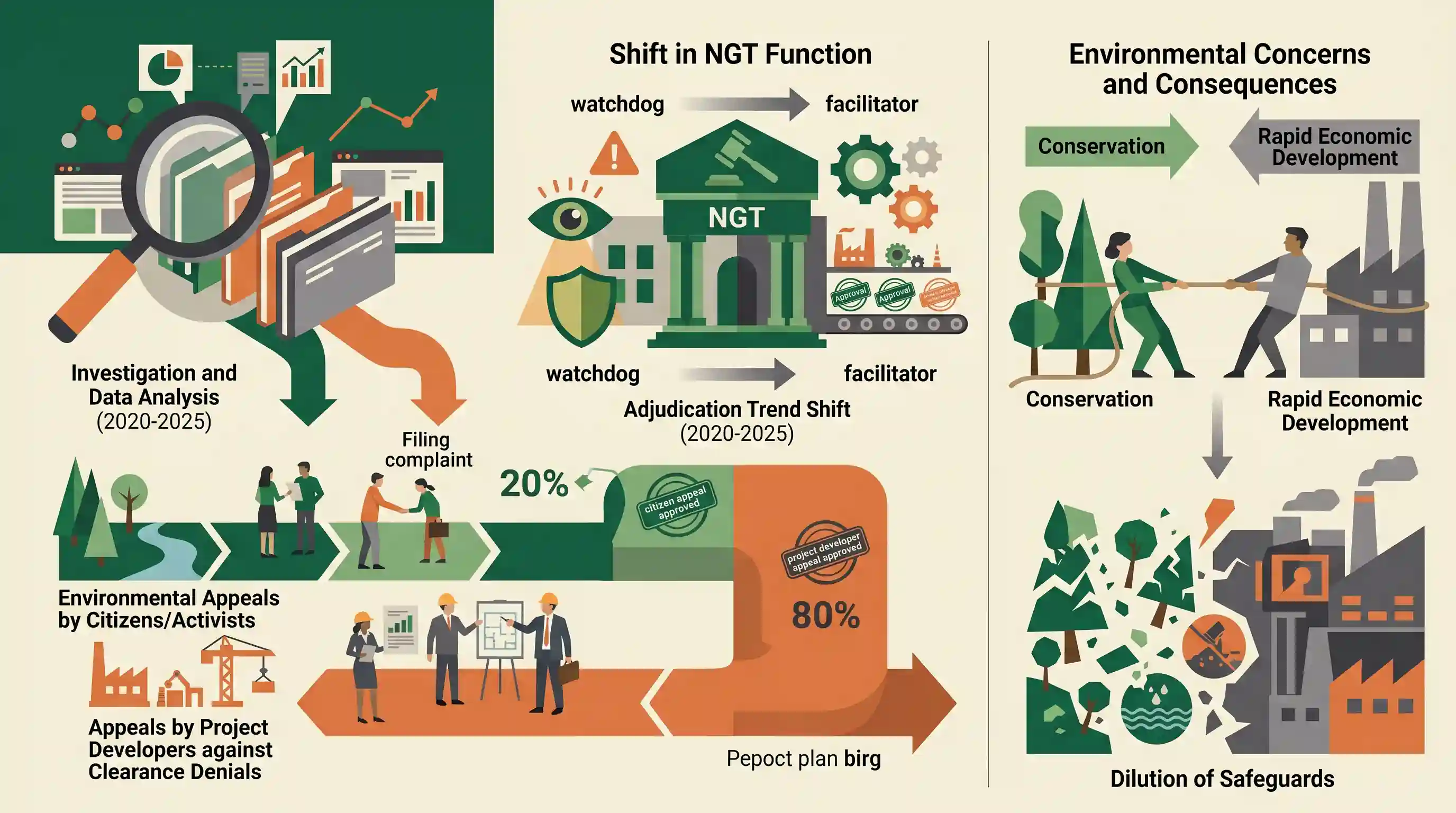
Why It Matters
The article provides critical empirical evidence regarding the NGT's recent jurisprudence and the effective enforcement of EIA norms. It is highly relevant for GS-III (Environment) and GS-II (Statutory Bodies) questions concerning the balance between ecological protection and infrastructure development.
Summary
An investigation into the functioning of the National Green Tribunal (NGT) between 2020 and 2025 reveals a significant shift in its adjudication pattern. The tribunal ruled in favor of project developers in 80% of appeals filed against environmental clearances. This trend has raised concerns among environmentalists that the statutory body is moving away from its mandate as a green watchdog, instead acting as a facilitator for big projects, thereby risking the dilution of environmental safeguards in favor of rapid economic development.
Key Points
- Between 2020 and 2025, the National Green Tribunal (NGT) ruled in favor of project developers in 4 out of 5 appeals against environmental clearances.
- This shift has sparked concerns that the NGT is transitioning from a strict environmental watchdog into a facilitator for large-scale development projects.
- The findings highlight ongoing debates over the potential dilution of Environmental Impact Assessment (EIA) norms to prioritize 'ease of doing business' over ecological conservation.
Important Terms
National Green Tribunal (NGT)

A specialized statutory body established for the effective and expeditious disposal of cases relating to environmental protection, conservation of forests, and enforcement of legal rights relating to the environment.
UPSC context
GS-II (Statutory Bodies) & GS-III (Environment); tests understanding of judicial mechanisms for ecological justice and environmental governance.
National Green Tribunal Act, 2010
The legislation enacted under Article 253 that established the NGT, giving it jurisdiction over civil cases involving substantial environmental questions under seven key laws.
UPSC context
GS-II (Acts/Governance); crucial for understanding the legal framework and specialized adjudication process for environmental disputes.
Environmental Impact Assessment (EIA)
A systematic decision-making tool used to identify and evaluate the environmental impacts of a proposed project before a decision is taken, governed by the EIA Notification 2006.
UPSC context
GS-III (Environment); frequently tested regarding balancing infrastructure growth with ecological conservation and public participation.
Ministry of Environment, Forest and Climate Change (MoEFCC)
The nodal agency of the Central Government responsible for planning, promoting, and coordinating environmental and forestry programs, including granting developmental project clearances.
UPSC context
GS-II (Ministries/Executive); central to questions on environmental policy implementation and regulatory oversight.
Environmental Clearance (EC)
A mandatory approval required from the MoEFCC or state authorities for listed projects, confirming adherence to environmental safeguards and mitigation measures.
UPSC context
GS-III (Environment); relevant for understanding the administrative project approval process and subsequent judicial scrutiny by the NGT.
Precautionary Principle
An environmental law principle stating that if an action has a suspected risk of harm, the burden of proof falls on proponents to show it is safe.
UPSC context
GS-III (Environment); a mandatory principle for NGT decision-making, testing the application of legal doctrines to environmental adjudication.
Sustainable Development
Development that meets current needs without compromising future generations' ability to meet theirs, balancing economic growth, social equity, and environmental protection.
UPSC context
GS-III (Environment/Economy); the overarching goal of environmental governance and a primary guiding principle for NGT rulings.
Prelims Trap
"NGT decisions on Environmental Clearances are final and binding, with no provision for further appeal."
False. Under the NGT Act 2010, decisions or awards passed by the NGT can be appealed directly to the Supreme Court of India within 90 days.
Static Concepts Connected
What are the core jurisdiction and guiding principles of the NGT?
- Guiding principles: It is not bound by the Code of Civil Procedure (1908) but is guided by principles of Natural Justice.
- Core mandates: Statutorily mandated under Section 20 to apply the Precautionary Principle, Polluter Pays Principle, and Sustainable Development.
- Notable exclusions: It explicitly cannot hear matters under the Wildlife (Protection) Act, 1972, or the Forest Rights Act, 2006.
What is the statutory framework for Environmental Clearances (EC) in India?
- Statutory backing: Derives legal authority from the Environment (Protection) Act, 1986, primarily functioning through the EIA Notification (2006/2020 drafts).
- Two-tier clearance: Category A projects are cleared at the center by MoEFCC, while Category B projects go to State Environmental Impact Assessment Authorities.
- Public consultation: Mandatory for most major projects; procedural lapses or suppression of facts here form the primary basis for NGT appeals.
Cross-Topic Patterns
NGT & Ease of Doing Business
This statistical shift in NGT rulings aligns with broader state efforts—like the Jan Vishwas Act and recent forest law amendments—to relax environmental norms and accelerate infrastructure development.
Judicial restraint vs. overreach
A decade ago, NGT was criticized for 'judicial overreach' (e.g., 10-year diesel car ban). The current statistical trend highlights a sharp pivot toward judicial restraint and executive alignment.

Expect a Mains GS-3 question critically evaluating NGT’s recent track record on environmental clearances vs 'ease of doing business'.
Linked PYQs · 4
Linked PYQs · 4
- 2018PrelimsGS1
How is the National Green Tribunal (NGT) different from the Central Pollution Control Board (CPCB)? 1. The NGT has been established by an Act whereas the CPCB has been created by an executive order of the Government. 2. The NGT provides environmental justice and helps reduce the burden of litigation in the higher courts whereas the CPCB promotes cleanliness of streams and wells, and aims to improve the quality of air in the country. Which of the statements given above is/are correct?
- 2024MainsGS3
What role do environmental NGOs and activists play in influencing Environmental Impact Assessment (EIA) outcomes for major projects in India? Cite four examples with all important details.
- 2020MainsGS3
How does the draft Environment Impact Assessment (EIA) Notification, 2020 differ from the existing EIA Notification, 2006?
- 2014MainsGS3
Environmental Impact Assessment studies are increasingly undertaken before a project is cleared by the Government. Discuss the environmental impacts of coal-fired thermal plants located at coal pitheads.
