Urban Local Bodies Face Severe Sewerage Infrastructure Gap
Source:Indian Express ↗
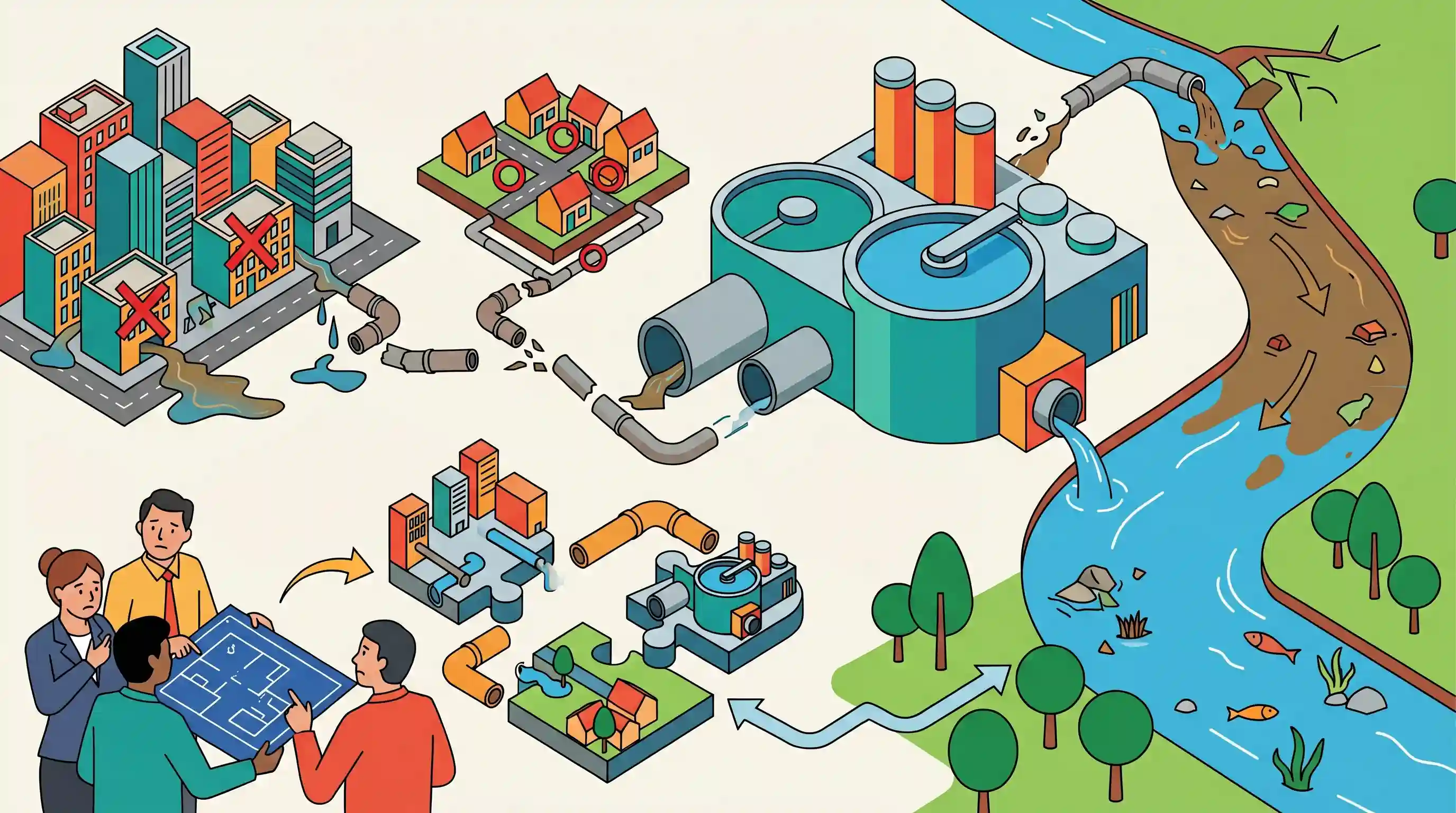
Why It Matters
The disconnect between sewerage networks and STPs is a classic example of fragmented urban planning. It is highly relevant for GS Paper 2 (Role of Local Bodies) and GS Paper 3 (Environmental Pollution), illustrating the governance and infrastructure challenges faced by India's rapidly urbanizing towns.
Summary
A significant number of Urban Local Bodies (ULBs) are struggling with urban sanitation infrastructure, with 20 lacking comprehensive sewerage facilities and 7 having inadequate networks. However, Sewage Treatment Plants (STPs) in these towns are still managing to handle sewage, highlighting a disconnect between the construction of treatment facilities and the establishment of proper underground drainage networks. This gap in urban planning and municipal governance severely impacts wastewater management, often leading to underutilized STPs and the risk of untreated sewage polluting water bodies. The issue emphasizes the need for holistic urban infrastructure development and capacity building for ULBs under missions like AMRUT and Swachh Bharat.
Key Points
- A recent assessment highlights a critical infrastructure gap in urban sanitation, with 20 Urban Local Bodies (ULBs) completely lacking sewerage facilities and 7 having inadequate ones.
- Despite the absence of comprehensive underground drainage networks, Sewage Treatment Plants (STPs) in these 'deficient' towns are still handling sewage, indicating a reliance on alternative collection mechanisms or a disconnect between network laying and STP construction.
- The lack of synchronized urban planning often results in underutilized STP capacities, as the wastewater generated fails to reach the treatment facilities efficiently.
- Inadequate sewerage infrastructure directly contributes to the discharge of untreated domestic wastewater into nearby water bodies, exacerbating river pollution and posing significant public health risks.
- The situation underscores the need for empowering ULBs with better financial and technical resources to ensure end-to-end urban wastewater management.
Important Terms
Urban Local Bodies (ULBs)

Statutory bodies representing the third tier of government in urban areas, responsible for local administration and providing essential civic amenities like sanitation, water supply, and waste management.
UPSC context
GS Paper II (Polity/Governance) and GS III (Urbanization); tests understanding of decentralized governance and urban infrastructure challenges.
74th Constitutional Amendment Act
A 1992 legislation that granted constitutional status to Urban Local Bodies, introducing Part IXA and the Twelfth Schedule containing 18 functional subjects for municipal governance.
UPSC context
GS Paper II; essential for questions on local self-government, federalism, and the devolution of power (Functions, Funds, and Functionaries).
AMRUT (Atal Mission for Rejuvenation and Urban Transformation)
A national transformation initiative launched in 2015 to establish robust urban infrastructure, primarily focusing on universal water supply, sewerage networks, and developing green spaces.
UPSC context
GS Paper II (Schemes) and GS III (Infrastructure); relevant for urban rejuvenation and sustainable development goals.
Swachh Bharat Mission (SBM)
A flagship mission launched in 2014 to achieve universal sanitation coverage, eliminate open defecation, and improve municipal solid and liquid waste management across India.
UPSC context
GS Paper II and III; evaluates government initiatives for public health, environmental hygiene, and behavioral change in sanitation.
Sewage Treatment Plant (STP)
An infrastructure facility designed to treat municipal wastewater through physical, chemical, and biological processes, removing contaminants to ensure safe environmental discharge or potential reuse.
UPSC context
GS Paper III (Environment/Infrastructure); tests knowledge on wastewater management, water pollution control, and the circular economy of water.
Prelims Trap
"AMRUT 2.0 mandates 100% underground sewerage and septage coverage for all statutory towns in India."
AMRUT 2.0 targets 500 major cities for sewerage and septage, while SBM-Urban 2.0 covers liquid waste management for smaller cities (under 1 lakh population).
Static Concepts Connected
What is Biochemical Oxygen Demand (BOD) and its relation to urban wastewater?
- Definition: The amount of dissolved oxygen needed by aerobic biological organisms to break down organic material present in a given water sample.
- Pollution Indicator: Untreated domestic sewage bypasses STPs and enters rivers, resulting in extremely high BOD levels, which indicates severe organic pollution.
- Ecological Impact: High BOD strips water of dissolved oxygen, leading to the creation of 'dead zones' where aquatic life cannot survive.
How does the 12th Schedule of the Constitution address urban sanitation?
- 12th Schedule: Added by the 74th Constitutional Amendment Act (1992), it contains 18 functional items devolved to municipalities.
- Sanitation Mandate: Public health, sanitation conservancy, and solid waste management are explicitly listed as municipal responsibilities.
- Capacity Constraints: Despite constitutional mandates, ULBs often lack financial autonomy and rely heavily on tied grants or parastatal agencies for capital-intensive sewerage infrastructure.
Cross-Topic Patterns
Decentralized FSSM vs. Centralized STPs
The failure of underground sewerage networks elevates the National FSSM Policy's focus on decentralized vacuum-truck septage collection, bypassing expensive pipe-laying to feed existing STPs.
Circular Water Economy & AMRUT 2.0
Under-utilized STPs threaten AMRUT 2.0’s target of meeting 20% of overall urban water demand and 40% of industrial water demand through treated and recycled wastewater.

Expect a multi-statement prelims question contrasting SBM-U 2.0 and AMRUT 2.0 mandates on liquid waste management based on city population.
Linked PYQs · 3
Linked PYQs · 3
- 2024MainsGS2
Analyse the role of local bodies in providing good governance at local level and bring out the pros and cons merging the rural local bodies with the urban local bodies.
- 2024MainsGS3
Industrial pollution of river water is a significant environmental issue in India. Discuss the various mitigation measures to deal with this problem and also the government's initiatives in this regard.
- 2019PrelimsGS1
As per the Solid Waste Management Rules, 2016 in India, which one of the following statements is correct?
