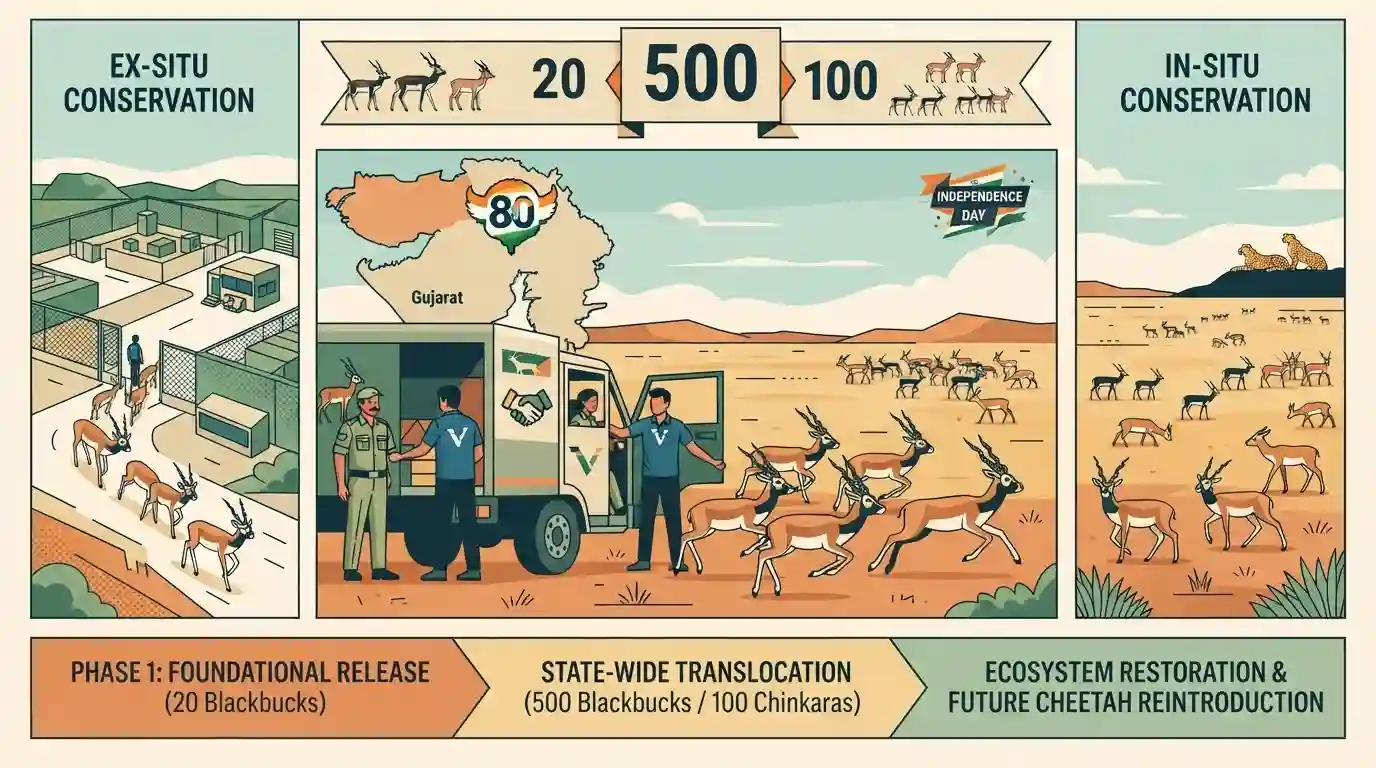
Blackbucks rewilded in Banni grassland for native wildlife restoration
Source:republicworld ↗
Why It Matters
It highlights the ecological significance of the Banni Grasslands and the growing importance of public-private partnerships (like the collaboration with Vantara) in executing large-scale, complex wildlife translocations and habitat restorations.
Summary
A landmark wildlife restoration initiative successfully rewilded 20 blackbucks into the Banni Grasslands of Kutch on India's 80th Independence Day. The translocation, executed collaboratively by the Gujarat Forest Department and Vantara, aims to restore the historical native herbivore population of the grassland ecosystem. This initiative is a foundational phase in a broader state-wide strategy to translocate 500 blackbucks and 100 chinkaras. Restoring this prey base is also strategically aligned with the ultimate national vision of reintroducing cheetahs to Gujarat's habitats.
Key Points
- On August 15, 2026, 20 blackbucks (5 males, 15 females) were successfully rewilded into the Banni Grasslands in Kutch, Gujarat.
- The initiative is a collaborative effort between the Gujarat Forest Department and Vantara (operated by GZRRC), representing a significant public-private partnership in wildlife conservation.
- This release is part of a broader, CZA-approved plan to translocate 500 blackbucks and 100 chinkaras across Gujarat to restore native ungulate populations.
- The restoration of the prey base in the Banni ecosystem is also viewed as a crucial preparatory step for the planned cheetah reintroduction program in the region.
Important Terms
Project Cheetah

India's ambitious intercontinental wildlife translocation program to reintroduce the African cheetah, which was declared locally extinct in 1952. The Banni Grassland is currently being developed as a secondary habitat to establish a stable metapopulation.
UPSC context
GS Paper 3 (Environment). Tests knowledge of species reintroduction, apex predators, and grassland ecosystem restoration.
Central Zoo Authority (CZA)
A statutory body established in 1992 under the Wildlife (Protection) Act, 1972, to oversee and regulate zoos, captive breeding facilities, and animal exchange programs across India.
UPSC context
GS Paper 3 (Environment). Tests understanding of environmental statutory bodies and ex-situ conservation frameworks.
Greens Zoological Rescue and Rehabilitation Centre (GZRRC)
A large-scale animal rescue facility located in Jamnagar, Gujarat. It focuses on wildlife rehabilitation, captive care, and conservation breeding, and provided the blackbucks for the Banni rewilding initiative.
UPSC context
GS Paper 3 (Environment). Important for understanding ex-situ conservation models and private sector participation in wildlife management.
Vantara
A comprehensive animal welfare and wildlife rescue initiative launched by Reliance Industries. It provided the technical support, veterinary expertise, and transportation for the blackbuck rewilding project in Banni Grassland.
UPSC context
GS Paper 3 (Conservation). Relevant for examining corporate social responsibility (CSR) and private-public partnerships in ecological restoration.
Prelims Trap
"Because the Blackbuck is a Schedule I species under the WPA 1972, it is classified as Endangered on the IUCN Red List."
Aspirants often assume Schedule I species are highly threatened globally. Blackbucks have the highest domestic legal protection but have a stable global population, earning a 'Least Concern' status.
Static Concepts Connected
What are the ecological and cultural features of the Banni Grassland?
- Formation & Geography: Located in the Kachchh district, it was formed by alluvial deposits from the Indus river system, making it one of Asia's largest tropical arid grasslands.
- Maldhari Community: Home to the pastoralist Maldhari community, famous for breeding the resilient Banni buffalo, which is uniquely adapted to extreme weather and scarce water.
- Ecological Threat: The grassland faces severe ecological degradation due to the spread of the invasive alien species Prosopis juliflora, introduced decades ago to check salinity.
What is the mandate of the Central Zoo Authority (CZA)?
- Statutory Origin: Established in 1992 as a statutory body under the Wildlife (Protection) Act, 1972, primarily to regulate zoos and rescue centers across India.
- Regulatory Powers: It holds the authority to recognize or derecognize zoos, and must approve all captive breeding, translocations, and rewilding programs like the Banni initiative.
- Leadership: It is chaired by the Union Minister for Environment, Forest and Climate Change, ensuring top-tier executive oversight of ex-situ conservation efforts.
Cross-Topic Patterns
Invasive Species & Grassland Degradation
Banni's restoration for blackbucks is directly linked to Gujarat's parallel ecological schemes to clear the invasive Prosopis juliflora (Gando Baval) and recover indigenous grass varieties.
PPP in Ex-Situ Conservation
Vantara's involvement marks a strategic shift from purely state-led wildlife management to authorized public-private partnerships governed by the Wildlife Protection Act and CZA.

Banni Grassland geography + Blackbuck IUCN status + Cheetah prey base preparation is ripe for a complex multi-statement GPSC question.
Linked PYQs · 3
Linked PYQs · 3
- 2025GPSC_PRELIMSGS1
What are Banni, Rabari and Bavalia in Gujarat?
- 2026GPSC_PRELIMSGS1
Consider the following statements regarding the drainage system of Kutch: 1. Most rivers in the Kutch region are ephemeral and non-perennial, carrying water only during the brief monsoon season. 2. The rivers originating from the central hilly tracts of Kutch invariably drain into the Arabian Sea directly. 3. The Luni River, after traversing through Rajasthan, dissipates into the marshy lands of the Rann of Kutch. Which of the above statements are correct?
- 2022GPSC_PRELIMSGS1
From the following which place of Gujarat has been named on UNESCO's World Heritage list?
