Banni grassland blackbuck rewilding and biodiversity restoration
Source:dailypioneer ↗
Why It Matters
Conservation initiatives in Gujarat, particularly concerning the Banni Grasslands, blackbucks, and ecological restoration efforts like prey-base augmentation (linked to Project Cheetah), are highly relevant for GPSC Prelims Geography and Environment sections.
Summary
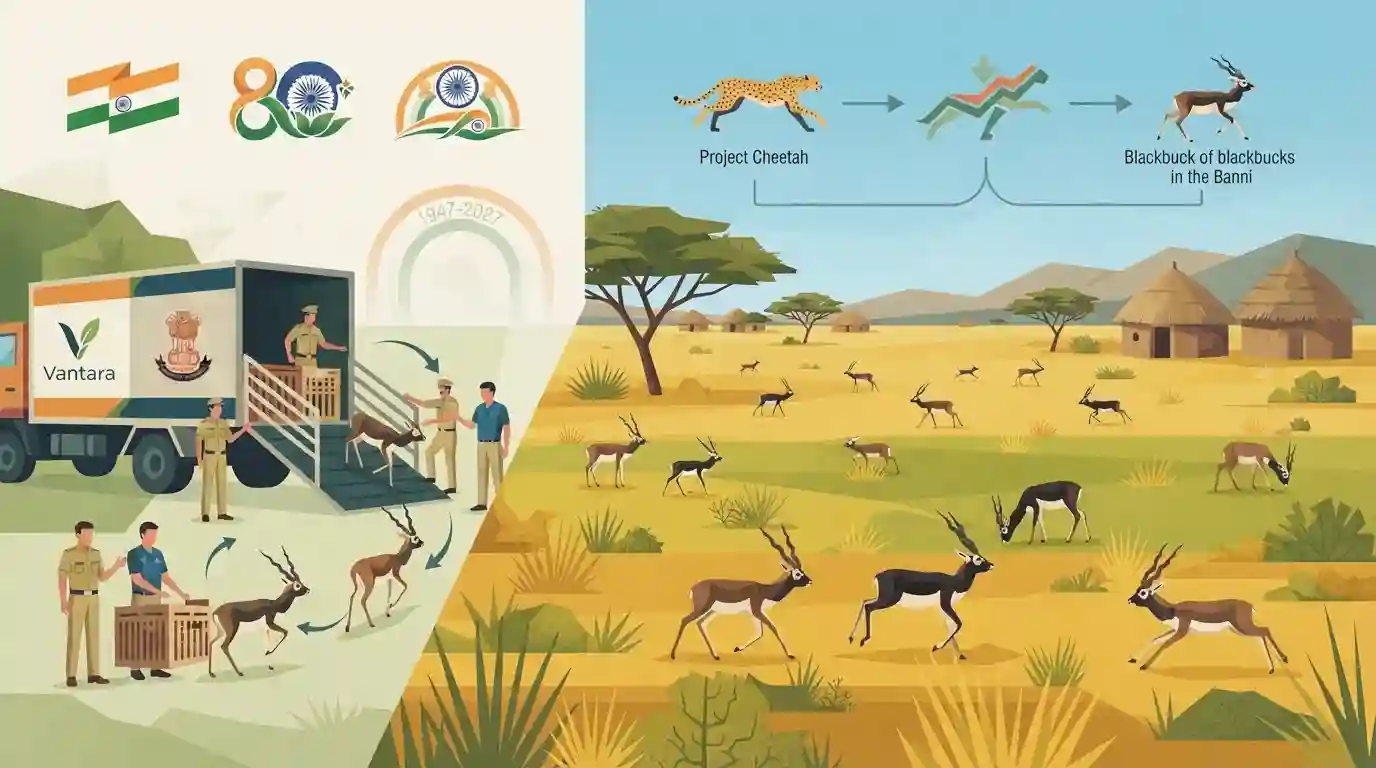
The Gujarat Forest Department and Vantara successfully released 20 blackbucks into the Banni Grassland of Kutch on India's 80th Independence Day. This rewilding effort, inspired by broader national conservation strategies like Project Cheetah, aims to restore native herbivore populations and the ecological balance of the unique Banni landscape.
Key Points
- On India’s 80th Independence Day, 20 blackbucks were rewilded in the Banni Grassland of Kutch, Gujarat.
- The initiative is a collaborative effort between the Gujarat Forest Department and Vantara (Greens Zoological Rescue and Rehabilitation Centre).
- This ecological restoration aligns with national directives like Project Cheetah, aiming to re-establish native herbivore populations and augment prey bases.
- Future phases of the project aim to introduce more blackbucks along with other native species such as chinkaras and wild asses to the Banni landscape.
Important Terms
Banni Grassland

A belt of arid grassland ecosystem in the Rann of Kutch, Gujarat. Formed from river sediments, it supports rich biodiversity, native herbivores like blackbuck, and pastoral Maldhari communities, serving as a crucial ecological and conservation zone.
UPSC context
Highly relevant for Geography and Environment. It tests knowledge of India's unique ecosystems, biodiversity hubs, and sites for wildlife reintroduction (like cheetahs).
Project Cheetah
India's 2022 initiative to reintroduce African cheetahs, establishing a free-ranging population. It acts as a flagship program to restore and conserve open natural ecosystems, grasslands, and savanna habitats, starting in Kuno National Park.
UPSC context
Crucial for Environment & Ecology. It tests knowledge of species reintroduction, transcontinental conservation efforts, and grassland ecosystem restoration.
Central Zoo Authority (CZA)
A statutory body established in 1992 under the Wild Life (Protection) Act, 1972. It oversees, regulates, and grants recognition to zoos in India, enforcing standards for animal housing, upkeep, and coordinating conservation breeding.
UPSC context
Important for Environmental Governance. Tests knowledge of statutory bodies, wildlife protection laws, and ex-situ conservation frameworks in India.
Vantara
An expansive animal rescue, care, and rehabilitation initiative established by the Reliance Foundation in Jamnagar, Gujarat. It includes state-of-the-art veterinary facilities and partners with the government on wildlife restoration and rewilding projects.
UPSC context
Relevant for Biodiversity Conservation. It highlights the growing role of private-corporate initiatives and public-private partnerships in modern wildlife conservation.
Greens Zoological Rescue and Rehabilitation Centre (GZRRC)
The primary rescue and rehabilitation zone within the Vantara project in Jamnagar. A CZA-recognized facility, it provides expert care, houses a massive wildlife hospital, and facilitates ethical breeding and rewilding of species.
UPSC context
Pertinent to Environment & Ecology. It serves as an example of large-scale, CZA-approved ex-situ conservation and rehabilitation infrastructure.
Prelims Trap
"Because Blackbuck is protected under Schedule I of WPA, it is categorized as an Endangered species."
Despite having the highest protection under Schedule I of the WPA 1972, the Blackbuck is actually classified as 'Least Concern' by the IUCN.
Static Concepts Connected
What makes the Banni Grassland ecologically unique?
- Geographic location: Located in arid Kutch, Gujarat, it forms Asia's largest tropical grassland ecosystem.
- Ecosystem structure: A unique juxtaposition of wetlands (chari-dhand) and saline-tolerant short grasslands.
- Cultural ecology: Home to the pastoral Maldhari community, recognized for their traditional breeding of the Banni buffalo.
- Invasive threat: The widespread introduction of Prosopis juliflora (Gando Baval) threatens its native grassy plains.
What is the conservation status and habitat of the Blackbuck?
- Legal protection: Protected under Schedule I of the Wildlife Protection Act, 1972, granting it absolute protection.
- IUCN Status: Listed as 'Least Concern' on the IUCN Red List due to successful conservation efforts.
- Habitat preference: Endemic to the Indian subcontinent, thriving in open plains, scrublands, and short grass plains.
- Key reserves: Velavadar (Gujarat), Tal Chhapar (Rajasthan), and Point Calimere (Tamil Nadu) are major sanctuaries.
Cross-Topic Patterns
Augmenting prey base for Cheetah Relocation
Banni was identified by WII as a potential site for cheetah breeding. Reintroducing blackbucks and chinkaras directly prepares the landscape's prey base for future apex predators under Project Cheetah.
Corporate participation in Schedule I conservation
Vantara's involvement highlights the growing trend of private sector and CSR initiatives partnering with Forest Departments for Schedule I rewilding, bridging critical funding and veterinary gaps.

Expect a multi-statement question combining Banni's ecology (Maldharis, Prosopis invasion) with the Blackbuck's paradoxical IUCN status.
Linked PYQs · 2
Linked PYQs · 2
- 2026GPSC_PRELIMSGS1
The 'Great Indian Bustard (GIB)' (Ghorad) is frequently seen in the news in the context of wildlife conservation efforts in western India. Consider the following statements regarding this species: 1. Currently, the highest surviving wild population of the Great Indian Bustard in India is located in the semi-arid grasslands of Gujarat. 2. It is a long-distance migratory bird that travels from Central Asia to the Indian subcontinent to escape harsh winters. Which of the above statement(s) is/are correct?
- 2022GPSC_PRELIMSGS1
From the following which place of Gujarat has been named on UNESCO's World Heritage list?
