Origins of Martyrs Day Silence and Historical Commemoration
Source:Indian Express ↗
Why It Matters
Understanding the historical and global origins of national observances like Martyrs' Day provides critical insights into how commemorative traditions evolve and shape a nation's collective memory, relevant for both Modern Indian History and World History.
Summary
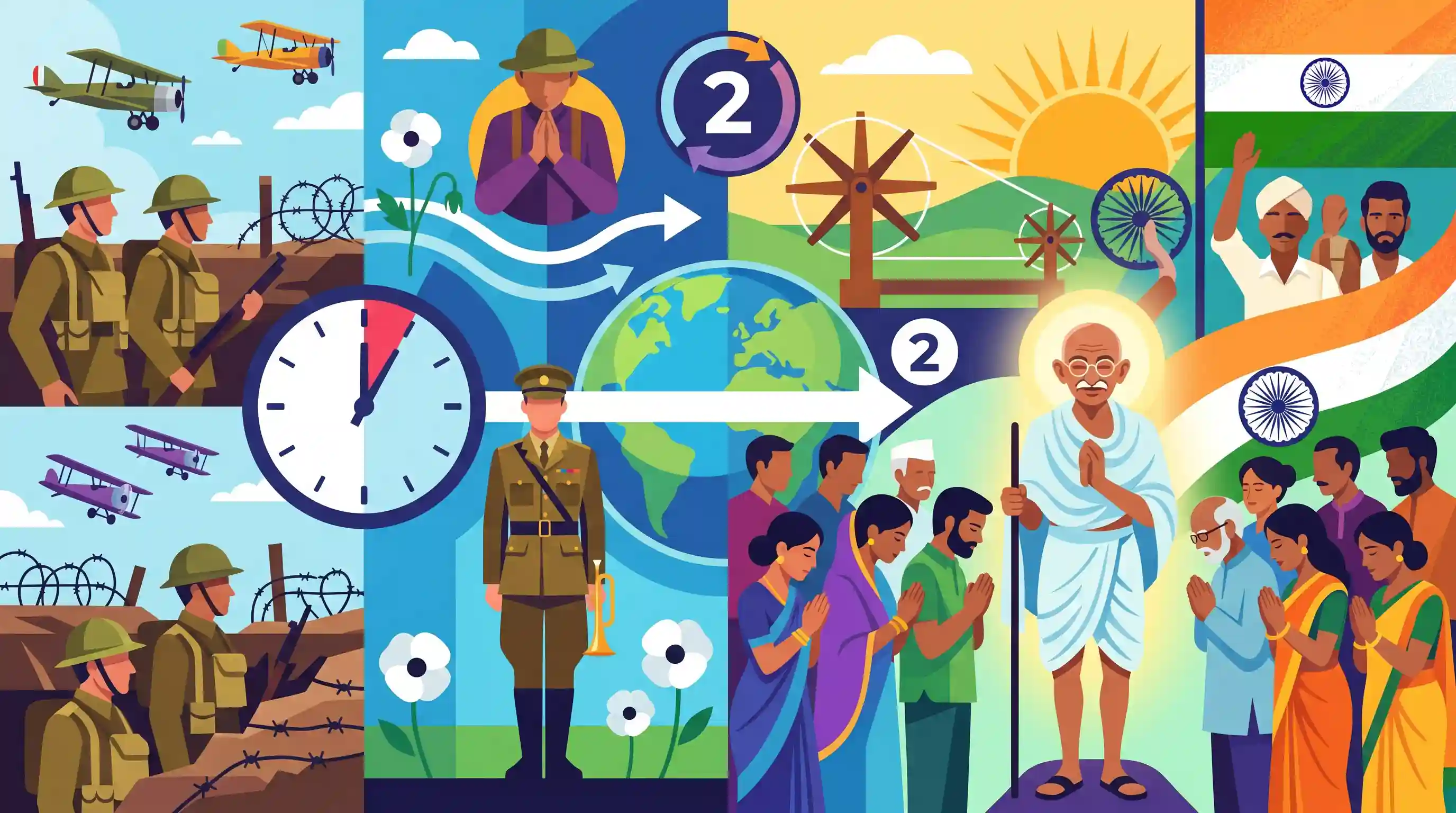
The article explores the origins of observing a two-minute silence on January 30, which marks Martyrs' Day in India commemorating the assassination of Mahatma Gandhi. It traces the global roots of this solemn tradition back to Armistice Day following the end of World War I, where a period of silence was instituted to honor fallen soldiers. In India, this practice was adopted as a collective ritual of remembrance and reverence to honor the martyrs of the Indian freedom struggle, particularly Mahatma Gandhi, seamlessly blending a global post-war tradition with the nation's independence narrative.
Key Points
- January 30 is observed as Martyrs' Day (Shaheed Diwas) in India to commemorate the assassination of Mahatma Gandhi.
- A nationwide two-minute silence is observed on this day to honor those who sacrificed their lives during the Indian freedom struggle.
- The global tradition of observing a two-minute silence originated from Armistice Day, which marked the end of World War I and honored the war dead.
- India adapted this global practice of collective mourning and remembrance to fit its national narrative of honoring its own freedom fighters and Mahatma Gandhi.
Prelims Trap
"The two-minute silence on Jan 30 is an indigenous Gandhian practice introduced during the freedom struggle."
Aspirants logically assume peaceful silence equates to indigenous Gandhian Satyagraha. It actually originated from a Western military tradition (WWI Armistice Day) and was adopted in 1955.
Static Concepts Connected
What are the two primary dates observed as Martyrs' Day (Shaheed Diwas) in India?
- January 30: Marks the 1948 assassination of Mahatma Gandhi, accompanied by a nationwide two-minute silence.
- March 23: Commemorates the 1931 execution of revolutionary freedom fighters Bhagat Singh, Sukhdev, and Rajguru.
- Ideological span: Together, these official observances structurally accommodate both the non-violent and revolutionary ideological strands of India's freedom movement.
How did World War I influence global commemoration rituals?
- Armistice Day: November 11, 1918, marked the end of WWI hostilities on the Western Front.
- Two-minute silence: Originated globally on Armistice Day to honor fallen soldiers. It was later adapted by post-colonial nations like India for domestic memorialization.
Cross-Topic Patterns
Post-colonial adaptation of military traditions
The adoption of the WWI Armistice silence for Gandhi's memorialization shows how newly independent India repurposed British imperial military traditions for its own national civic narrative.
K.M. Cariappa & early nation-building
Field Marshal Cariappa's 1955 suggestion to Nehru highlights the early Indian Army's subtle but significant role in shaping civilian civic rituals and post-independence national integration.

A Prelims question could contrast the origins of Jan 30 and Mar 23 Martyrs' Days, specifically testing the WWI Armistice Day connection.
Linked PYQs · 4
Linked PYQs · 4
- 2019PrelimsGS1
With reference to the British colonial rule in India, consider the following statements: 1. Mahatma Gandhi was instrumental in the abolition of the system of 'indentured labour'. 2. In 'Lord Chelmsford's War Conference', Mahatma Gandhi did not support the resolution on recruiting Indians for World War. 3. Consequent upon the breaking of Salt Law by Indian people, the Indian National Congress was declared illegal by the colonial rulers. Which of the statements given above are correct?
- 2018MainsGS1
Throw light on the significance of the thoughts of Mahatma Gandhi in the present times.
- 2015MainsGS1
How different would have been the achievement of Indian independence without Mahatma Gandhi? Discuss.
- 2024MainsGS1
How far is it correct to say that the First World War was fought essentially for the preservation of balance of power?
