Kolkata Warehouse Collapse and Urban Infrastructure Safety
Source:Indian Express ↗
Why It Matters
The incident serves as a crucial case study for civil services aspirants regarding urban disaster management and the governance challenges faced by Urban Local Bodies. It highlights the real-world consequences of poor regulatory oversight in urban infrastructure and the necessity of coordinated disaster response mechanisms.
Summary
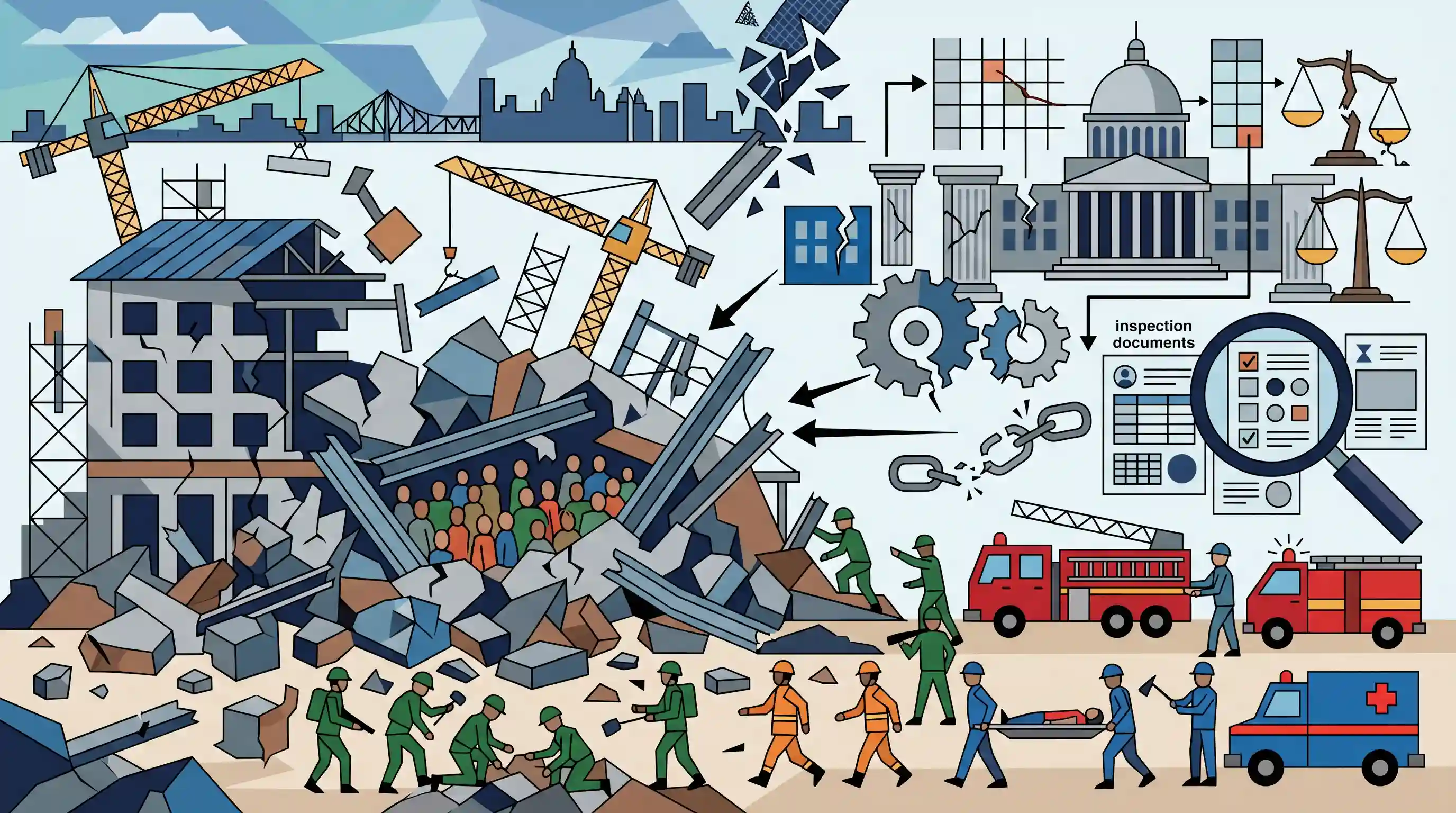
A warehouse under construction in Kolkata's Taratala area collapsed, causing at least five fatalities and leaving around 20 workers injured, with dozens more feared trapped. The Indian Army, National Disaster Response Force (NDRF), and local authorities launched coordinated rescue operations. The incident has raised serious questions regarding urban planning, construction safety protocols, and the regulatory efficiency of the Kolkata Municipal Corporation (KMC), highlighting systemic vulnerabilities in urban infrastructure development and the critical need for effective disaster management.
Key Points
- A warehouse under construction in Kolkata collapsed, resulting in at least five deaths and prompting a major multi-agency rescue operation.
- The Indian Army and the National Disaster Response Force (NDRF) were deployed alongside local disaster management teams to clear debris and rescue trapped workers.
- The disaster exposes significant flaws in urban construction safety, regulatory enforcement, and municipal oversight by the Kolkata Municipal Corporation.
- The incident underscores the necessity of robust urban disaster management frameworks and strict adherence to building codes to prevent human-made infrastructural disasters.
Important Terms
National Disaster Response Force (NDRF)

A specialized multi-skilled force constituted under the Disaster Management Act, 2005, for responding to natural and man-made disasters. It operates under the Ministry of Home Affairs using personnel from Central Armed Police Forces.
UPSC context
GS Paper III: Disaster Management. Tests knowledge of specialized response agencies and their operational efficiency in crises.
Disaster Management Act, 2005
The primary legislation providing India's institutional framework for disaster management. It established authorities at national, state, and district levels, shifting the country's focus from reactive relief to proactive disaster risk reduction.
UPSC context
GS Paper III: Disaster Management. Fundamental for understanding the statutory and institutional landscape of emergency management in India.
Urban Local Bodies (ULBs)
Constitutional third-tier government units in urban areas empowered by the 74th Amendment Act. They manage civic infrastructure, public health, safety regulations, and urban planning within their respective city jurisdictions.
UPSC context
GS Paper II: Governance/Polity. Tests themes of decentralization, the 74th Amendment, and municipal accountability.
Kolkata Municipal Corporation (KMC)
The urban local body governing Kolkata, responsible for approving building plans, enforcing construction safety, and providing civic services. It acts as the primary regulator for urban infrastructure safety.
UPSC context
GS Paper II: Local Governance. Relevant for case studies on urban infrastructure lapses and municipal regulatory failure.
Aid to Civil Authority
The statutory role of the Indian Army to assist civilian administration during emergencies. This includes providing specialized engineering, medical support, and large-scale search and rescue capabilities during disasters.
UPSC context
GS Paper III: Security/Disaster Management. Evaluates the role of armed forces in non-combatant roles and civil-military coordination.
Urban Planning
A regulatory process focused on land use, infrastructure design, and the built environment. It involves enforcing building codes and safety protocols to ensure sustainable and safe city development.
UPSC context
GS Paper I & III: Urbanization and Infrastructure. Critical for discussing urban resilience and the prevention of man-made disasters.
Prelims Trap
"The National Building Code is a mandatory statutory framework enforced directly by the Union government across all states."
The NBC is inherently recommendatory. It relies entirely on State governments and Urban Local Bodies (ULBs) to mandate its provisions by incorporating them into local building bye-laws.
Static Concepts Connected
Under what framework do Armed Forces conduct civilian disaster rescue operations?
- Aid to Civil Authorities: Deployed when civilian administrative resources are overwhelmed by a disaster, acting strictly in a supplementary capacity.
- Civilian Control: Despite military deployment, overall operational and administrative control remains firmly with the local civil administration (e.g., District Magistrate).
How does the 12th Schedule empower Municipalities regarding urban infrastructure?
- Constitutional Mandate: Introduced by the 74th Constitutional Amendment Act (1992), it enumerates 18 functional domains devolved to urban local bodies.
- Core Functions: Explicitly mandates ULBs to undertake urban planning, town planning, and the regulation of land-use and building construction.
Cross-Topic Patterns
Urban Disasters + 74th Amendment
The rising frequency of infrastructural collapses shifts the focus of disaster management from natural hazards to the regulatory, financial, and technical capacities of Urban Local Bodies.
Sendai Framework + BIS standards
Connects the Bureau of Indian Standards' role in drafting the National Building Code with the Sendai Framework's priority of investing in disaster risk reduction for resilience.

Expect a 2026 prelims question testing the recommendatory nature of the National Building Code versus mandatory local ULB bye-laws.
Linked PYQs · 4
Linked PYQs · 4
- 2024MainsGS3
What is disaster resilience? How is it determined? Describe various elements of a resilience framework. Also mention the global targets of Sendai Framework for Disaster Risk Reduction (2015–2030).
- 2024MainsGS2
Analyse the role of local bodies in providing good governance at local level and bring out the pros and cons merging the rural local bodies with the urban local bodies.
- 2023MainsGS2
“The states in India seem reluctant to empower urban local bodies both functionally as well as financially.” Comment.
- 2016MainsGS1
With a brief background of quality of urban life in India, introduce the objectives and strategy of the 'Smart City Programme'.
