Crop Damage Assessment under Pradhan Mantri Fasal Bima
Source:Indian Express ↗
Why It Matters
It highlights the growing vulnerability of India's agricultural sector to extreme climate events and assesses the effectiveness of institutional response mechanisms like PMFBY and crop-cutting experiments. It also connects domestic agrarian stability with international geopolitical variables like the West Asia conflict impacting fertilizer supply chains and exports.
Summary
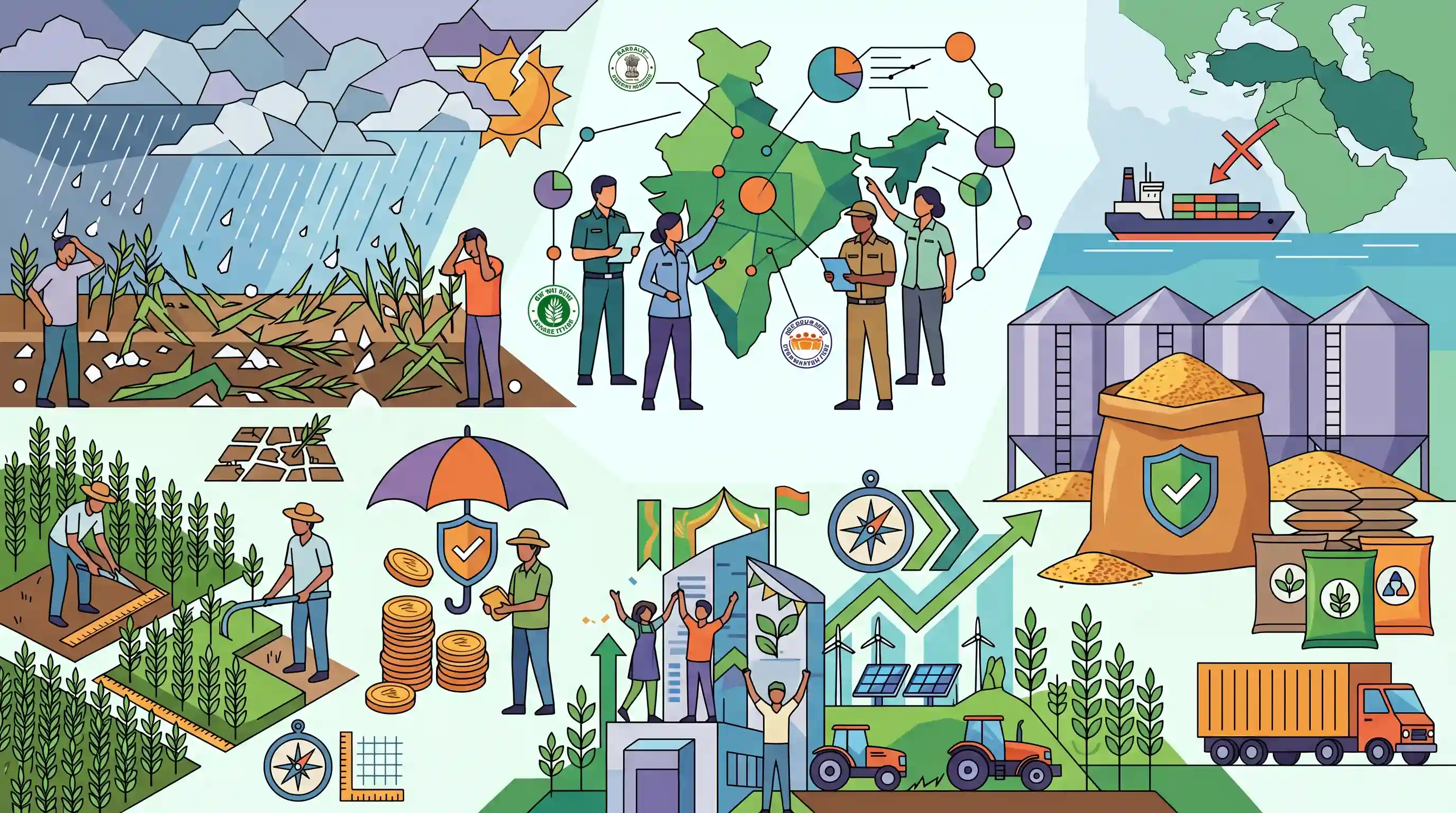
Union Agriculture Minister Shivraj Singh Chouhan highlighted that unseasonal rains and hailstorms have damaged at least 2.49 lakh hectares of crops across India, emphasizing the urgent need for robust joint damage assessments. States have been urged to coordinate surveys involving the Revenue, Agriculture, and Panchayati Raj departments, and to utilize crop-cutting experiments for accurate yield estimation to facilitate swift Pradhan Mantri Fasal Bima Yojana (PMFBY) insurance payouts. The government provided reassurances that despite concerns regarding agricultural exports due to the West Asia conflict, domestic food buffer stocks and fertilizer availability remain adequate. The announcement coincided with the Unnat Krishi Mahotsav in Pusa, highlighting a strategic agriculture roadmap designed to modernize the sector and secure farmers' livelihoods against climatic shocks.
Key Points
- Unseasonal rains and hailstorms have severely damaged over 2.49 lakh hectares of crop land across India, predominantly affecting Rabi crops, with the damage expected to cross 3 lakh hectares.
- The Union Government has instructed states to conduct joint surveys involving Revenue, Agriculture, and Panchayati Raj departments for precise crop damage assessment.
- States are mandated to leverage crop-cutting experiments to estimate crop yields, ensuring timely and accurate insurance payouts under the Pradhan Mantri Fasal Bima Yojana (PMFBY).
- Despite the ongoing West Asia conflict posing challenges to agricultural exports, domestic food stocks remain sufficient and fertilizer production is uninterrupted.
- The Unnat Krishi Mahotsav exhibition was held in Pusa to showcase an upcoming agriculture roadmap aimed at transforming the agrarian economy and bolstering farmers' incomes.
Important Terms
Pradhan Mantri Fasal Bima Yojana (PMFBY)

A flagship crop insurance scheme providing comprehensive financial support to farmers against yield losses due to natural calamities, pests, or diseases, utilizing an area-based approach for claim settlements.
UPSC context
GS III: Agriculture. Critical for risk management, insurance penetration, and farmer welfare policies.
Crop-Cutting Experiments (CCE)
A scientific sampling method where a small portion of a field is harvested and weighed to estimate total yield, crucial for insurance payouts and national production forecasting.
UPSC context
GS III: Technology in Agriculture. Tests knowledge of methodology for accurate yield estimation and policy data.
Buffer Stocks
Strategic reserves of essential food grains maintained by the government to stabilize market prices, ensure national food security, and manage supply during emergencies or crop failures.
UPSC context
GS III: Food Security. Relates to PDS, FCI operations, and price stability mechanisms.
Unnat Krishi Mahotsav
A national-level agricultural festival and exhibition designed to connect farmers with scientific research, modern technology, and government initiatives through direct interaction with experts and stakeholders.
UPSC context
GS III: Agricultural Extension. Important for technology transfer, lab-to-land initiatives, and farmer empowerment.
Ministry of Agriculture and Farmers Welfare
The nodal central government body responsible for formulating and implementing policies related to agricultural productivity, farmer welfare, and rural development in India.
UPSC context
GS II: Governance. Tests understanding of institutional frameworks and central-state coordination in agriculture.
Panchayati Raj Institutions (PRI)
Constitutional bodies at the local level involved in grassroots governance, including the coordination of revenue and agriculture surveys for disaster damage assessment and relief distribution.
UPSC context
GS II: Devolution of Powers. Essential for understanding local-level implementation of welfare and disaster relief.
Prelims Trap
"PMFBY provides insurance coverage strictly for standing crops and excludes post-harvest losses."
PMFBY explicitly covers post-harvest losses for up to 14 days for crops left in the field to dry, alongside localized calamities like hailstorms.
Static Concepts Connected
What are the premium and coverage features of PMFBY?
- Uniform Premium: Farmers pay 2% for Kharif, 1.5% for Rabi, and 5% for commercial/horticultural crops.
- Subsidy Sharing: Premium subsidy is shared equally between Centre and States (90:10 for North Eastern and Hilly States).
- Comprehensive Risk: Covers prevented sowing, standing crops, localized calamities, and post-harvest losses up to 14 days.
How are Crop Cutting Experiments (CCEs) utilized in yield estimation?
- Methodology: A scientific sampling method where randomly selected crop plots are harvested and weighed to determine average yield.
- PMFBY Linkage: They form the baseline data for accurate and objective insurance claim settlements under PMFBY.
- Tech Integration: State governments increasingly use smartphones, satellite imagery, and drones to ensure tamper-proof, real-time data capture.
Cross-Topic Patterns
Climate Extremes + Food Inflation
Unseasonal rains impacting the Rabi harvest closely links climate change with macroeconomic stability, as domestic crop losses directly feed into volatile cereal and vegetable inflation.
Geopolitics + Agri-Export Vulnerability
Geopolitical shocks in the Middle East disrupt agricultural export routes (e.g., Red Sea crisis), highlighting Indian agriculture's dual vulnerability to domestic climate shocks and global logistics.

Expect a multi-statement question on PMFBY in 2026 testing the role of Crop Cutting Experiments (CCEs) and remote sensing in claim settlement.
Linked PYQs · 3
Linked PYQs · 3
- 2016MainsGS3
Given the vulnerability of Indian agriculture to vagaries of nature, discuss the need for crop insurance and bring out the salient features of the Pradhan Mantri Fasal Bima Yojana (PMFBY).
- 2023MainsGS3
What are the direct and indirect subsidies provided to farm sector in India? Discuss the issues raised by the World Trade Organization (WTO) in relation to agricultural subsidies.
- 2024MainsGS3
Elucidate the importance of buffer stocks for stabilizing agricultural prices in India. What are the challenges associated with the storage of buffer stock? Discuss.
