Appointments Committee of the Cabinet and Civil Service Roles
Source:Indian Express ↗
Why It Matters
Understanding the mechanism of high-level bureaucratic appointments (via the ACC) is important for Polity and Governance. The Agriculture Secretary is a pivotal administrative figure responsible for implementing massive agrarian schemes like PM-KISAN and PMFBY, directly linking civil service leadership to GS3 agriculture topics.
Summary
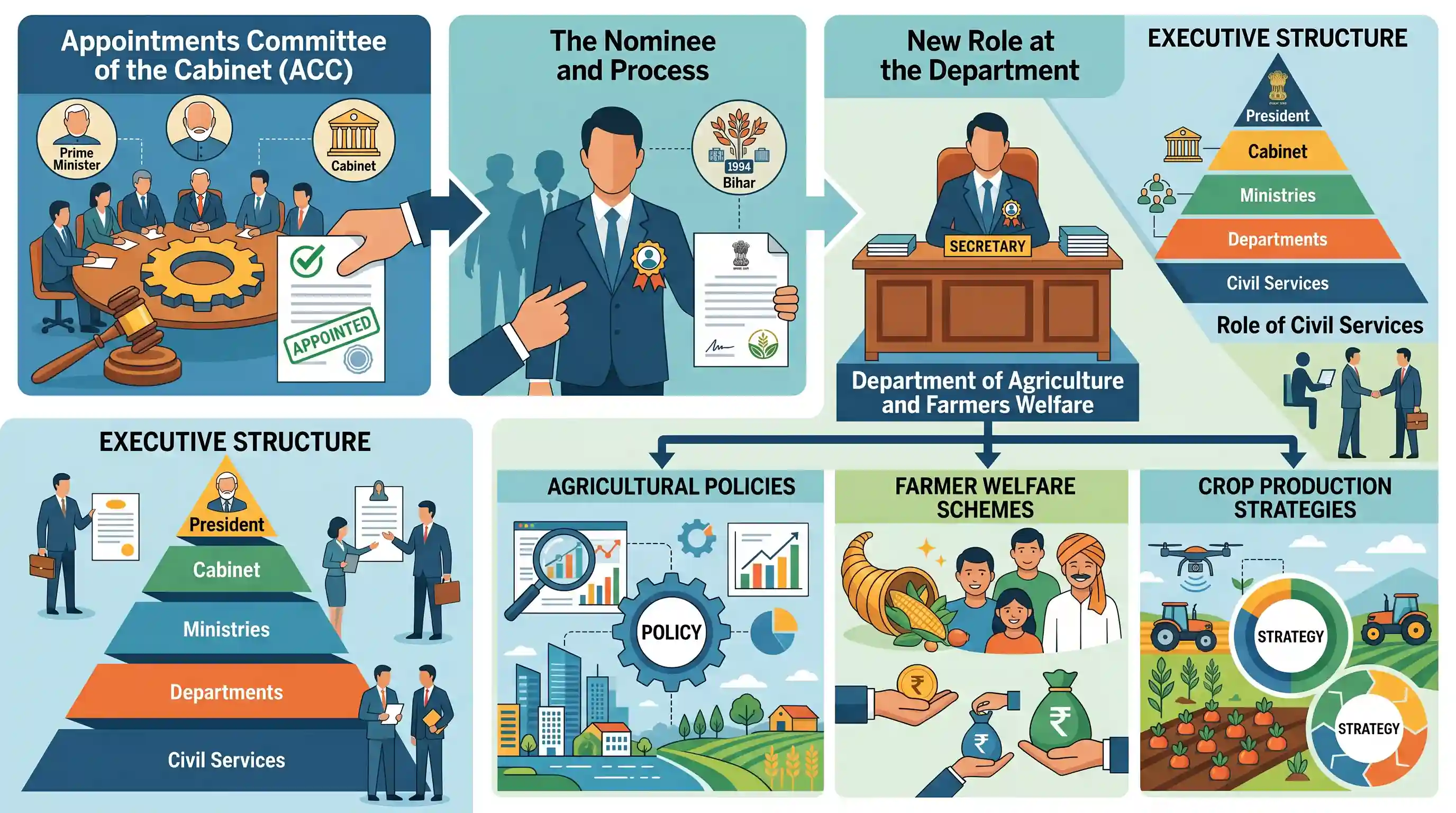
Senior IAS officer Atish Chandra (1994 batch, Bihar cadre) has been appointed as the new Agriculture Secretary by the Appointments Committee of the Cabinet (ACC). This key bureaucratic reshuffle places him at the helm of the Department of Agriculture and Farmers Welfare, where he will oversee critical agricultural policies, central schemes for farmer welfare, and crop production strategies. The move highlights the standard executive procedure for high-level civil service appointments under the Government of India.
Key Points
- Atish Chandra, a 1994-batch IAS officer of the Bihar cadre, has been appointed as the Secretary of the Department of Agriculture and Farmers Welfare.
- The appointment was cleared by the Appointments Committee of the Cabinet (ACC), which is headed by the Prime Minister.
- As the Agriculture Secretary, he will be instrumental in driving key agrarian policies and welfare measures, including minimum support price (MSP) operations and farmer income schemes.
- This appointment illustrates the established protocol for senior bureaucratic postings in the Government of India, where top administrative leadership rotates through empanelment and ACC clearance.
Important Terms
Appointments Committee of the Cabinet (ACC)

A high-level extra-constitutional committee chaired by the Prime Minister that approves senior bureaucratic appointments (Joint Secretary and above) and heads of major public institutions in the Government of India.
UPSC context
GS Paper II (Executive/Governance): Tests understanding of the executive’s role in administrative control and the functioning of Cabinet Committees.
Department of Agriculture and Farmers Welfare
The nodal administrative unit under the Ministry of Agriculture responsible for formulating and implementing national policies for agricultural productivity, food security, and flagship farmer welfare schemes.
UPSC context
GS Paper III (Agriculture): Crucial for questions on government interventions, agrarian reforms, and implementation of central sector schemes.
Indian Administrative Service (IAS)
A premier All-India Service established under Article 312, whose members are recruited by the Union but serve both Central and State governments to maintain administrative unity and federal coordination.
UPSC context
GS Paper II (Civil Services): Focuses on the role of civil services in a democracy and the structural framework of Indian administration.
Prelims Trap
The Appointments Committee of the Cabinet includes the Minister of Personnel and the Cabinet Secretary.
The ACC consists of strictly two members: the Prime Minister (Chairperson) and the Home Minister. The Cabinet Secretary only heads the Civil Services Board, which recommends names to the ACC.
Static Concepts Connected
What is the composition and role of the Appointments Committee of the Cabinet (ACC)?
- Composition: It consists of only two members: the Prime Minister (Chairperson) and the Minister of Home Affairs.
- Role: It clears all senior appointments (Joint Secretary and above) in the Central Secretariat, PSUs, and public sector banks.
- Secretariat Support: It is assisted by the Establishment Officer (EO) who sits within the Department of Personnel and Training (DoPT).
How are Government Ministries created and their business allocated?
- Constitutional Basis: Article 77(3) empowers the President to make rules for the more convenient transaction of the business of the Government of India.
- Allocation Rules: Ministries and departments are created and assigned responsibilities via the Government of India (Allocation of Business) Rules, 1961.
- Advising Authority: The President alters or creates these departments solely on the advice of the Prime Minister.
Cross-Topic Patterns
360-degree appraisal vs traditional ACRs
The shift from traditional Annual Confidential Reports (ACRs) to the '360-degree appraisal' system for empanelment connects directly to 2nd ARC recommendations on bureaucratic accountability and lateral entry.
Executive oversight of Central Sector Schemes
The Agriculture Secretary oversees massive central outlays like PM-KISAN, linking administrative efficiency directly to Direct Benefit Transfer (DBT) outcomes and agricultural macro-economics.

Expect a Prelims statement comparing the composition of the ACC (only PM & HM) with the Cabinet Committee on Economic Affairs (CCEA).
Linked PYQs · 3
Linked PYQs · 3
- 2020MainsGS2
Institutional quality is a crucial driver of economic performance". In this context suggest reforms in Civil Service for strengthening democracy.
- 2024MainsGS2
The Doctrine of Democratic Governance makes it necessary that the public perception of the integrity and commitment of civil servants becomes absolutely positive. Discuss.
- 2019PrelimsGS1
The Chairmen of public sector banks are selected by the
