Bhopal Gas Tragedy Toxic Waste Disposal and Judicial Stance
Source:The Hindu ↗
Why It Matters
The safe disposal of toxic and hazardous waste is a critical environmental and public health issue, frequently tested in GS Paper 3 (Environment and Disaster Management). The involvement of expert institutions (NEERI, CPCB) in environmental decision-making underscores the institutional framework for pollution control in India, relevant for Prelims and Mains. The long-term environmental consequences of industrial disasters like the Bhopal gas tragedy also serve as essential case studies for disaster management.
Summary
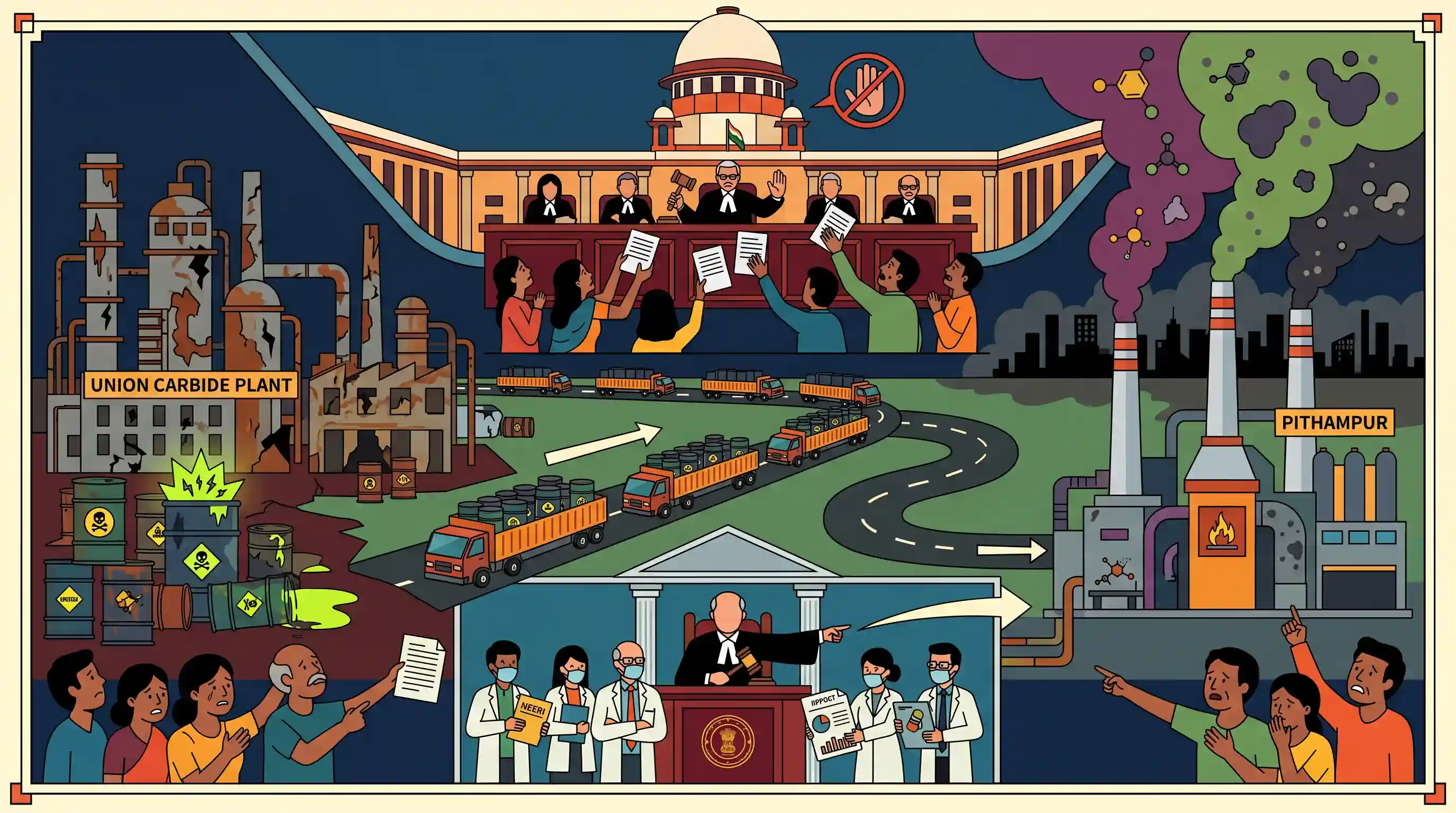
The Supreme Court has refused an urgent hearing on a plea by survivors of the 1984 Bhopal gas tragedy challenging the Madhya Pradesh High Court's order that allows the incineration of 346 metric tons of toxic waste. The High Court had approved the transfer of this hazardous waste from the defunct Union Carbide plant in Bhopal to a disposal facility in Pithampur. This decision was based on recommendations from a technical committee comprising heads of key environmental bodies like NEERI, NGRI, and CPCB. However, petitioners argue against the move, highlighting the extreme toxicity of the waste and the already high pollution levels in Pithampur.
Key Points
- The Supreme Court declined an urgent stay on the transfer and incineration of 346 metric tons of toxic waste from the 1984 Bhopal gas tragedy site.
- The Madhya Pradesh High Court had permitted the disposal of this hazardous waste at a facility in Pithampur, Dhar district, relying on a report by a technical committee.
- The technical committee comprised the directors of NEERI, NGRI, and CPCB, who approved the incineration method at the Common Hazardous Waste Treatment, Storage and Disposal Facility (CHWTSDF).
- Petitioners opposed the move, citing the extreme toxicity of the waste and the existing severe pollution levels at the proposed Pithampur disposal site.
Important Terms
Central Pollution Control Board (CPCB)

A statutory organization under the Ministry of Environment, Forest and Climate Change, established in 1974 to monitor and control air and water pollution and coordinate State boards.
UPSC context
GS Paper II (Statutory Bodies) and GS Paper III (Environment); focuses on pollution standards and regulatory enforcement.
National Environmental Engineering Research Institute (NEERI)
A constituent laboratory of the Council of Scientific and Industrial Research (CSIR) dedicated to environmental science and engineering research, often providing technical expertise for court-mandated environmental assessments.
UPSC context
GS Paper III (Science & Tech / Environment); vital for technical solutions in industrial waste management and pollution control.
Union Carbide India Limited (UCIL)
The Indian subsidiary of Union Carbide Corporation that operated the Bhopal pesticide plant; it is central to legal and ethical debates on corporate liability after the 1984 tragedy.
UPSC context
GS Paper III (Disaster Management) and GS Paper IV (Ethics); case study for industrial safety and corporate responsibility.
Bhopal Gas Peedith Mahila Udyog Sangathan (BGPMUS)
A victim-led advocacy group formed in 1986 to seek legal compensation, medical relief, and rehabilitation for those affected by the 1984 Bhopal gas tragedy.
UPSC context
GS Paper II (Role of NGOs/Civil Society); illustrates the impact of organized advocacy in pursuing environmental and social justice.
National Geophysical Research Institute (NGRI)
A CSIR research institute specializing in geosciences, including groundwater exploration and subsurface safety, used in assessing the environmental stability of hazardous waste disposal sites.
UPSC context
GS Paper III (Environment); relevant for geological and subsurface impact assessments in disaster and waste management.
Supreme Court of India
The highest judicial authority in India, which frequently invokes the 'Polluter Pays Principle' and 'Precautionary Principle' to adjudicate complex environmental and industrial disaster litigations.
UPSC context
GS Paper II (Judiciary); critical for Public Interest Litigation (PIL) and enforcing fundamental rights related to a clean environment.
Prelims Trap
"The Central Pollution Control Board (CPCB) is a statutory body constituted under the Environment (Protection) Act, 1986."
The CPCB was actually established under the Water (Prevention and Control of Pollution) Act, 1974. It only derives additional powers from the EPA 1986.
Static Concepts Connected
What is the statutory framework governing the Central Pollution Control Board (CPCB)?
- Origin Act: It was constituted as a statutory organization under the Water (Prevention and Control of Pollution) Act, 1974.
- Additional Powers: It was later entrusted with the powers and functions under the Air (Prevention and Control of Pollution) Act, 1981.
- Advisory Role: It provides technical services to the Ministry of Environment, Forests and Climate Change under the Environment (Protection) Act, 1986.
What are the primary methods of hazardous waste disposal and their environmental risks?
- Incineration: Burning organic substances at high temperatures; risks releasing toxic dioxins and furans if exhaust gases are not properly scrubbed.
- Secure Landfills: Burying waste in heavily engineered, lined pits. Carries long-term risks of groundwater contamination if toxic leachate escapes the liner.
- Bioremediation: Using microorganisms to degrade toxic chemicals into less toxic forms. It is environmentally safer but often too slow for massive industrial spills.
Cross-Topic Patterns
Evolution of Absolute Liability
The Bhopal tragedy exposed flaws in the 'Strict Liability' doctrine, leading the Supreme Court to establish the 'Absolute Liability' principle (no exceptions for hazardous industries) during the 1986 Oleum gas leak case.
Incineration and the Stockholm Convention
Improper incineration of chlorinated hazardous waste can produce dioxins and furans. These are highly toxic Persistent Organic Pollutants (POPs) targeted for global reduction under the Stockholm Convention.

Expect a matched-pair question in 2026 linking specific environmental bodies (CPCB, NEERI, NGRI) to their parent ministries or founding acts.
Linked PYQs · 3
Linked PYQs · 3
- 2018MainsGS3
What are the impediments in disposing the huge quantities of discarded solid wastes which are continuously being generated? How do we remove safely the toxic wastes that have been accumulating in our habitable environment?
- 2018PrelimsGS1
How is the National Green Tribunal (NGT) different from the Central Pollution Control Board (CPCB)? 1. The NGT has been established by an Act whereas the CPCB has been created by an executive order of the Government. 2. The NGT provides environmental justice and helps reduce the burden of litigation in the higher courts whereas the CPCB promotes cleanliness of streams and wells, and aims to improve the quality of air in the country. Which of the statements given above is/are correct?
- 2020MainsGS3
Discuss the recent measures initiated in disaster management by the Government of India departing from the earlier reactive approach.
