Bhilwara Student Arrested for Selling Fake NEET Papers on Telegram
Source:freepressjournal ↗
Why It Matters
This event highlights the increasing sophistication of exam-related cyber crimes, the role of federal intelligence portals like S-Make in local enforcement, and the crucial relevance of state and central legislation (such as the Public Examinations Prevention Acts) designed to protect exam integrity in Rajasthan and India.
Summary
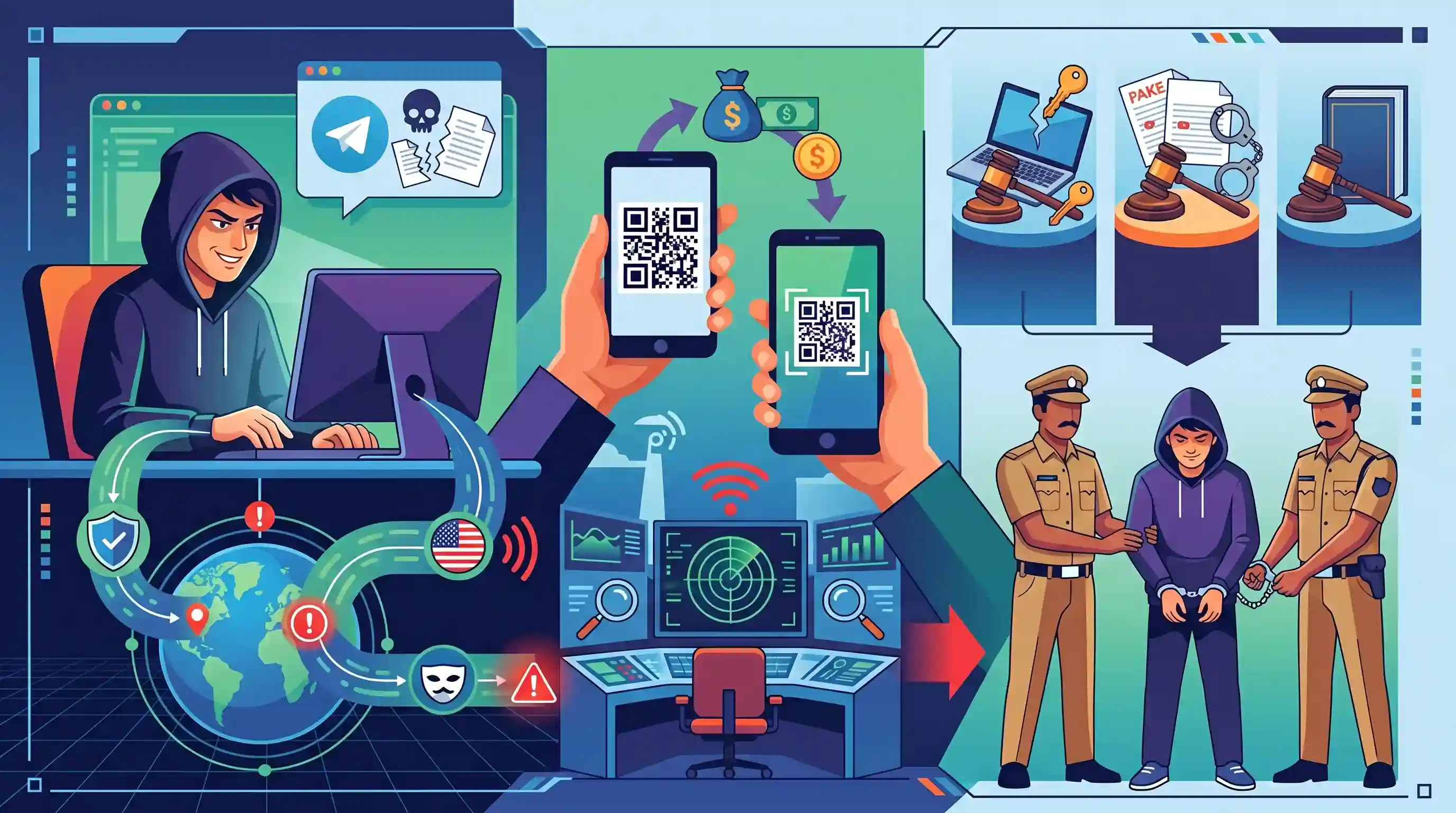
A 19-year-old NEET aspirant was arrested in Bhilwara, Rajasthan, for running a 'Paper Mafia' Telegram channel that sold fake NEET-UG re-test papers. Using a US-based VPN and proxy networks to hide his identity, he received payments via QR codes. He was apprehended through tracking initiated by the central S-Make portal and booked under the IT Act, Public Examination Acts, and the BNS.
Key Points
- Akash Choudhary, a 19-year-old student from Churu living in Bhilwara, was arrested by Pratap Nagar Police and the District Special Team for running a fraudulent Telegram channel.
- Under the channel name 'Paper Mafia', Choudhary sold forged question papers for the NEET-UG re-test at ₹4,000 per paper via digital QR code payments.
- The accused masked his digital footprint using proxy servers and a US-based Virtual Private Network (VPN) to evade law enforcement.
- The operation was uncovered based on an intelligence alert from the Government of India's S-Make portal, which flags suspicious social media activities and cyber risks.
- Choudhary has been booked under various sections of the IT Act, 2000, state/central public examination laws regarding unfair means, and cheating provisions under the Bharatiya Nyaya Sanhita (BNS).
Important Terms
Public Examinations (Prevention of Unfair Means) Act, 2024

A central Indian legislation targeting unfair practices like paper leaks, impersonation, and hacking in public competitive exams. It lays down severe penalties for individuals and exam service providers.
UPSC context
GS Paper II (Governance); tests legislative measures safeguarding competitive exam transparency, meritocracy, and student welfare.
Information Technology Act, 2000
India's primary legislation regulating e-commerce, digital signatures, and cybercrime. It penalizes offences like identity theft, digital personation, and data breaches, and governs online intermediary liability.
UPSC context
GS Paper III (Cyber Security); tests legal measures mitigating digital fraud, regulating internet platforms, and protecting public cybersecurity.
Subsidiary Multi-Agency Centre (S-MAC)
A state-level intelligence fusion center operating under the central Intelligence Bureau. It facilitates 24x7 coordination, collation, and real-time sharing of security threats among central and state law enforcement agencies.
UPSC context
GS Paper III (Internal Security); tests national intelligence networks, inter-agency coordination, and state-level threat assessment frameworks.
Rajasthan Public Examination (Measures for Prevention of Unfair Means in Recruitment) Act, 2022
A state law passed by Rajasthan designed to prevent paper leaks and malpractices in state recruitment exams, prescribing strict penalties, asset confiscation, and examinee debarment.
UPSC context
GS Paper II (State Laws/Governance); tests provincial legal mechanisms combating administrative irregularities and securing recruitment process sanctity.
Bharatiya Nyaya Sanhita (BNS)
India’s comprehensive penal code enacted in 2024 to replace the colonial-era Indian Penal Code of 1860, consolidating criminal law, punishments, and updated legal provisions.
UPSC context
GS Paper II (Polity/Judiciary); tests major judicial and criminal system reforms, updated penal provisions, and rights of citizens.
Telegram
An encrypted cloud-based messaging platform that functions as an online intermediary under Indian law, frequently scrutinized in cybercrime cases for its role in enabling anonymous fraud networks.
UPSC context
GS Paper III (Internal/Cyber Security); tests regulations on secure messaging apps, intermediary due diligence, and digital intelligence gathering.
Prelims Trap
The Public Examinations (Prevention of Unfair Means) Act, 2024, uniformly governs and penalizes leaks in both Central and State-level recruitment exams.
The central 2024 Act does not automatically override or govern state-level civil service leaks. States must enact their own laws or formally adopt the central framework for state-conducted exams.
Static Concepts Connected
What are the key provisions of the Public Examinations (Prevention of Unfair Means) Act, 2024?
- Classification of Offences: Declares all offences under the Act to be cognizable, non-bailable, and non-compoundable.
- Graded Punishment: Distinguishes individual cheating (3-5 years jail, up to ₹10 lakh fine) from organized paper leaks (5-10 years jail, minimum ₹1 crore fine).
- Investigating Authority: Mandates that investigations must be led by an officer not below the rank of Deputy Superintendent of Police (DySP) or equivalent.
What are the CERT-In directives regarding Virtual Private Networks (VPNs) in India?
- Data Retention Mandate: Requires commercial VPN providers to register and maintain validated customer details and IP logs for a minimum of five years.
- Targeted Scope: Exempts corporate and enterprise VPNs from the logging directive, focusing regulations primarily on general consumer proxies.
Cross-Topic Patterns
Dual-track legislation on public exams
The intersection of the Central Public Examinations Act 2024 with stringent state laws highlights federal dynamics in tackling interstate, cyber-enabled examination syndicates.
Encryption vs Law Enforcement
The use of encrypted messaging and proxies by student fraud networks underscores the persistent policy conflict between user privacy rights and state cyber-policing capabilities.

The Public Examinations Act 2024 and CERT-In's controversial VPN logging mandates are highly likely to be tested together in 2026.
Linked PYQs · 3
Linked PYQs · 3
- 2023RPSC_PRELIMSGS1
Which company was established by the Government of Rajasthan in the 21st century with the objective of developing information technology (IT) skills?
- 2018RPSC_PRELIMSGS1
Which of the following are the important mineral-based industries in Rajasthan? (a) Zinc Smelting Industry (b) Cement Industry (c) Electronic Industry (d) Marble Industry Code:
- 2003RPSC_PRELIMSGS1
In which region of Rajasthan is the copper mine located?
