Governor Offers Prayers at Vriddha Jageshwar and Jageshwar Dham
Source:governoruk.gov.in ↗
Why It Matters
The religious and archaeological sites of Uttarakhand, such as Jageshwar Dham and Dandeshwar in Almora, are highly relevant for UKPSC PCS Prelims. Questions frequently touch upon temple locations, Kumaon history, ancient dynasties (such as Katyuris, Chands, and Pauravas), and the role of the Governor as the executive head of the state.
Summary
On June 19, 2026, Lieutenant General Gurmit Singh (Retd.), the Governor of Uttarakhand, visited the historic temple sites of Vriddha Jageshwar, Dandeshwar Mahadev, and Jageshwar Dham in the Almora district. Offering prayers for national and state-level peace, prosperity, and public welfare, he emphasized the vital role of these ancient Kumaoni heritage shrines in conserving India's spiritual values and cultural traditions.
Key Points
- Uttarakhand Governor Lieutenant General Gurmit Singh (Retd.) visited and offered traditional prayers at the historic shrines of Vriddha Jageshwar, Dandeshwar Mahadev, and Jageshwar Dham in Almora district.
- The Governor highlighted Jageshwar Dham and the wider Kumaon region as custodians of India's cultural heritage, spiritual values, and traditions.
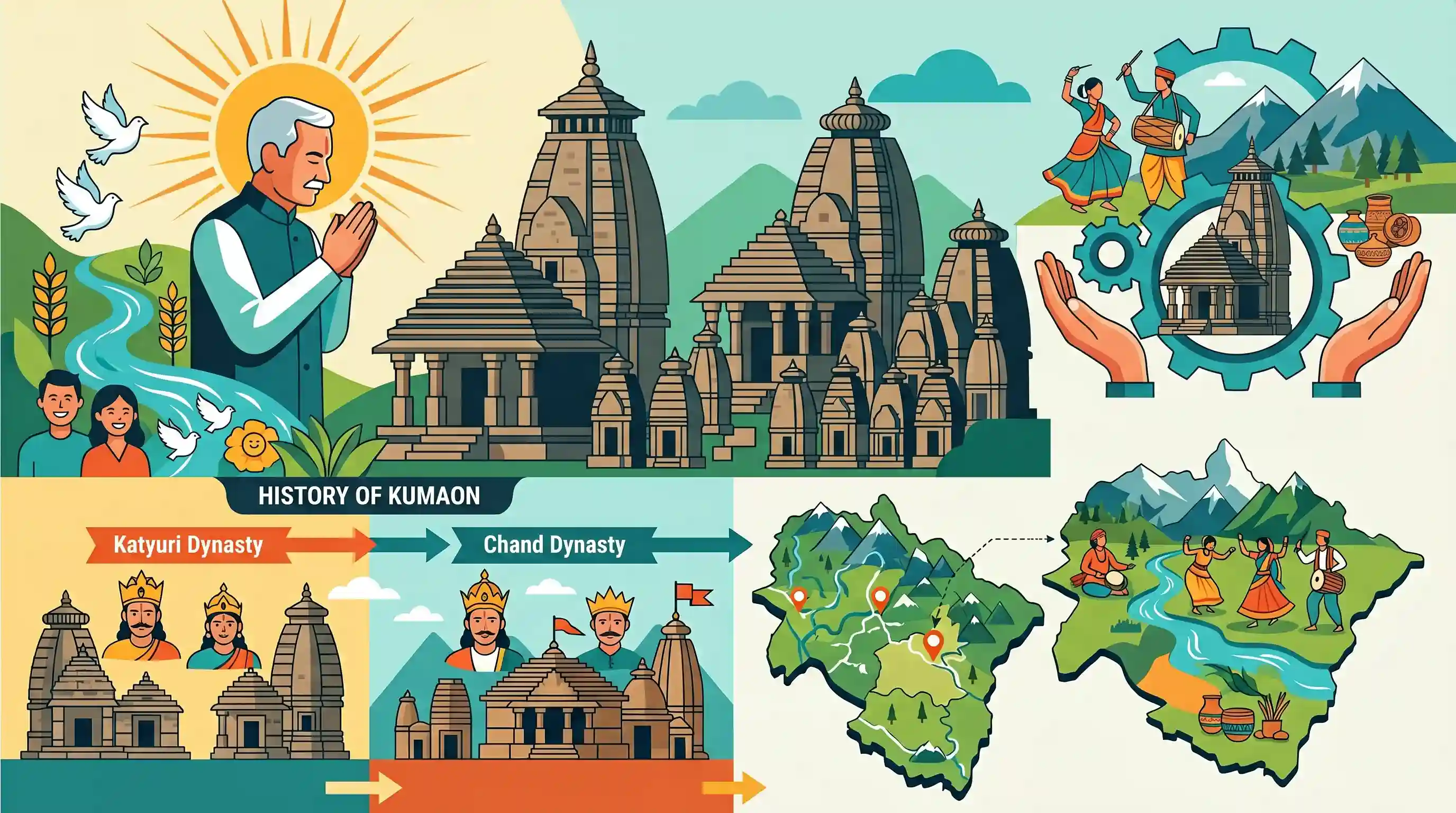
- Jageshwar Dham is a highly revered Shaivite pilgrimage site comprising over 100 stone temples built mostly between the 7th and 14th centuries CE by the Katyuri and Chand dynasties.
- Dandeshwar Mahadev Temple is renowned as the largest temple in the Jageshwar complex, distinguished by its unique tall stone tower (shikhara) and historic architectural heritage.
- Vriddha Jageshwar, situated atop a hill above the main temple group, is traditionally regarded as the original site of worship for Lord Shiva in the Jageshwar valley.
Important Terms
Lok Bhavan Uttarakhand

The official state residence of the Governor of Uttarakhand, formerly known as Raj Bhavan, renamed in December 2025 to replace colonial-era nomenclature following a Ministry of Home Affairs advisory.
UPSC context
GS Paper II (Polity & Governance); tests awareness of post-colonial administrative reforms and state executive institutions.
Jageshwar Dham
A major Shaivite pilgrimage site and temple complex comprising 124 stone temples in Uttarakhand's Almora district, mostly built by the Katyuri dynasty between the 7th and 11th centuries.
UPSC context
GS Paper I (Art and Culture); tests knowledge of ancient temple complexes and regional architecture of northern India.
Katyuri Dynasty
A medieval ruling dynasty of Kumaon (Uttarakhand) from the 7th to 11th centuries, credited with building major regional stone temples and patronizing early Hindu revivals.
UPSC context
GS Paper I (Ancient & Medieval Indian History); tests knowledge of regional Himalayan kingdoms and their architectural patronage.
Chand Dynasty
A ruling dynasty of the Kumaon region from the 10th century to 1790, which succeeded the Katyuris, established capitals at Champawat and Almora, and consolidated Kumaoni culture.
UPSC context
GS Paper I (Medieval History); tests understanding of regional kingdoms, transition of power, and administrative evolution in the hills.
Nagara Style of Architecture
The predominant northern Indian temple architectural style characterized by a square plan, a tall curved spire (shikhara) capped by an amalaka, and a kalasha.
UPSC context
GS Paper I (Art and Culture); tests conceptual understanding of major styles of temple architecture in ancient and medieval India.
Dandeshwar Mahadev Temple
The largest and tallest temple structure in the Jageshwar Dham complex, dedicated to Lord Shiva, featuring a natural rock deity instead of a traditional Shivalinga.
UPSC context
GS Paper I (Art and Culture); tests knowledge of iconic architectural monuments, local myths, and regional Shaivite shrines.
Prelims Trap
The Taleshwar copper plate grants, which record early donations in Kumaon, were issued by the Katyuri dynasty of Baijnath.
The Taleshwar copper plates belong to the earlier Paurava (or Parvatakar) dynasty of Brahmapur (6th-7th century CE), not the subsequent Katyuris who built Jageshwar.
Static Concepts Connected
What is Lakulisha Shaivism and its iconographic identity?
- Origin & Sect: Oldest major Shaivite school, established as the systematic philosophy of the Pashupata sect in western India around the 2nd century BCE.
- Iconographic Representation: Lakulisha is considered the 28th and final avatar of Shiva, conventionally represented holding a club (lakula) in one hand and wearing a sacred thread.
- Architectural Footprint: Featured on the temple pediments of major early medieval complexes, notably at Jageshwar in Uttarakhand, Ellora, and various sites in Rajasthan and Odisha.
What are the key architectural features of the Katyuri style?
- Masonry Technique: Constructed from massive dressed stone blocks without mortar, showing a regional variant of the North Indian Nagara style of temple architecture.
- Climatic Integration: Topped with a wooden umbrella-like canopy (chhatra) or flat roofs over the stone shikharas to protect the sanctum from snow.
- Structural Plan: Includes a shallow pillared porch (mandapa) leading to a small, dark sanctum (garbhagriha) surmounted by a tall, tapering curvilinear tower.
Cross-Topic Patterns
Temple Architecture and Climate Adaptation
The wooden protective canopies (chhatras) atop Jageshwar's stone shikharas demonstrate how classical North Indian Nagara designs were modified to withstand heavy Himalayan snow and precipitation.
Numismatics and Early Himalayan Statehood
Transition from Kuninda tribal coinage (Chitreshwar type) to Katyuri temple grants shows how classical Sanskritization consolidated early medieval state formations in the Central Himalayas.

UPSC may test Jageshwar's Nagara style, linking its Lakulisha Shaivism iconography with Katyuri and Chand dynastic patronages in Art & Culture.
Linked PYQs · 3
Linked PYQs · 3
- 2025UKPSC_PRELIMSGS1
Where is the Herbal Research and Development Institute of Uttarakhand situated?
- 2025UKPSC_PRELIMSGS1
Consider the following statements with reference to Uttarakhand and choose the correct answer: 1. The executive of Uttarakhand includes Governor as the head of the state. 2. It also includes the Chief Minister and his/her council of ministers.
- 2024UKPSC_PRELIMSGS1
Which one among the following royal dynasties is associated with the Taleshwar copper plate grants ?
